
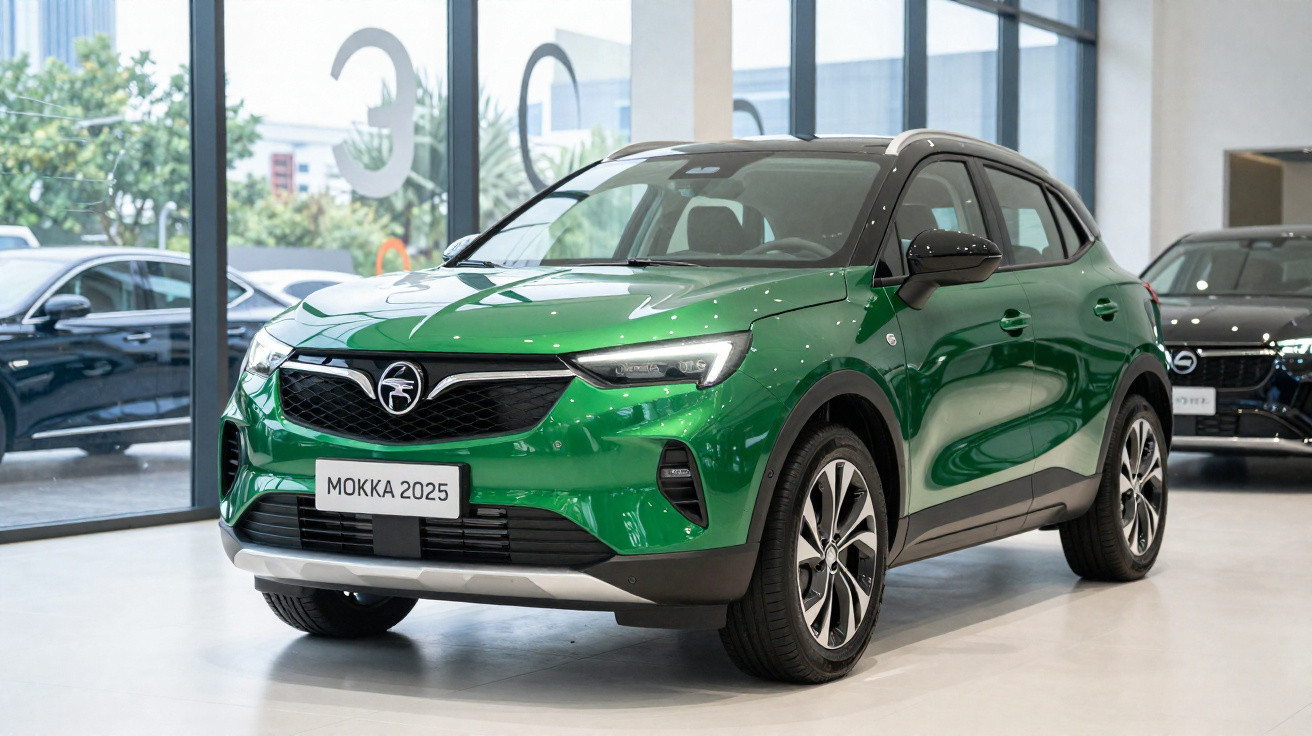
Now that the Opel Mokka line-up has been updated, which version has become the smartest buy? I think I’ve already made up my mind.
“What do you mean, the ‘new’ Opel Mokka?” you might ask - and don’t worry, because that was exactly my reaction when I first saw the latest update to the German brand’s compact crossover. Even so, the changes that matter are there.
First off, the “new” Opel Mokka has done away with anything chrome. Every strip and trim piece has been replaced with black elements, including the model name and the brand badge, which is now the new “Blitz”.
On top of that, the headlamps and tail-lamps have been revised too - not just in styling terms, but also in the tech they bring - with Opel’s Intelli-Lux LED matrix system available as an option.
Cosmetic tweaks
The overall cabin layout hasn’t been reshuffled, with almost all buttons and systems sitting exactly where you’d expect if you already know the Opel Mokka. That said, there’s a redesigned centre console, plus fabrics made using materials that include recycled content.
One of the most noticeable updates is the steering wheel, which adopts a design flattened at both the top and bottom. It also carries new controls for the speed functions and the infotainment system.
Ahead of the driver, the two horizontal screens remain, but the infotainment itself has been comprehensively updated. It is now built around Qualcomm Technologies’ Snapdragon Cockpit and Auto Connectivity platforms.
In practice, that means you can tailor the user interface with widgets, and the voice recognition now supports a more natural back-and-forth. The system also brings ChatGPT into the mix, working alongside connected navigation.
Refined and efficient
Across the city streets, main roads and mountain routes of Mallorca - where the Opel Mokka 2025 launch event took place - the standout change in the range proved to be a very convincing pairing. The German crossover’s nimble feel combined with the mild-hybrid powertrain (used across many Stellantis models) makes this, in my view, probably the most sensible choice in the line-up.
At the heart of this 48 V ‘light’ hybrid set-up is a 1.2 Turbo petrol engine with 136 cv (now with a timing chain), backed up by a 28 cv electric motor. That electric unit is integrated into the six-speed automatic transmission (dual-clutch).
Together, they not only give the Opel Mokka a lively enough pace, they also help it run in a more efficient, thriftier way. In everyday driving, it’s not hard to notice the combustion engine cutting out at various points - even while moving - which naturally brings consumption figures down.
Opel claims figures below five litres per 100 kilometres, and that didn’t strike me as unrealistic. Still, we’ll be able to confirm that properly once we get the Opel Mokka Hybrid 2025 in for a test back in Portugal.
You can also feel Opel’s work on the Mokka’s ride and suspension, which now comes across as more polished and comfortable. The traditional German firmness hasn’t disappeared, but it’s more pleasant to live with. That difference is even clearer in the 100% electric version, which carries noticeably more weight than the Hybrid.
Three powertrains and two trim levels
Now open for orders in the Portuguese market, the Opel Mokka Hybrid 1.2 Turbo with 136 cv starts at 27 465 euros. That figure already includes the two thousand euros discount tied to the launch campaign for this model.
If you choose the sportier-looking GS trim level, the entry price rises to 29 715 euros, again including the launch-campaign offer.
The 100% electric version - 115 kW (156 cv), 54 kWh and 402 km - is also offered in these same two trim levels, with starting prices of 35 515 euros, or 37 765 euros for the GS.
However, if you don’t need anything quite so involved, the range still includes a ‘simple’ 1.2 Turbo petrol engine with 136 cv, with no electrification assistance and a six-speed manual gearbox - prices start at 23 965 euros. It’s also available with an eight-speed automatic gearbox, although in that case the engine is rated at 130 cv.
Comments
No comments yet. Be the first to comment!
Leave a Comment