
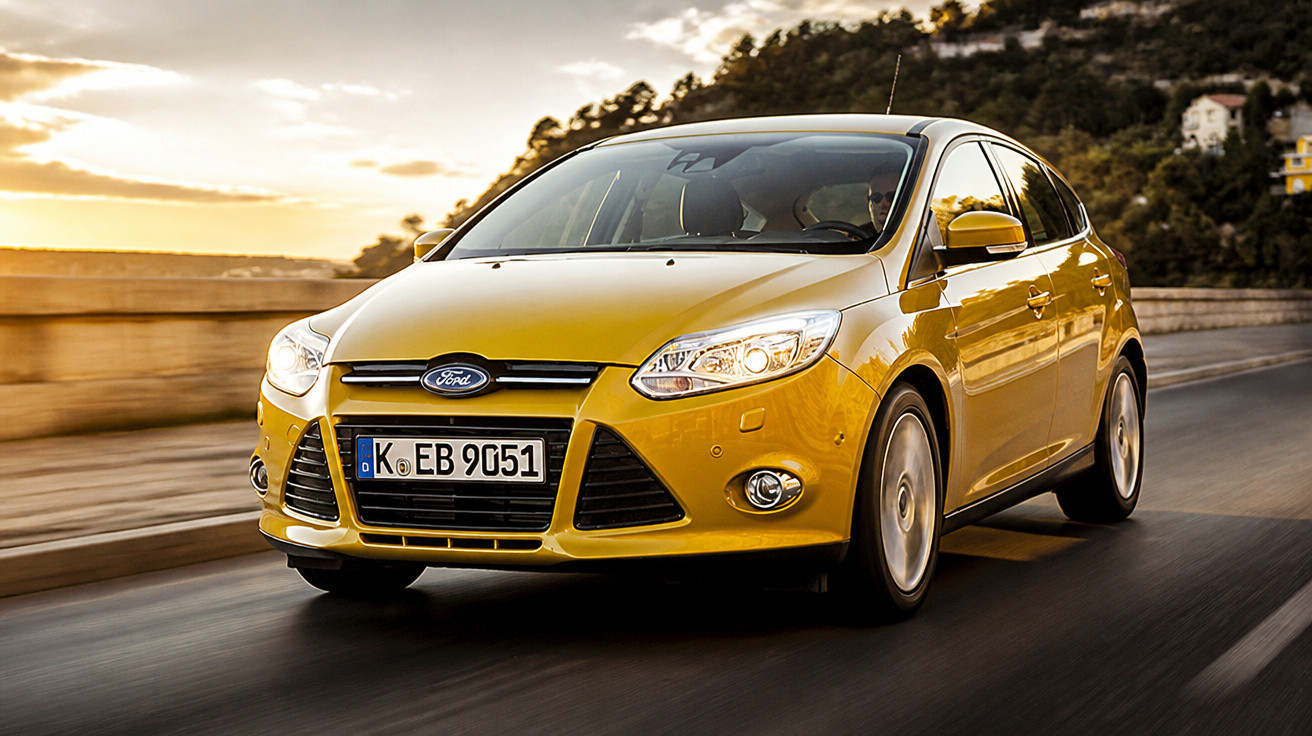
I’m not convinced Ford ought to badge this as the Focus 1.0T. Being so upfront about its size might put off the sort of thrusting estate agent who wants a company car, yet it delivers far more than you’d ever expect from 999cc.
Ford Focus 1.0T engine options and what replaces what
Under the bonnet sits a turbocharged three-cylinder unit, offered with either 100 or 125bhp. The more powerful version I tried comes with a six-speed 'box. It takes over from the naturally aspirated 105 and 125bhp Focus models, and it’s a marked step up to drive: quieter, with more character, and noticeably torquier.
It’s also lighter, so the steering feels truer and more immediate. Plus it burns a lot less petrol. What’s not to like?
Refinement, torque and real-world driving feel
The refinement is what hits you first. We’ve become accustomed to diesel power in economy hatches, so jumping into a small-capacity petrol like this feels like a treat.
Most of the time you’ll keep it between 1,500-3,000rpm: that’s where economy is strongest, and the generous torque-along with the lack of vibration (apart from a faint tingle through your feet)-makes it easy-going and relaxing to drive. When you need to make progress, it’s perfectly willing to spin faster as well.
Even then it stays subdued: you get a hint of that three-cylinder thrum, but in a pleasing way-almost a half-a-911 sort of flavour. There’s no harshness, and there’s barely any turbo lag or other oddities in the throttle response.
Clean-sheet engineering and why it matters for economy
It’s the sort of engine that really appeals to your inner engineer. This wasn’t a larger motor with a cylinder lopped off; it was designed from the ground up, with everything tailored to the compact format. The block is only as long as a sheet of A4 paper, and the powertrain is 40kg lighter than the old 1.6 (or an astonishing 150kg lighter than a 2.0 diesel).
It uses direct injection and dual variable camshafts, plus a tiny jewel of a turbine that can spin up to 248,000rpm.
The exhaust manifold is integrated into the cylinder head, allowing coolant to take heat out of the exhaust gas. The engine’s narrow-bore layout also reduces its tendency to knock, so it rarely needs much ignition retardation-which helps keep exhaust-gas temperatures down. On top of that, the turbo itself is happy with gas at 1,030°C.
What does all this mean for the price of fish? In many turbo engines, extra fuel gets dumped in at high power simply to evaporate and cool the turbo-an enormous waste. This little engine is engineered so it seldom needs that overfuelling, meaning that even with the occasional wide-open throttle you shouldn’t stray too far from the official fuel figures. Unlike a Fiat TwinAir. On a particularly brisk drive across some hilly Spanish countryside, I saw 40mpg.
That petrol saving helps cover the cost. In 125bhp trim it’s £500 more than the old 125 1.6, and you get an extra gear in the 'box for the money. That’s less than metallic paint, for Pete’s sake.
Comments
No comments yet. Be the first to comment!
Leave a Comment