
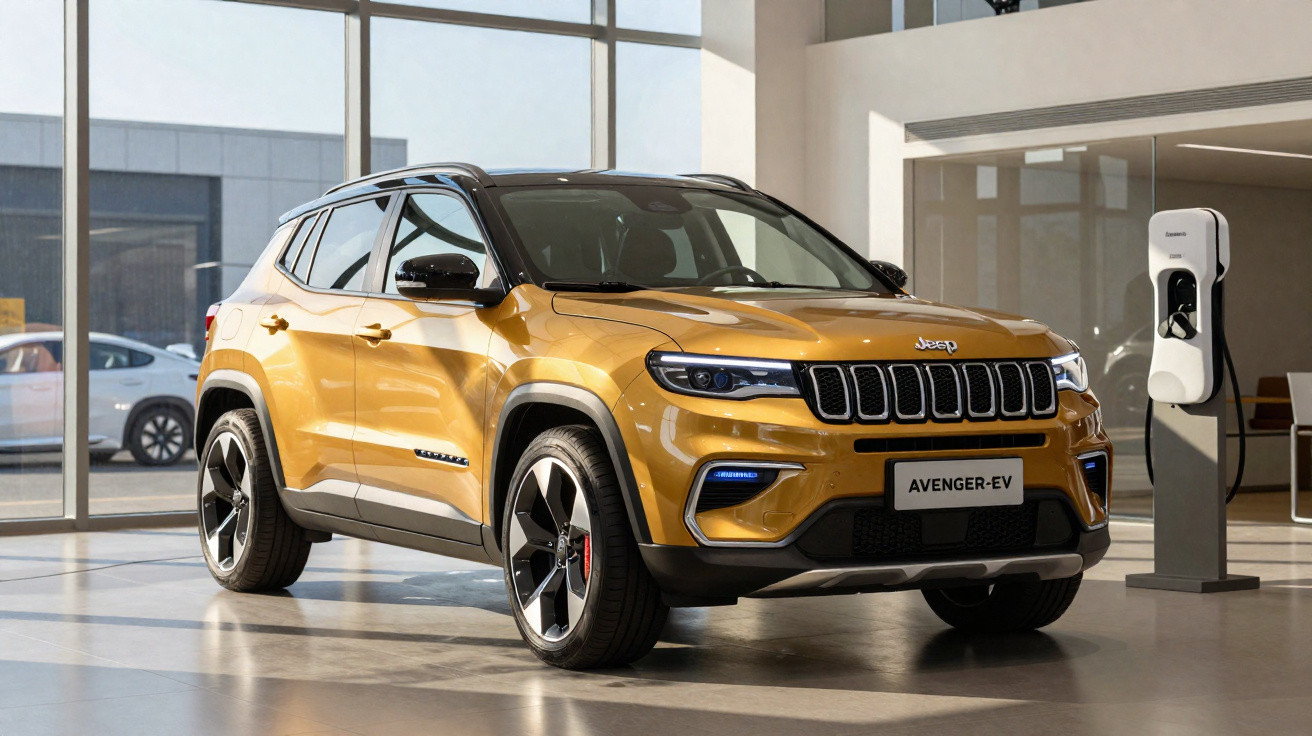
The new Jeep Avenger dips into Stellantis’ parts bin, adds a dose of the brand’s much-valued design DNA, and packages it all as a compact SUV. It is a strong formula that looks well suited to winning over Europe.
It is the first fully electric model the brand has ever produced, even though Jeep only began selling partially electrified vehicles two years ago - the 4xe plug-in hybrids arrived at the end of 2020, and today those 4xe versions already account for half of Jeep’s European sales.
The outlook is that by 2025 there will be four fully electric Jeeps on sale, and five years later every Jeep sold in Europe will be 100% electric - a clear sign of the iconic American marque’s reinvention.
Developed in Europe for Europeans
As well as being Jeep’s first EV, the Avenger is also the first Jeep developed in Europe specifically for Europeans (it is simply too small for the US). Production is also based in Europe, at Stellantis’ Tychy plant in Poland.
Even before the first customer car has been delivered, it is already evident the Avenger is set to be a pivotal model for Jeep: 60% of the 7,000 orders already placed have come from outside Italy.
That marks a notable shift for the American brand, whose European revival has so far been largely Italy-led, in part due to its close ties with the former FCA. The numbers underline it: only one in every 100 SUVs sold in Europe wears a Jeep badge.
In Europe, the Avenger joins the fiercely contested B-SUV segment with this electric version only - except in Italy and Spain, where it will also be offered with a petrol engine. Its closest rivals are mainly its Stellantis “relatives”, such as the Opel Mokka-e and the Peugeot e-2008, with which it shares a large number of components.
Jeep genes
That shared hardware made it essential to retain Jeep’s DNA in the design, respecting the styling heritage and roots the brand is proud of - and it is fair to say the job has been done convincingly. As Jeep design director Daniele Calonaci explains: “the typical, albeit reinterpreted, seven-slot front grille, the ‘X’-themed rear lights introduced on the Renegade and also as a tribute to the original Willys, the floating C-pillar very similar to the one first seen on the Compass a decade ago, and the ‘X’ subtly repeated across various areas of the Avenger, outside and inside”.
Some choices are also aimed at lowering the cost of minor body repairs, such as the 360º plastic cladding that runs around the entire car.
Arguably even more important than those details is the Avenger’s ‘square’ profile. The front and rear ends have been ‘trimmed’ - 30 mm shorter than on other Stellantis vehicles based on the eCMP2 platform (an evolution of eCMP) - which reduces the body overhangs.
Those shorter overhangs help deliver generous off-road angles: 20º approach, 20º breakover and 32º departure (similar to the Renegade), along with a segment-leading 201 mm of ground clearance.
Inside, you are met by a straightforward, uncluttered dashboard layout. Gear selection is handled via buttons rather than any kind of traditional transmission lever and, pleasingly, there are proper physical controls for the climate functions - exactly what you would expect from a brand that prizes usability.
The interior finishes look well judged and suit the car’s character. Colour-matched inserts brighten the cabin, and the textures come across better than plain dark-grey plastics.
2+2+1…
Four adults can travel with adequate room in the Avenger, while a third adult in the rear will feel noticeably more squeezed in the centre seat, which is narrower and firmer. Even so, there is no intrusion in the floor - typical of EVs designed as electric vehicles from the outset.
Headroom in the second row is sufficient for people up to 1.90 m tall, and legroom back there is also perfectly acceptable.
Jeep states there is a total of 34 litres of small-item storage in the cabin. A highlight is a practical rubberised tray on the dashboard, spanning around two-thirds of its total width, which is ideal for sunglasses, keys, phones and the like (oddly, there are no pockets in the rear doors).
The boot is mid-pack at 380 litres. That is still more than the larger Renegade 4xe (330 l) and also ahead of its cousin, the Opel Mokka-e (310 l), though it cannot match the Peugeot e-2008 (410 l).
For owners who like travelling and spending time outdoors with their four-legged friends, or for carrying small beach/sea items, the adjustable boot floor features a washable surface on its underside.
400 km range
The Jeep Avenger uses a front-mounted 115 kW (156 hp) motor producing 260 Nm, powered by a 54 kWh lithium-ion battery (51 kWh usable) with a 400 V architecture. Installed beneath the front seats, rear seats and centre tunnel, the pack comprises 17 modules and 102 cells. WLTP range is quoted at 400 km on the combined cycle (or 550 km in urban driving).
For now, this EV drives only the front wheels - although within a year Jeep says it will honour its origins by introducing an Avenger 4×4. Even so, the Avenger is the first front-wheel-drive Jeep to include hill descent control as standard, along with the Select Terrain system offering Eco (speed limited to 130 km/h), Normal (150 km/h), Sport (150 km/h), Sand (120 km/h), Mud (50 km/h) and Snow (80 km/h) modes.
However, in this first drive of the Avenger, energy consumption came out far higher than the already “strange” official average of 12.5 kWh/100 km. That figure is notably lower than the Opel Mokka-e, Peugeot e-2008 or DS 3 E-Tense (all around 15 kWh/100 km), even though they use the very same drivetrain as the Jeep Avenger.
And, as if to confirm that this (even if provisional) number is overly optimistic, my 70 km route - including motorway, urban sections, secondary national roads and a short but challenging off-road stretch - ended with an average of 19.3 kWh/100 km. In practice, the indicated range dropped from 399 km (99%) to 242 km (148 km less).
Naturally, this drive involved harder acceleration and higher speeds than those used for type approval, but compared with 12.5 kWh/100 km it is a much bigger gap than is typically seen in press tests.
Behind the wheel
In Normal mode, the steering feels slightly too light. Sport could easily serve as the default setting, while Sport itself could do with heavier software calibration. This is inevitably a subjective point, as some drivers prefer lighter steering.
Drive modes are selected via the same switchgear used across Peugeot, Citroën, DS and Opel models - and it still takes too long to engage the newly chosen mode.
Another area that could be refined is brake pedal feel. The transition between regenerative and hydraulic braking is not progressive, and there is not enough initial ‘bite’ when you first press the left pedal.
Suspension tuning is excellent, striking a strong balance between stability and ride comfort regardless of the surface.
Body roll is kept well in check - helped, as usual, by the low centre of gravity created by heavy batteries mounted in the floor - and the steering response also contributes to the driver feeling more ‘emotionally’ connected to the road (provided you are in Sport).
The relatively high steering ratio (2.75 turns lock-to-lock) and tight turning circle are beneficial in town and when parking.
On the off-road trail and during an axle-articulation challenge set up by Jeep to demonstrate that it will keep moving even if one wheel on each axle loses contact with the ground, the Avenger performed well. It felt comfortable on slippery ground and very uneven surfaces, thanks in part to the easy-to-modulate nature of electric power delivery.
With a kerb weight just over 1.5 tonnes and modest output, you are more likely to appreciate the typical instant response at low and medium speeds than the 0 to 100 km/h sprint of 9.0s.
To get that punch, Sport needs to be selected, as Eco (limited to 82 hp and 180 Nm) and Normal (109 hp and 220 Nm) feel more sluggish than the full 156 hp and 260 Nm available in Sport.
As for regeneration, you can either coast or switch to B mode, which increases deceleration and energy recovery (from 15 kW to 45 kW when you lift off the accelerator).
That means there are no steering-wheel paddles to vary regeneration. And B does not replicate a true One Pedal Drive system, so the Avenger will not come to a complete stop unless you use the brake pedal.
When does it arrive?
The Jeep Avenger Launch Edition is already available to order. It comes generously equipped, which helps justify its €39,500 price, and deliveries are due to start in April 2023.
Once this version sells out, a more affordable Avenger (with less equipment) is expected to follow, with prices starting at €35,000.
Technical specifications
| Item | Specification |
|---|---|
| Jeep Avenger | |
| Engine | |
| Motors | 1 front motor |
| Power | 115 kW (156 hp) |
| Torque | 260 Nm |
| Transmission | |
| Drive | Front-wheel drive |
| Gearbox | Single-speed reduction gearbox |
| Battery | |
| Type | Lithium-ion |
| Capacity | 54 kWh (51 kWh usable) |
| Charging | |
| Max. DC power | 100 kW |
| Max. AC power | 11 kW |
| Charging times | |
| 20-80% 100 kW (DC) | 24 minutes |
| 0-100% 11 kW (AC) | 5h34min |
| Chassis | |
| Suspension | FR: Independent, MacPherson; RR: torsion beam with Panhard rod |
| Brakes | FR: Ventilated discs; RR: Discs |
| Steering | Electric assistance |
| Turning circle / No. of turns | N/A / 2.75 |
| Dimensions and capacities | |
| Length x Width x Height | 4084 mm x 1776 mm x 1528 mm |
| Wheelbase | 2562 mm |
| Boot capacity | 380 litres |
| Tyres | FR: N/A; RR: N/A |
| Weight | 1536 kg |
| Off-road angles | Approach: 20º; Breakover: 20º; Departure: 32º |
| Ground clearance | 201 mm |
| Performance and consumption | |
| Top speed | 150 km/h |
| 0-100 km/h | 9.0s |
| Combined consumption | 12.5 kWh/100 km |
| Range | 400 km |
Comments
No comments yet. Be the first to comment!
Leave a Comment