
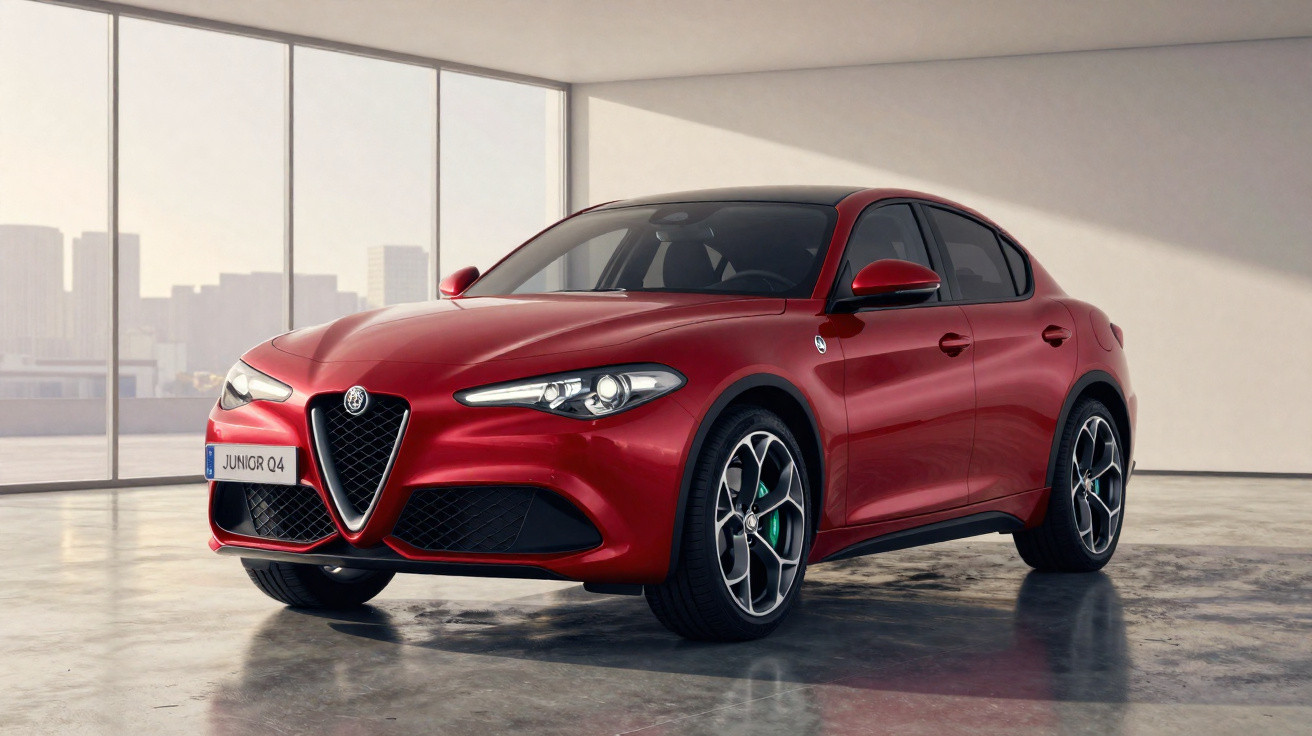
All-wheel drive is only one of the new selling points of the Alfa Romeo Junior Ibrida Q4, but it comes with one major downside.
There is another version in the new Alfa Romeo Junior line-up: it is called the Ibrida Q4 and, as the name implies, it stands out for having all-wheel drive.
By adding an extra electric motor on the rear axle, the Q4 edition of the Junior Ibrida becomes the most capable option when grip is at a premium, bringing a level of versatility that Alfa Romeo’s B-SUV had not offered until now.
But is that, on its own, enough to justify the extra €7,500 the Italian brand asks for the Junior Q4? And does it really make sense for the Portuguese market? We travelled to Turin, Italy, to drive it and find out. Here is what we learned:
Where does the Alfa Romeo Junior Ibrida Q4 differ?
From the outside, it is hard to spot what sets the Junior Ibrida Q4 apart from the other versions. If it were not for the badge on the tailgate, the more traditional scudetto up front and the standard 18-inch wheels, you would struggle to tell this is a new variant.
The same is true inside, where it delivers exactly the same styling solutions as the front-wheel-drive hybrid Junior.
That said, one point is worth highlighting: even the entry-level Junior Ibrida Q4 comes with a much richer equipment list. And in the flagship Intensa trim, the only options are the paint (including a two-tone finish), the panoramic roof and the Sport pack, which, among other additions, brings Sabelt-branded bucket seats.
A broader line-up
It is out on the road that you truly understand what separates the Junior Ibrida Q4 from the rest of the Junior range. For now, at least, it is the only all-wheel-drive version of Alfa Romeo’s compact SUV, and it arrives alongside one of the widest engine catalogues in the segment.
It is worth remembering that the Junior is offered with two fully electric versions, one with 115 kW (156 hp) and another with 205 kW (280 hp), as well as two hybrid variants: a front-wheel-drive option with 136 hp, and now this all-wheel-drive version with 145 hp.
For the new Junior Ibrida Q4, Alfa Romeo pairs a 1.2-litre turbo engine with 136 hp with two 21 kW (29 hp) electric motors: one at the front, integrated into the six-speed dual-clutch automatic gearbox; and another mounted on the rear axle.
Add to that the 0.89 kWh battery and the 48 V electrical system, and it becomes possible to spend much of your urban driving without “waking up” the combustion engine.
New selling points
There is no physical connection between the axles, so the entire all-wheel-drive system is controlled via software. This ensures consistently balanced torque distribution and improves traction capability, even when surface grip is compromised.
During this first drive in Turin, I had the chance to try the Junior Ibrida Q4 on a “wide track” covered in loose gravel, and I was surprised by how effective the system felt compared with the front-wheel-drive Junior Ibrida.
Which only added another 100 kg to this model,
Even though it is slightly more powerful than the front-wheel-drive Ibrida, the Q4 is slower in the 0–100 km/h sprint: 9.1s versus 8.7s. It is a marginal gap, explained mainly by the extra weight: there is a 195 kg difference between the two variants.
Needless to say, you will not really notice that difference on the road. And at no point during this initial contact did the Junior Ibrida Q4 feel short of “firepower”.
However, one thing was clear: the Ibrida Q4 is far more capable than the conventional two-wheel-drive Junior Ibrida. The all-wheel-drive system helps, of course, because it allows you to go where the front-wheel-drive model cannot. But the biggest change lies elsewhere.
That change is the independent rear suspension using a multilink layout-an entirely new feature for models on this platform and, as a result, a first within the Junior range.
On top of that, Alfa Romeo has equipped this Junior Ibrida Q4 with new front dampers, new springs and a new anti-roll bar, which together have noticeably improved the way it feels from behind the wheel.
Compared with the “standard” Junior Ibrida, the Junior Q4 rides with more polish and comfort, while also feeling more planted on the road.
In addition, it feels like you can carry more speed out of corners because you are able to get back on the throttle much earlier-always backed up by precise steering and a well-judged brake pedal.
If you want to know what it is like to drive this new version of the Italian SUV, the best thing is to watch the featured video in this review:
Does it make sense to pay the price difference?
The new Alfa Romeo Junior Ibrida Q4 can already be ordered in Portugal, with prices starting at €37,000. The better-equipped Ibrida Intensa Q4 starts at €39,000. The first units arrive at the end of April.
If you look at the entry-level front-wheel-drive Junior Ibrida, which starts at €29,500, it becomes clear you need to pay an extra €7,500 to step into the base Junior Q4. However, if you compare the range-topping Intensa versions, that gap drops to €3,500.
These price differences are not small, especially as we are talking about a B-segment model. Which leads to the obvious question: is it worth paying more to get all-wheel drive?
There is no universally right or wrong answer here. In reality, it depends on each person’s needs and, above all, what they expect from a car of this type.
If you want a B-SUV mainly for shorter day-to-day journeys, then spending €37,000 on this Junior Q4 does not make much sense. If, on the other hand, you are looking for a model that can “get its feet dirty” and head down a dirt road-or simply a proposition that is more balanced and refined on tarmac-then this new version becomes easier to justify.
In a northern European country, where winter conditions create a different set of demands, this question barely arises. In Portugal, it truly will come down to individual needs.
One thing is certain: setting pricing aside, the Junior Ibrida Q4 is a strong proposition that genuinely adds new selling points-something we can now all agree this model was very well born with.
Comments
No comments yet. Be the first to comment!
Leave a Comment