
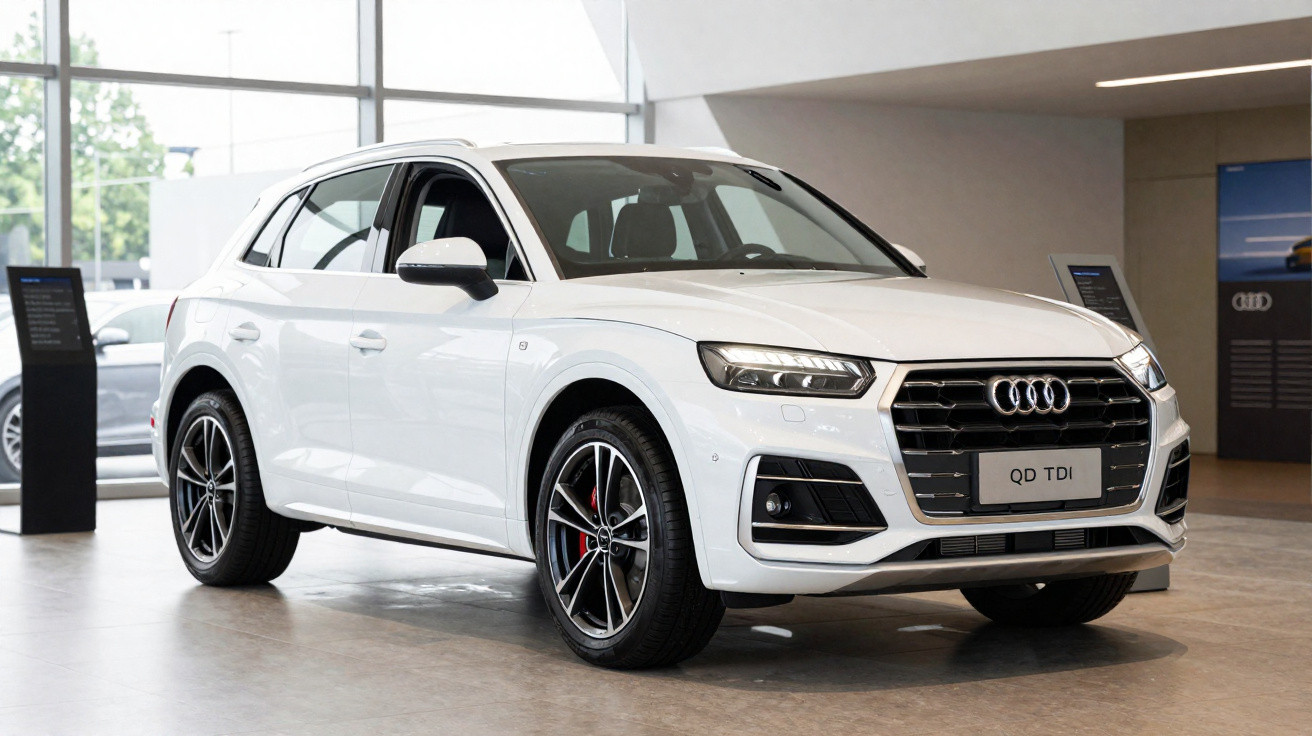
Diesel may no longer be fashionable, but the latest Audi Q5 generation proves the 2.0 TDI is still a genuine asset.
After a few quieter years, Audi appears to have well and truly got back to work, with new models arriving at an impressive pace. And none feels more significant than the new Audi Q5 - the brand’s best-selling model worldwide.
That’s exactly why my expectations for this test were higher than usual. Even more so because this is the Diesel variant: nowadays treated as a bit of a pariah, yet still delivering strong sales figures in the Q5’s segment. That, in turn, explains why Audi has kept hold of its familiar 2.0 TDI.
My first impression is that this Audi Q5 looks considerably larger than the one it replaces, although the spec sheet says the changes are only marginal. The second is that the styling follows Audi’s latest design direction: sharper lines, more attitude, and a noticeably more aggressive stance. Taste will always play a role, but the look of this S line version won me over.
New look, lots of screens
Step inside and it instantly reads as a new-generation Audi cabin, with screens taking centre stage. The main touchscreen measures almost 15” diagonally and it’s where the overwhelming majority of functions and settings live.
There’s a lot to take in at first, because the volume of information is substantial. That said, the driver-assistance systems do have a dedicated “favourites” page, which makes it easier to switch them on or off quickly.
The instrument cluster is digital too and, as an option, you can add a third screen for the front passenger. And even then, Audi still fits a generously sized head-up display.
From behind the wheel, if I tune out the lights, chimes and tech theatre, the excellent driving position is what stands out. On the other hand, given where this model sits in the market, the quality of some materials and the overall fit and finish could be a touch better.
The Audi Q5’s steering wheel uses touch controls with haptic feedback, which can sometimes lead to accidental inputs when you didn’t mean to press anything. More convincing is the decision to group several functions - lights, mirrors, and so on - into a single module on the driver’s door panel.
Audi Q5 with just enough space
Audi says the car is built on the PPC (Premium Platform Combustion) architecture, but in practice it’s an evolution of the previous MLB. The 2,82 m wheelbase is exactly the same as the outgoing generation’s.
And you feel that in the rear: space is at a good level, but it doesn’t really move the game on from before. Comfort is fine, yet anyone stuck in the middle rear seat will be pulling faces - it’s narrower and they also have to contend with a tall central tunnel.
To make up for it, the rear bench slides fore and aft, so you can prioritise legroom or luggage capacity. In its minimum configuration, the Audi Q5’s boot offers 520 litres, plus an extra storage area beneath the floor.
Missing Diesel
At the risk of sounding like the elderly woman from that well-known supermarket advert, “I’m still from the time when” Diesel engines were the most desirable option. In fact, looking only at the Audi Q5, the TDI has always been the best-seller and a key reason for the model’s success.
The 2.0 TDI (204 cv) carries over into this generation, but it now sits within a 48 V mild-hybrid system that includes a 1,7 kWh battery.
As a result, many manoeuvres are now carried out with the combustion engine switched off and, even while driving, the TDI no longer cuts out only at traffic lights. Sometimes a downhill stretch is enough - and it can even happen on flat ground.
The main benefit, as you’d expect, is fuel economy. Even acknowledging that this test car has quattro all-wheel drive and weighs around two tonnes, Audi quotes 6,1 l/100 km on the combined WLTP cycle for the base version.
In our tested car, though, we were nowhere near that figure: 7,5 l/100 km. It’s easy to explain: the optional 20″ wheels - two inches larger than standard - wider tyres, and a driving pace that wasn’t always especially restrained. Even so, with a 65-litre tank, it’s still possible to cover more than 850 km in one uninterrupted stint.
More polished dynamics
From earlier (brief) drives, I’d already suspected this new generation of Audi models was dynamically sharper and more agile. Spending several days with this new Audi Q5 2.0 TDI quattro confirmed it.
The steering feels accurate, quick and informative. Combined with the air suspension - set slightly firmer in S line form - and the larger wheels, it delivers improved cornering stability and inspires more confidence from the driver.
While the 2.0 TDI won’t wow anyone on paper - 204 cv and 400 Nm - the reality is that this Audi Q5 can maintain a strong and genuinely enjoyable touring pace.
The only real downside is the engine noise when you work it hard, something many of us have become unaccustomed to after spending time in the latest hybrids and fully electric models.
The long odyssey of the options list
The new Q5 starts at 75 677 euros, which corresponds to the tested 2.0 TDI version. It’s far from inexpensive, yet unlike in the past, the standard equipment offering isn’t disappointing: every Q5 comes with quattro all-wheel drive, the seven-speed S tronic automatic gearbox, and even air suspension.
It also includes three-zone automatic climate control, navigation, full LED lighting, and the list - huge - goes on, to the point where repeating it all here would make this the most tedious text on the planet.
So what’s the catch? If you open the Audi Q5 configurator and compare the image of the model with the car we drove, you’ll notice something missing, won’t you? In reality, what’s missing is 26 735 euros’ worth of extras - resulting in an options list almost as long as the standard equipment list.
It’s practically impossible to itemise, in detail, every option fitted to (and available for) the new Audi Q5. So I’ll only highlight the ones that make the biggest difference.
To start with, Daytona Grey paint (1155 euros), and also the full paint treatment (430 euros) - where the plastic trim is finished in the same colour as the bodywork. The 20″ Audi Sport wheels? 2965 euros.
Beyond that, there are “plus” and “pro” equipment packages, more comprehensive than the standard systems, adding features you may or may not actually want.
For instance, LED lighting is standard. But choose the Tech Pro Pack (8730 euros) and you get digital light signatures, exterior mirrors with projection lights, OLED digital rear lights, and LED Plus headlamps with Matrix functionality.
In the end, the Audi Q5 you see in the images comes to almost 107 thousand euros. Do you need every optional extra fitted to this car? Probably not. But that decision is ultimately yours.
Comments
No comments yet. Be the first to comment!
Leave a Comment