
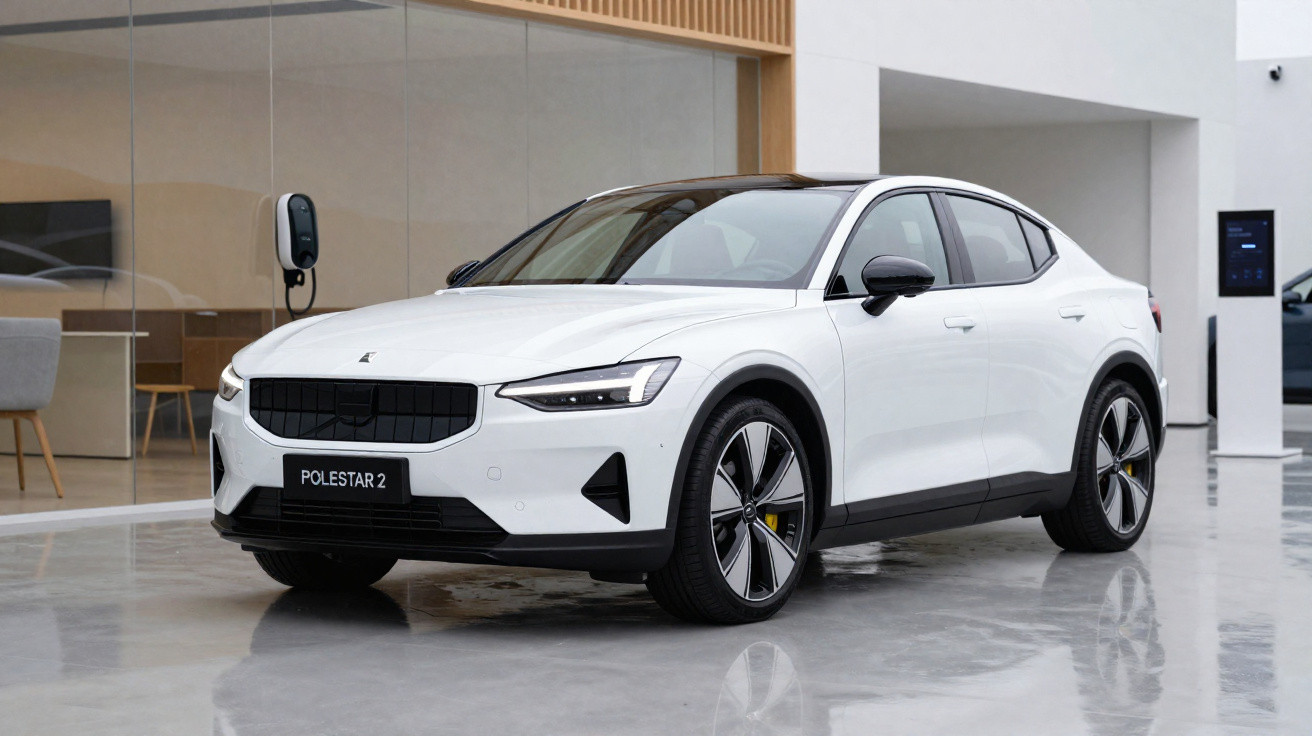
Whenever I drive the Polestar 2, I struggle to understand why it isn’t more successful. Now more than ever, it’s hard to fault its strengths.
Polestar refuses to call it a facelift, having already said it doesn’t “sign up” to the usual mid-cycle refresh routine. Even so, the reality is that for this year (and next), the Polestar 2 has changed and gained fresh selling points.
In a class dominated by the Tesla Model 3, it’s never easy to be one of the alternatives. The Polestar 2 is now better equipped than ever for that “fight”, with more heavyweight names in the mix - starting with the BMW i4 - while never losing sight of the BYD Seal.
Visually, the differences are subtle, boiling down to a few tweaks at the front end (where a grille would normally sit).
Don’t be fooled by that. The 2024 Polestar 2 received major upgrades where you can’t see them, enough to treat it as a thoroughly renewed proposition. For a start, it brings new electric motors, new inverters and new batteries.
On the Long range Single motor version (single motor) we tested, the electric motor has even moved location: it’s no longer mounted at the front and is now positioned over the rear axle. Yes, this Polestar 2 has gone from front-wheel drive to rear-wheel drive.
With these changes, the Polestar 2 line-up is now structured as follows:
- Standard range Single motor - 1 motor (rear-wheel drive); 200 kW (272 hp) and 490 Nm; 70 kWh battery;
- Long range Single motor - 1 motor (rear-wheel drive); 220 kW (299 hp) and 490 Nm; 82 kWh battery;
- Long range Dual motor - 2 motors (all-wheel drive); 310 kW (421 hp) and 740 Nm; 82 kWh battery;
- Long range Dual motor Performance Pack - 2 motors (all-wheel drive); 350 kW (476 hp) and 740 Nm; 82 kWh battery;
Range is the key
Interestingly (or perhaps not), the version I drove (Long range Single motor) is the one that makes the most sense to me. It has power in the right measure and delivers the longest range in the range: up to 659 km (WLTP cycle).
And as we all know, range still plays a major role when choosing a 100% electric car. I don’t fully agree with that (that alone could be a whole article…), but I do acknowledge how much weight this factor carries.
On that front, the Polestar 2 has moved into a strong position against its rivals. The equivalent BMW i4 (i4 eDrive40 Gran Coupé) claims up to 589 km (WLTP), while the Tesla Model 3 RWD quotes up to 513 km (WLTP). The BYD Seal (RWD) advertises up to 570 km (WLTP).
What about efficiency?
Over the days I spent with the 2, I recorded a final average of 16,9 kWh/100 km, on mixed journeys split almost evenly between more urban driving and motorways.
At that pace - and taking the battery capacity into account - it’s feasible to cover roughly 467 km on a single charge. That’s a very decent figure, even if it sits some distance from the numbers the brand advertises.
However, on trips made exclusively in town, I managed to reduce consumption to close to 14,5 kWh/100 km. With that kind of use, I can tell you it’s relatively easy to “extract” more than 500 km between charges.
On the subject of charging, there’s more good news: the 2024 Polestar 2 also charges faster. On alternating current (AC), all versions are limited to 11 kW. But on direct current (DC), the variant with the smaller battery (70 kWh) supports charging of up to 135 kW, while the larger battery (82 kWh) allows speeds of up to 205 kW.
Sharper driving dynamics
There’s no doubt the Polestar 2 has progressed in range, efficiency and charging. The next question is how its driving manners - already very capable - have been influenced by moving the electric motor.
Even though this isn’t the most overtly sporty Polestar 2, first impressions are that it retains the solidity it’s known for.
The difference is that, with the motor now at the back, the Polestar 2 puts power down better on corner exit and feels more agile. And although this is “only” the second step up in the power hierarchy (299 hp), it never leaves you wishing for more.
It’s true that the 0 to 100 km/h sprint in 6,2s isn’t as eye-catching as in some rival offerings, but the way it accelerates is very linear - and that makes brisk driving more enjoyable.
As before the update, the suspension is on the firm side - firmer, for example, than the BYD Seal. You notice it over rougher tarmac or on cobbled streets. Even so, it doesn’t undermine the overall onboard experience, nor does it catch you out with harsh, hard-to-manage reactions.
As for the steering, it offers several distinct settings, but the more you “force” it to feel heavier, the more artificial the feedback becomes. For that reason, I found myself using the normal mode almost all the time, as it’s the nicest and most communicative.
The brakes also proved very capable, even when pressing on. That said, I found the regenerative braking rather strong, taking some getting used to. As with many EVs, the Polestar 2 allows one-pedal driving using only the accelerator pedal.
Let’s talk money…
The updated Polestar 2 is sold in the Portuguese market with prices starting at 52 400 euros for the Standard range Single motor, rising to 65 900 euros for the Long range Dual motor with Performance Pack.
The Long range Single motor drivetrain - the focus of this test - sits in the middle of the line-up and starts at 55 900 euros, already with a very appealing standard equipment level.
What’s more, at the time this review is being published, Polestar is running a campaign that includes two important equipment packs: the Pilot Pack (expands the suite of driver-assistance and safety systems) and the Plus Pack (panoramic glass roof, LED fog lights with cornering function, interior ambient lighting, electric front seats and an electric tailgate).
So, where does the Polestar 2 sit against the main rivals? The equivalent Model 3 (RWD with 283 hp) is 14 410 euros cheaper. However, it offers slightly less power and significantly less range.
When the comparison is made with the BYD Seal with a single motor (313 hp) and an 83 kWh battery, the gap is 8905 euros in favour of the Chinese model, which claims a 570 km range.
Finally, when you put this Polestar 2 head-to-head with a premium-badge rival - the BMW i4 eDrive40 - the Swedish car comes out ahead, with an 8850 euros advantage.
With that in mind, and considering what the Polestar 2 delivers in range and performance, I don’t feel the price is excessive. Yes, the gap to the Tesla Model 3 and the BYD Seal forces you to do the sums, but Polestar positions itself as a premium brand - and a look at this EV’s cabin makes that clear.
The interior may not be the roomiest in the segment - far from it - but it’s very well finished and uses quality materials. Even so, I have to admit that by now, some cabin solutions look a little dated.
What’s missing from the Polestar 2?
The Polestar 2 arrived with a bang, yet it seems to have slipped into obscurity remarkably quickly. And every time I drive it, I find it hard to understand why - especially now, with this update and this version.
It’s a well-built EV, with a genuinely premium image, and it stands out in a sea of cars that are becoming increasingly anonymous in styling. It’s enjoyable to drive, sharper than average, and it now offers a very respectable range.
On paper, it appears to have what it takes to be a winning formula. Yet in the so-called real world, the Polestar 2 still struggles to catch on.
The figures back that up. In 2023, 54 600 Polestar 2 were sold worldwide. Over the same period, BMW sold 83 000 units of the i4, BYD sold 127 323 examples of the Seal, and Tesla sold 529 287 Model 3.
Would the Polestar 2 sell more if it were a Volvo? We’ll never know the answer. But one thing is certain: anyone who buys this EV won’t be disappointed.
Comments
No comments yet. Be the first to comment!
Leave a Comment