
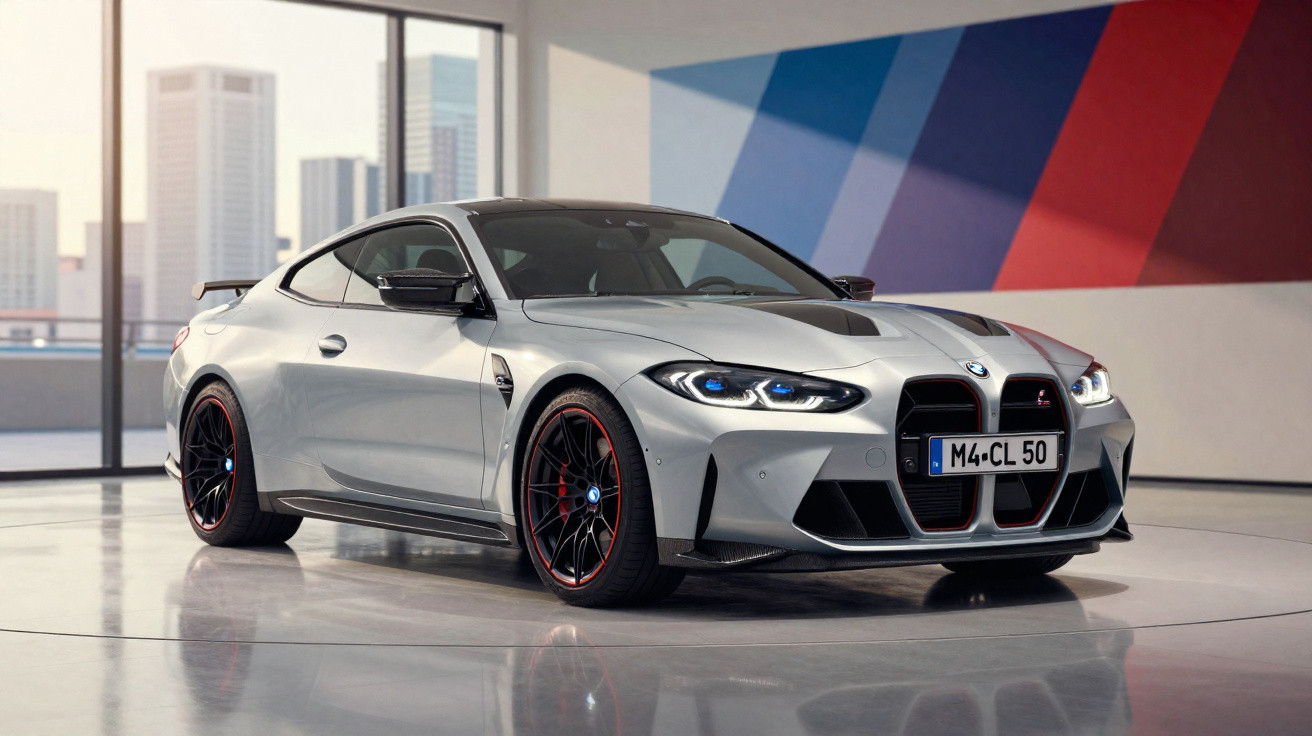
BMW marked the 50th anniversary of its M division with a gift for performance-car devotees: the M4 CSL, a special, limited-run model that also serves as a nod to the car that won the 1973 European Touring Car Championship.
Starting from the M4 Competition, BMW added extra punch to the 3,0-litre straight-six, carried out a stringent weight-saving programme worth 100 kg, and ultimately delivered the lap time it was chasing at the Nürburgring: 7min15,677s (in the “classic” 20,6 km layout) and 7min20,207s (in today’s official 20,832 km layout, which includes the straight in the T13 section).
In other words, the M4 CSL (Competition, Sport, Leichtbau - effectively Competition, Sporty, Lightweight) shown here is now the holder of the quickest Nürburgring lap ever set by a series-production BMW in the “Green Hell”.
Other eye-opening figures in this battle against the clock include 3,7s from 0 to 100 km/h (0,2s quicker than the M4 Competition), just 10,7s to reach 200 km/h, and a 307 km/h top speed - which would be higher still if the electronics were not brought in to “muzzle” the dynamic madness lurking beneath the M4 CSL’s bonnet.
How the BMW M4 CSL loses 100 kg
“Here we had to be very creative to manage to throw away 100 kg for the CSL version,” says project manager Sebastian Maier - particularly because the base car, the M4 Competition, is hardly a heavyweight to begin with. Even so, the diet target was met, with this M4 CSL officially tipping the scales at 1625 kg (DIN).
The key measures include: the rear seats were deleted and replaced with helmet storage compartments, taking 21 kg out in one hit; fully carbon-fibre seats, saving 25 kg; and the removal of carpets and luggage nets, alongside reduced cabin sound-deadening (with the added benefit of letting you hear more of the engine’s wonderful note), trimming a further 15 kg.
Beyond that, BMW introduced additional changes such as a carbon-fibre bonnet and boot lid (the M4 already used this ultra-light, rigid material for the roof), standard carbon-ceramic brake discs, special lightweight alloy wheels, lighter springs and dampers, and more. Some equipment was also pared back, including single-zone air conditioning (rather than the M4’s dual-zone set-up), LED lights - including optional Laserlight - and a boot left without trim panels.
An engine with a little extra boost
The straight-six received a 0,4 bar increase in turbo boost pressure, up to 2,1 bar, plus revised engine management. The result is 40 additional horsepower over the M4 Competition, lifting maximum output to 550 cv and delivering an outstanding 2,95 kg/cv power-to-weight ratio.
To ensure that all of that power could be translated into forward motion after passing through the eight-speed M-Steptronic automatic gearbox, BMW M engineers reduced the ride height by 8 mm, increased front-wheel camber, fitted thicker anti-roll bars, replaced all rubber mounts with spherical joints on the rear axle, softened the spring rates, and recalibrated the electronic damper software.
Confident that CSL purists would see four-wheel drive as heresy, BMW kept the car strictly rear-wheel drive. The M Traction Control function (standard) features track-focused settings, allowing the driver to choose how strongly the system limits wheelspin.
On dry tarmac, levels “1” to “5” of M Traction Control are designed to help the driver execute controlled drifts, while levels “6” to “10” draw on an application developed for Touring Car racers and are tuned for dry and wet surfaces (and varying tyre temperatures) to maximise traction and straight-line stability.
When does it arrive?
Production of the first units at the Dingolfing plant (Munich) starts in July, but any interested buyer will need more than simply setting aside 165 200 euros (in Germany; with taxes in Portugal it should come to around 200 000 euros…) to secure one of the 1000 examples due to be built. Of these, 250 are allocated to the United States, 150 to Germany, and so on - meaning very few are likely to remain for more “peripheral” markets.
Comments
No comments yet. Be the first to comment!
Leave a Comment