
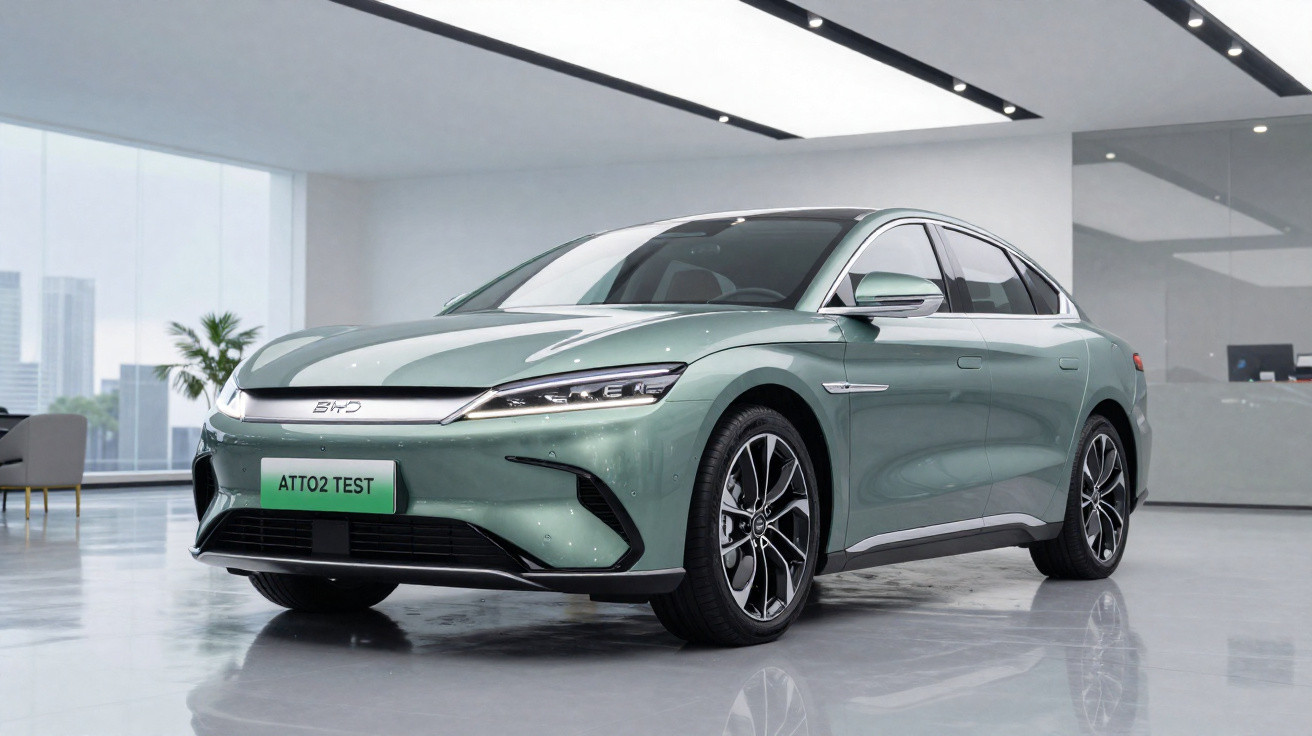
BYD has revamped the Atto 2 line-up by dropping its entry-level trims and focusing on a single Comfort specification. The headline changes are a much larger battery and a very generous equipment list. This compact urban SUV can genuinely carry four adults in comfort and has plenty going for it. However, our extended test also brought up a few weaknesses that are worth knowing about.
For anyone after an electric car that can transport four people comfortably, BYD positions the Atto 2 as a small city SUV that bridges the gap between the Dolphin Surf supermini and the rest of its family SUVs and saloons. Priced at €35,990, the Atto 2 is now sold only in Comfort trim-BYD’s top level-so you get the full equipment package intended for the model.
Previously, the Atto 2 felt like a non-starter: a small battery, slow charging (65 kW), and a less comprehensive specification. Those Active and Boost trims have since been dropped. Today, the only version available to order is the Comfort with the larger battery.
The larger battery arrived in December 2025, and we published a first drive shortly afterwards. At the time, the verdict was clear: the Atto 2 looked set for a strong 2026 thanks to improved range, a better boot (up from 400 to 450 litres), and a major leap in charging performance. The key question remained: how good is the BYD Atto 2 compared with its rivals?
That is what we set out to confirm with a multi-day test covering 1300 km. It proved worthwhile, because the car revealed strengths-and drawbacks-we had not spotted during our earlier brief drive.
To avoid repeating ourselves and to focus on what matters most-our view of the BYD Atto 2 Comfort-we split this review into two halves: what we like about this electric urban SUV, and what we like less. We then share our overall verdict.
The advantages of the BYD Atto 2
Plenty of space and comfort for four people
As electric cars have become mainstream, compact SUVs have increasingly delivered excellent cabin space without needing to stretch beyond 4.5 m. A flat floor and less bulky mechanical packaging help make better use of the interior, and BYD’s Atto 2 illustrates this well. Headroom and legroom are generous, storage is well thought out, and the boot is practical.
It can work as a family car-provided you are happy to stick to four occupants, because the Atto 2 has only four seats. BYD made the same call on the Dolphin Surf, its small city car, for reasons of width. The upside is that the rear bench is shaped into two deeper, more reclined individual seats than you typically find. Up front, the seats are very close in design to those in the Seal 6 saloon.
Unlike many rivals (including some from BYD), forward visibility from the rear seats is genuinely good. The front seatbacks are not overly bulky, and the rear seat bases sit slightly higher to give a better view ahead. The side windows are also very large, and the glass drops almost all the way down. You do not feel hemmed in inside the BYD Atto 2.
A cabin that treats occupants properly
Beyond the generous glass area and open feel, BYD has also paid attention to the interior experience by fitting a panoramic glass roof. Unfortunately, it does not open like the one in the Seal 6 saloon, but it spans the cabin from the front seats to the rear. The boot tailgate also gets a rear wiper-something missing from the Dolphin Surf and Seal 6 for cost and design reasons.
Overall, the cabin feels convincing in terms of finish quality and materials. Nothing gives the impression it will wear poorly; if anything, the opposite is true. The design is clever without looking bargain-basement. We also liked the option of a beige interior colour for the upholstery, door panels, and dashboard. You might assume that is an optional extra-but it is not. BYD includes this colour at no cost on the Atto 2 Comfort, alongside the black interior. Rear passengers also benefit from the same careful treatment, particularly on the door trim that is often neglected.
Because Comfort is the flagship trim, you also get heated seats and a heated steering wheel, wireless phone charging, and two electrically adjustable front seats. The central screen is not BYD’s largest (12.8 inches rather than 15.6 inches), but it is more than adequate. It uses the same technology as the bigger display, with responsive touch inputs and good resolution. It also controls an audio system on a similar level to the Seal 6-plenty powerful enough, even if the treble is a touch limited compared with more premium systems.
A look that is not as troublesome as expected (thanks to the Hiking Green paint)
The Atto 2’s styling is often criticised. To a point, that is understandable: in the compact SUV market, it is one of the less distinctive designs. The lines are not especially characterful and the overall shape is fairly straightforward. But this class also forces manufacturers into a rather boxy silhouette unless they are willing to compromise interior space or everyday practicality-two things BYD clearly chose not to sacrifice for bodywork flair.
So, while the BYD Atto 2 does not scream personality, it still has a mildly outdoorsy vibe and full-width rear light styling. Much like what we said about the Seal 6, the design plays it safe and does not commit to a bold direction. That said, after our December drive in a grey car, we really enjoyed the “Hiking Green” paint on our long-term test vehicle, which brings a welcome freshness to the Atto 2.
Sufficient range (360 km on average) and effective fast charging
Thanks to our extended test of more than 1300 km, we were able to complete several charging sessions and measure the real-world consumption of the BYD Atto 2 across different types of driving. That also let us calculate a realistic idea of how far you can travel in the BYD Atto 2 Comfort fitted with the 64.8 kWh large battery.
Based on our measurements, a full charge now delivers 360 km on average in the Atto 2 Comfort, with consumption recorded at 18 kWh/100 km. We managed to bring consumption down to 13 kWh/100 km in town, while on the motorway at 130 km/h it sat between 24 and 28 kWh/100 km. In other words, the Atto 2 Comfort can cover around 500 km with strictly urban driving, and between 230 and 270 km on the motorway.
It is important to note that these measurements were taken in spring, with an ideal outside temperature of around 15 degrees. We used heating and air conditioning very little, and there was only one person on board. You should therefore factor in colder weather, heavier use of air conditioning and the heat pump, and more passengers, all of which will reduce range.
On the charging side, peak power climbs from 65 kW to 155 kW when moving from the small battery to the large battery fitted to the Atto 2 Comfort. In everyday use, the difference is night and day. BYD claims 25 minutes to go from 10 to 80%. In our case, it took 23 minutes and 40 seconds to go from 18 to 80%, because the peak we saw was lower than claimed (143 kW). Even so, the curve holds up well: we still had 80 kW or more up to 83%, and between 103 and 105 kW from 60 to 77%.
The disadvantages of the BYD Atto 2
Not everything about the BYD Atto 2 Comfort was positive. By living with the car for several days and putting it through a 1300 km trip, we identified a number of issues that did not appear in our initial brief drive. Some previously noted drawbacks are also still present, and we will revisit them here.
Budget suspension and noticeable body roll
First, the suspension needs addressing. In Comfort form, the Atto 2 adds a new articulated arm on the rear axle that is meant to improve passenger comfort. Even so, the conclusion does not change: this compact urban SUV is not among the most comfortable. The low-cost damping does little to smooth out rough surfaces. Nothing feels harsh, but you are consistently jostled around inside the BYD Atto 2. Because of its ride height and weight, the Atto 2 also leans noticeably through bends.
The steering is clearly tuned for city driving. You can select a firmer setting in the menus, but the car is still not at its best on twisty country roads because the steering is not particularly precise. The issue is less obvious on the motorway. As for the brake pedal, it is very light to maximise regeneration, so you will need time to get used to pressing harder for a firm stop.
Two regenerative braking modes are available for those who like one-pedal driving. The “High” mode adds stronger deceleration than the standard setting, but it still is not strong enough for true one-pedal driving. In heavy traffic, we preferred using the adaptive cruise control so we did not have to touch the pedals: the Atto 2’s adaptive cruise can brake all the way to a stop and then pull away again automatically when traffic moves.
Heat pump noise during fast charging
One issue we were unable to spot during our previous first drive concerns charging noise. After around ten minutes, the heat pump kicks in and the noise only gets louder. It is hard to ignore: within minutes, the sound (a loud humming) becomes intrusive, even inside the cabin, making it difficult to listen to music or a podcast.
We ran this test in mild conditions, with temperatures around 10–20 degrees, and the behaviour was always the same. During an evening charging stop, the noise even continued for more than ten minutes after we stopped charging. We had to pull over, wait a few minutes with the ignition off, and only then could we drive away in silence. Unfortunately, this is not a new BYD complaint and affects other models too, as owners sometimes report on forums.
Subscribe to Presse-citron
Sound insulation and wind noise
The Atto 2’s soundproofing is also on the weak side. The very large glass surfaces and the car’s shape explain part of it. At motorway speeds, the usual EV refinement benefits are less obvious because road noise dominates, alongside wind noise. We also noticed you cannot drive with the driver’s window open (or even slightly open) above 40 km/h, because a whistling noise starts at that speed, coming from the area between the A-pillar and the mirror.
Semi-autonomous driving
BYD fits plenty of driver assistance systems, and the Atto 2 in Comfort trim includes all of them. For semi-autonomous driving (also offered on earlier trims), BYD combines lane-keeping assistance with adaptive cruise control. While the lane-keeping performs well in most situations, the adaptive cruise control is slow to react, which we also experienced in our BYD Seal 6 test.
The Atto 2’s semi-autonomous mode becomes awkward when overtaking on the motorway. The first issue is that the car brakes too aggressively to maintain its safety gap. That over-cautiousness makes overtaking less straightforward: you need to change lanes very early to avoid the car slowing down instead of holding speed for an overtake. In real traffic, it is not always possible-or desirable-to pull out 100 m in advance, and it does not help maintain a natural motorway flow.
Without the driver intervening, the Atto 2 will brake, which can surprise drivers behind who assume you are about to overtake. The second problem appears once you have moved out: the system is not responsive, and you have to wait several long seconds before a timid acceleration arrives. To keep traffic moving smoothly, we preferred taking over the pedals and accelerating ourselves.
Aside from that, the semi-autonomous driving suite on the BYD Atto 2 is very good, especially considering it is standard equipment-and it was also standard on the previous entry-level trims. Still, another detail stood out. Although it is intended to be level 2 and requires the driver to keep hands on the steering wheel, during our test we managed to drive for tens of kilometres without the car asking us to put our hands back on. Was this a detection sensor issue?
Wireless phone charging is unusable
Finally, a practical cabin gripe: the wireless charging pad on the centre console is effectively unusable because it is set at too steep an angle. Put your phone down and it eventually slides, meaning charging either becomes unreliable or does not start at all. Several times, we tried wedging the car key between the phone and the lip to stop it moving. But after a few minutes, because the phone was not perfectly centred, it overheated and triggered a safety shutdown.
The tray can hold two smartphones, but only one side actually includes wireless charging. That would have been fine-if the charging worked. In the end, we had to do without it. To avoid overheating altogether, we ultimately switched the charging pad off so we could still place a phone there without issues.
Summary: our verdict on the BYD Atto 2 Comfort after 1300 km
The BYD Atto 2 Comfort is a four-seat electric model with a genuinely spacious cabin and a pleasant environment for each occupant, thanks to individual seats, ambient lighting and strong overall finish quality-especially with the beige interior used on our test car. Outside, the light green paint adds some freshness to an urban SUV whose styling is not among the most striking in the segment, and which clearly prioritises the cabin.
Switching to the 64.8 kWh battery and 155 kW rapid charging completely changes the Atto 2’s role, turning it into a far more versatile car. Before, it was essentially limited to urban use; now you can travel further without losing huge amounts of time at charging stops. That said, traces of its former 100% city focus remain, particularly in the steering and suspension.
Sound insulation also shows its limits, as does the very loud heat pump noise when rapid charging. The semi-autonomous mode steers accurately, but its motorway speed control is not effective when overtaking. Also worth adding: like other BYD models, the Atto 2 has an in-cabin monitoring camera that you must deactivate after every restart if you want to avoid constant alerts.
At €35,990, the BYD Atto 2 Comfort competes directly with its DM-i equivalent (hybrid), priced at €29,990 in Boost trim (Comfort is reserved for the electric model). Citroën offers a very price-competitive ë-C3 at under €13,000, but with a much smaller battery. Otherwise, you are looking at options such as the Skoda Elroq, the Hyundai Kona Electric, or the Renault 4 E-Tech at a similar price but with a smaller battery (52 kWh).
BYD Atto 2 Comfort
€35,990
Overall score: 7.5
| Category | Score |
|---|---|
| Driving | 6.0/10 |
| Cabin | 8.0/10 |
| Tech | 7.0/10 |
| Range | 8.0/10 |
| Price/equipment | 8.5/10 |
What we like
- Space for 4 people
- Fit and equipment
- Far more versatility thanks to the large battery and 155 kW charging
- Competitive for the price
- Beige interior offered as standard
What we like less
- Suspension
- Semi-autonomous driving not smooth when overtaking
- Noise during rapid charging
- Unusable wireless phone charging
- Sound insulation
Comments
No comments yet. Be the first to comment!
Leave a Comment