
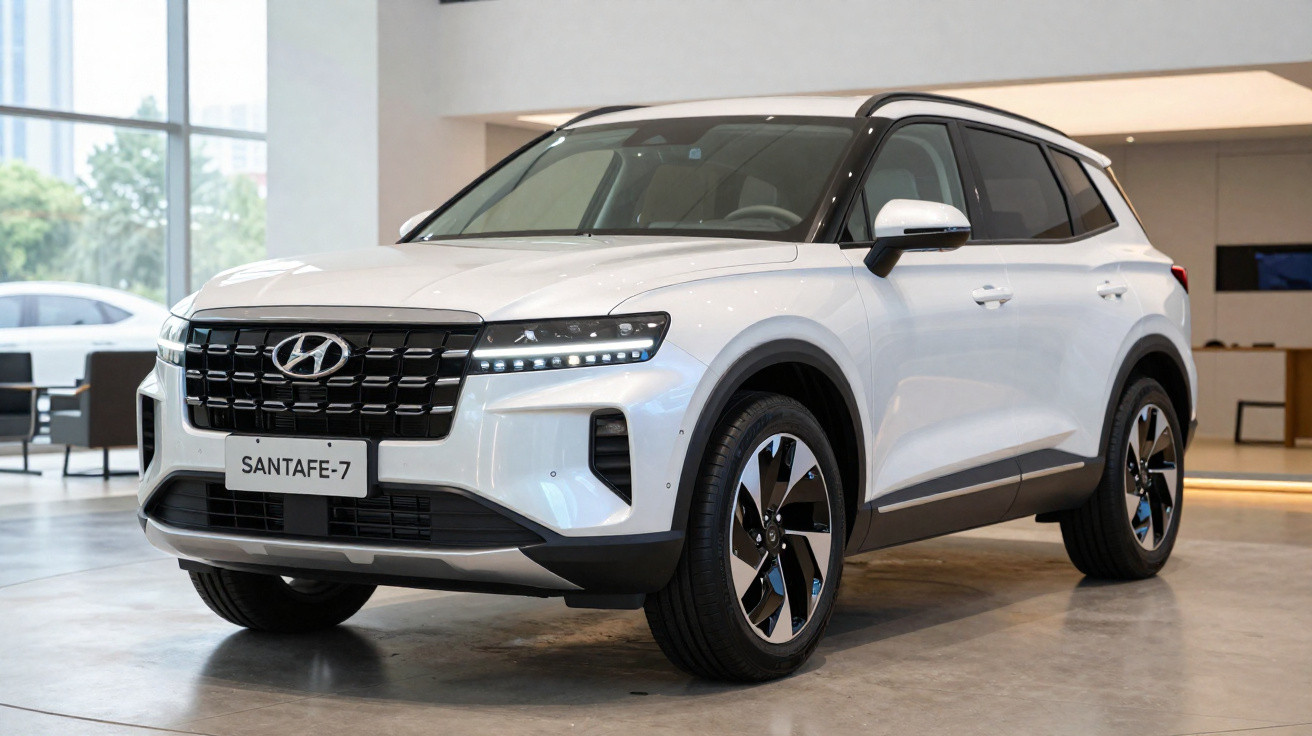
One thing is guaranteed: it will be impossible to mistake the new Hyundai Santa Fe for its predecessor… or for any of its rivals. Once again, Hyundai has taken an unexpected direction with the exterior styling of one of its most globally recognisable models.
Its looks are set to split opinion like few others, largely “because” of its design, while the generous space and comfort on board promise to bring people back together.
The new Hyundai Santa Fe will only reach us at some point in 2024, but as part of the World Car Awards, Guilherme Costa (the only Portuguese juror) has already driven it and shares everything there is to know about the new generation of the South Korean SUV.
Exterior divides, but the cabin convinces
The new Santa Fe’s exterior design will be polarising. The softer, more curved lines of the previous model have been replaced by a vehicle that looks as though it was drawn with a ruler and a set square.
The rear end, in particular, is the least likely to win unanimous approval, largely because the rear lights sit very low. That layout does have a purpose, though: it enables a wider tailgate opening, making access to the boot easier - the opening is broader than before.
There are more practical touches to find on the outside of this seven-seat SUV, including the intriguing cut-out in the C-pillar. It allows you to place your hand there as a support point to “climb” up more easily, helping you reach the roof and anything you might be carrying on it.
If the exterior divides, the interior should bring far more people on side. The dashboard layout is becoming familiar across Hyundai’s range, with two horizontal screens (instrument display and infotainment) positioned side by side. Despite the strong digital focus, Hyundai still retains some physical controls, including for the climate system.
Even so, the key point to highlight straight away is the amount of space inside the new Hyundai Santa Fe. There’s room for everything and everyone - the more “boxy” body shape will certainly have helped - regardless of which row you’re sitting in… even the third row, which is usually better suited to children.
Beyond space, the cabin felt solidly put together in this first encounter - despite being a pre-production vehicle - and it is finished with high-quality materials.
And the interior’s selling points do not stop there. It includes several unusual features, from an audio system that lets you speak to passengers sitting further back in the third row, to a compartment designed to sanitise objects. In the video, Guilherme shows these and other atypical details of the new Hyundai Santa Fe in more depth.
Not a sports car, but the dynamic behaviour surprises
The Santa Fe that Guilherme drove was fitted with a (non-plug-in) hybrid powertrain, similar to the one used in the Tucson and the current Santa Fe. It pairs a turbocharged 1.6-litre, four-cylinder petrol engine with an electric motor, for a combined maximum output of 230 hp.
We still do not know whether this figure will remain the same for the new Santa Fe - homologation has not yet been finalised - but it performed convincingly on the Angeles Crest Highway in Los Angeles, a mountain road packed with bends and gradients.
The real talking point, however, is its dynamic behaviour. Accurate, sharp, and controlled are not qualities we typically associate with the handling of a seven-seat SUV.
On top of that, it manages to combine that sharpness on the road with high levels of comfort - a balance that is rarely easy to achieve.
Final verdict will have to wait
This first dynamic taste of the new Hyundai Santa Fe left a very positive impression and raises expectations for when we test it in Portugal, with more time behind the wheel.
For now, we are not offering a definitive verdict, because two crucial points are still unknown. First, what fuel consumption can this generously sized hybrid SUV deliver? We know the Tucson hybrid can be frugal, but the Santa Fe is larger and heavier.
Second, what will the price be? Using the Hyundai Santa Fe currently on sale as a reference point, the hybrid version starts a little above €64,000. Will the new generation arrive with a similar price tag?
Comments
No comments yet. Be the first to comment!
Leave a Comment