
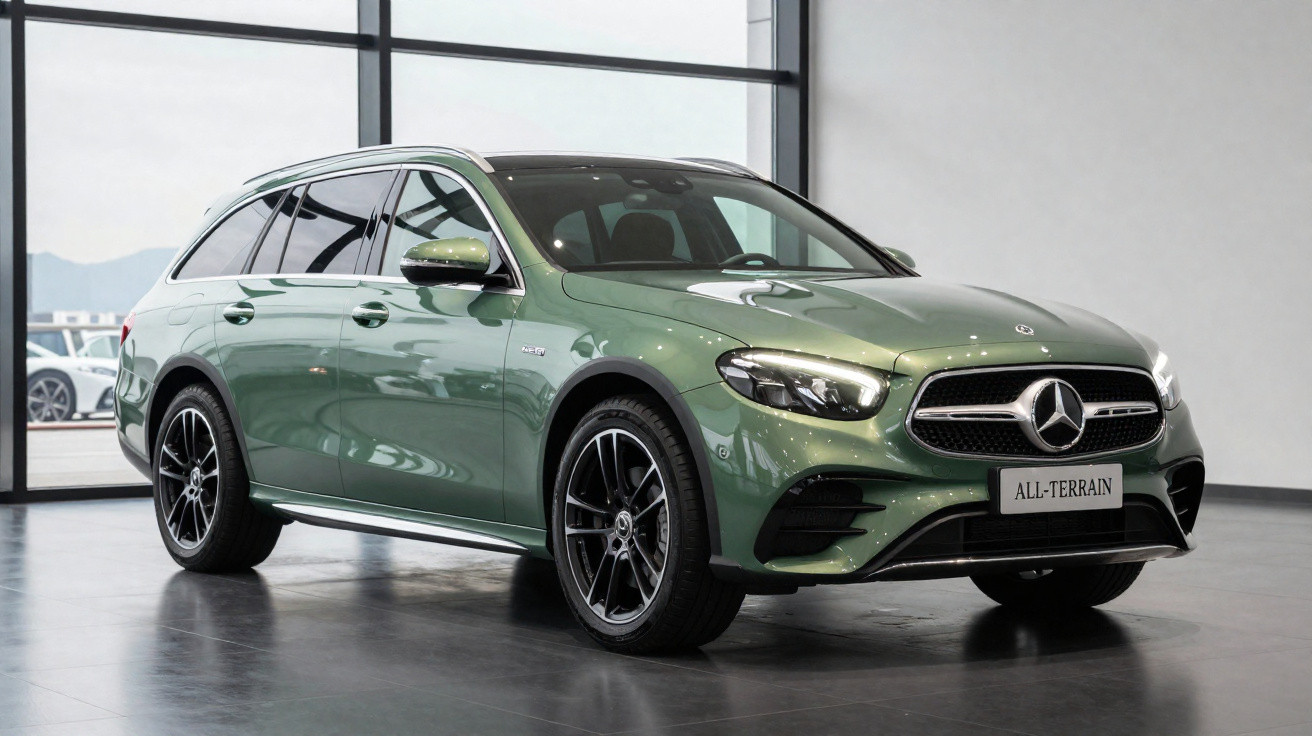
It’s hard to say no to the Mercedes-Benz All-Terrain… it can do (almost) everything exceptionally well.
Mercedes-Benz has a long-standing heritage when it comes to estate cars. In its home market they’re typically known as T-Modelle or Kombi, while locally they’re sold as the Station.
After driving this one, though, I feel I can forget all those labels and simply call it All-Terrain. Yes, it’s only one variant within the E-Class Station line-up, but it left me thinking the rest are almost redundant.
When the first E-Class All-Terrain arrived at the end of 2016, the lack of a hybrid option was noticeable. In this new generation, that gap has clearly been closed. Alongside this plug-in hybrid system, which can be recharged from the grid, there’s also a simpler 48 V mild-hybrid alternative.
What’s more, this 300 version I lived with for a few days is a rare proposition in today’s market because it pairs the system with a diesel engine. It combines the familiar 2.0-litre, four-cylinder unit producing 197 hp - an engine that, in other models from the brand, can deliver more than 1,000 km per tank - with a 95 kW (129 hp) electric motor, powered by a 19.5 kWh battery.
Altogether, the Mercedes-Benz E-Class All-Terrain offers 313 hp of combined peak output and 700 Nm of torque, sent across a wide range of surfaces via a nine-speed automatic gearbox and the 4Matic four-wheel-drive system.
An unmistakable look
Just like its predecessor - and much like its key rivals (Audi Allroad and Volvo Cross Country) - the Mercedes-Benz E 300 All-Terrain blends the elegant estate silhouette with a “rolled-up sleeves and trousers” attitude. In practice, that means a generous ride height, thanks to the air suspension, with maximum ground clearance close to 18 cm.
To shield the bodywork and give the All-Terrain a tougher stance, there are several underbody-style protections on the bumpers and side skirts, plus plastic cladding framing the wheel arches. Look a little closer and you’ll also spot a bespoke front grille design featuring two horizontal bars.
Reduced boot
Step inside the Mercedes-Benz E 300 All-Terrain and it’s business as usual compared with other E-Class Station versions. The cabin still feels carefully finished, the material quality remains high, the build feels robust, and there’s ample space along with above-average comfort - even more so here, because the air suspension comes as standard.
However, the plug-in hybrid hardware does take away some boot volume. Even so, you still get 460 litres of luggage capacity, plus side cubbies with nets for smaller items and even an automatic parcel shelf.
The driving position is superb, with wide-ranging (electric and memory) adjustment, although the steering-wheel controls - with multiple touch-sensitive functions - still need time to get used to.
Technology at your service
As elsewhere in the range, both the fully digital instrument display and the central touchscreen include telemetry readouts, showing (in real time) what the wheels, suspension, steering and drivetrain are doing.
In the Mercedes-Benz All-Terrain, that feature set becomes even more comprehensive, and it comes alive as soon as you select the “Offroad” driving mode, which is capped at a maximum of 110 km/h.
With it engaged, you can check your current GPS position and see your exact heading via a compass. On top of that, it’s possible to monitor the car’s lateral and longitudinal body tilt, among various other functions.
Asphalt and beyond
This, as you might expect, is one of the E-Class All-Terrain’s biggest strengths. Being able to leave the tarmac without worrying too much about the unknowns makes this more rugged-looking estate even more appealing - especially for anyone who’s grown tired of SUVs.
The four-wheel-drive system adds an extra layer of enjoyment on dirt tracks. The pairing of the diesel engine and the electric motor feels tailor-made for this sort of route, helped by the abundant availability of 313 hp and 700 Nm.
It isn’t a sports car, but the steering is accurate enough, and on-road behaviour inspires confidence behind the wheel - even with a package that’s already close to 2.4 tonnes.
A capable hybrid
Even so, this is a diesel plug-in hybrid, so it’s only natural to be curious about consumption figures and range. That’s entirely fair - it was one of my biggest question marks, too.
In full-electric running, the brand claims a maximum range of around 95 km. In the real world, it doesn’t fall far short. I managed close to 90 km on a single charge, averaging 20.2 kWh/100 km.
In hybrid mode, once the combustion engine was brought into play, it was very uncommon to see journeys averaging more than five litres. The best part is there’s no range anxiety: after the first 200 km covered, the remaining range was still above 800 km.
By the end of this test, once all the numbers were added up, the overall averages came out at 17.7 kWh/100 km for electricity and 2.7 l/100 km for diesel.
Overall - with a battery top-up along the way - 63% of the distance travelled was completed with the combustion engine switched off.
The bill, please…
This E 300 All-Terrain is one of Mercedes-Benz’s most well-rounded offerings to date, but as you’d expect, with E-Class Station credentials, a plug-in hybrid system, four-wheel drive, and all the comfort and tech on board, it doesn’t come cheap.
And once you factor in all the options fitted to the test car, the final price of the estate shown in the pictures reaches €91,000.
Is that a lot? Yes - but it doesn’t feel completely out of step with what the All-Terrain delivers. Without options, the starting price is €85,300, and the only thing I genuinely missed was the Burmester sound system. A matter of taste, of course.

Comments
No comments yet. Be the first to comment!
Leave a Comment