
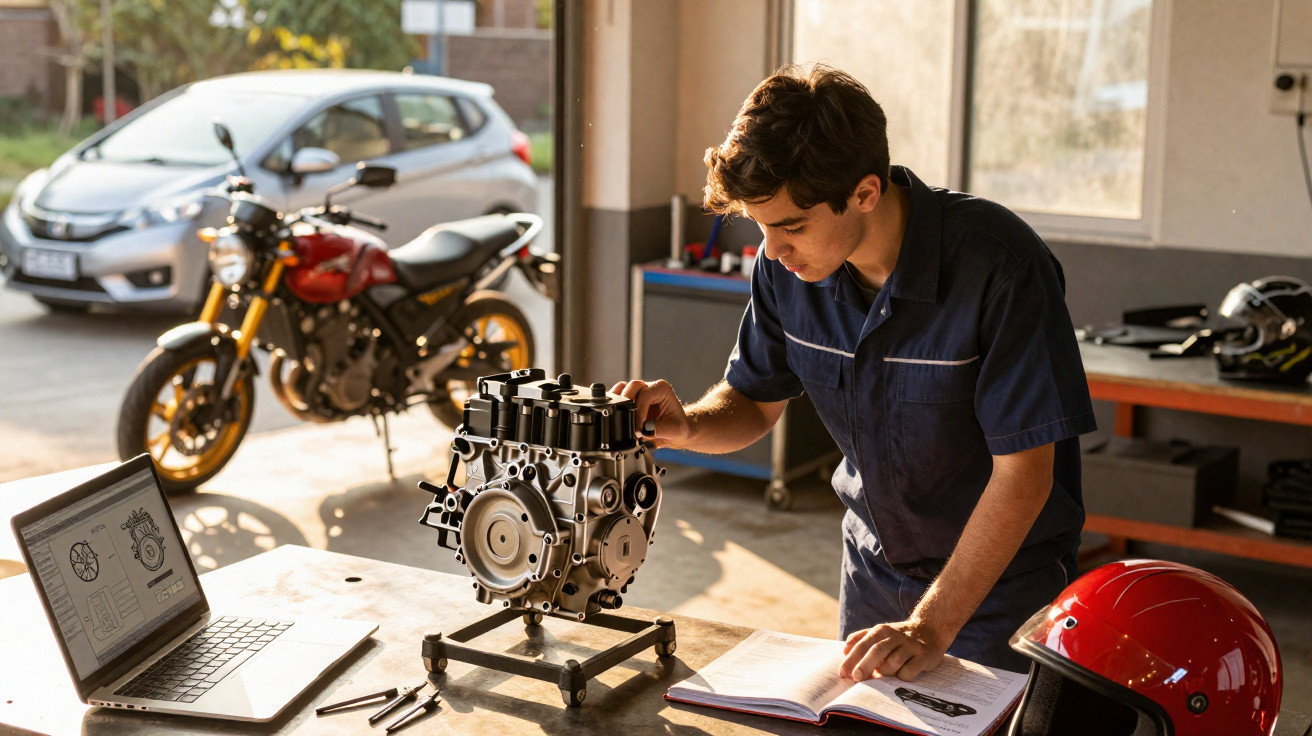
Launched in 2012, the Honda NC700 - whether in the more adventure-leaning “X” version or the sportier “S” - has since secured its place in the market as a tough, economical and easy-to-ride option, even for “beginners”.
However, long before it built a reputation through countless miles of real-world use, the bike that some call the “Volkswagen Golf of motorcycles” became known for the notion that its 670 cm³ parallel-twin engine was, quite literally, half a Honda Jazz engine.
That idea spread so widely that, even today, it is still repeated as established fact. And while plenty of myths are born in forums, café chat or social media comments, this one had a small push from the manufacturer itself.
The day Honda created a myth
It was at the international launch of the NC700 that the myth took shape. The project’s lead engineer, Soya Uchida, made a joke that would end up following this motorcycle for more than a decade. Laughing, he said:
“I took a saw and cut the Jazz engine in half, but it didn’t work very well, so we had to do a bit more work on the NC700X.”
Soya Uchida, chief engineer of the Honda NC700
The line was clearly tongue-in-cheek, but it landed perfectly. And there were genuine reasons why the comparison felt plausible. After all, Honda developed the NC700 engine with strong cooperation between its car and motorcycle divisions - during the project they met 1–2 times per month. You could sense that influence immediately in the engine’s character and the way it delivered its performance.
Where motorcycle engines typically chase specific power and a huge appetite for revs, the NC700’s unit went against the grain. Its 62 Nm of torque arrived early for a bike, at just 4750 rpm, and fuel consumption was low, with claimed averages of only 3.5 l/100 km. Meanwhile, a 6500 rpm redline left any rider used to stretching an engine through the rev range feeling short-changed.
In real terms, the NC700 gave you its best much earlier than you’d expect from a Japanese motorcycle. It pulled strongly from low revs, didn’t demand constant downshifts, and seemed perfectly content working between 2500 rpm and 5000 rpm. Almost like a… diesel.
Similarities with the Jazz engine gave the myth momentum
The car-like parallels weren’t limited to how the NC700 felt on the road. To achieve that low-rev strength, Honda chose - as with the Jazz - an undersquare design, meaning an engine where the piston stroke is longer than the bore.
That choice also helped thermal efficiency and smoothness, but at the expense of high-rpm power, shaping the NC700’s distinctive personality.
And this is where the myth’s foundations really sit: the bore and stroke of its two cylinders were exactly the same as the cylinders in the contemporary Honda Jazz 1.4 i-VTEC engine - technically a 1.3-litre unit at an exact 1339 cm³: 73 mm x 80 mm.
Coincidence? Not really. Soya Uchida didn’t literally chop a Jazz engine in half to create the NC700’s, but he did reuse certain components: the connecting rods (linking the piston to the crankshaft) and the piston rings (sealing the combustion chamber), for example, are exactly the same. The part numbers tell the story: the connecting rod with reference 13210-RB0-000 and the piston rings with reference 13011-RB0-004 are shared by both the Jazz and the NC700.
So, to settle it clearly: no, the Honda NC700 engine was not literally half a Jazz engine. But the chief engineer did, in effect, “copy the homework” to build it.
An engine designed for motorcycles
Even so, the NC700 engine was developed specifically for motorcycle use. Its internal design, 270-degree crankshaft (rather than the more conventional 180-degree), dynamic balancing, intake, lubrication and power delivery were all completely different from a Honda car engine.
On top of that, turning half of an inline four-cylinder car engine into a motorcycle parallel twin would be far more complex (and less efficient) than creating a new engine while borrowing only proven ideas.
So Honda took the smarter route. It adopted solutions from its car division that were more focused on combustion efficiency and friction reduction. The result was a mid-capacity bike built for everyday riding, offering lower fuel consumption and greater longevity.
Time ultimately proved Honda right
This healthy crossover between two and four wheels drew plenty of criticism at first: a large part of the press argued the engine lacked excitement. It was described as “too rational”, “too utilitarian” or “too car-like”. The DCT (dual-clutch) automatic versions didn’t help either, pushing it even further from the traditional idea of a motorcycle.
In the end, time sided with Honda. The NC700 arrived ahead of a period when efficiency, ease of use and low running costs became priorities. Leaning on those strengths, it became a sales success and a benchmark for durability - something backed up by the many examples still seen on the road today.
That philosophy continues in the NC750, its successor… this time without any myth about sawing car engines in half.
Much discussed, *motorcycle inspections** were one of the topics covered in a podcast where we talked about changes to periodic inspections. Take the opportunity to listen (you can also watch) this episode:*
Comments
No comments yet. Be the first to comment!
Leave a Comment