
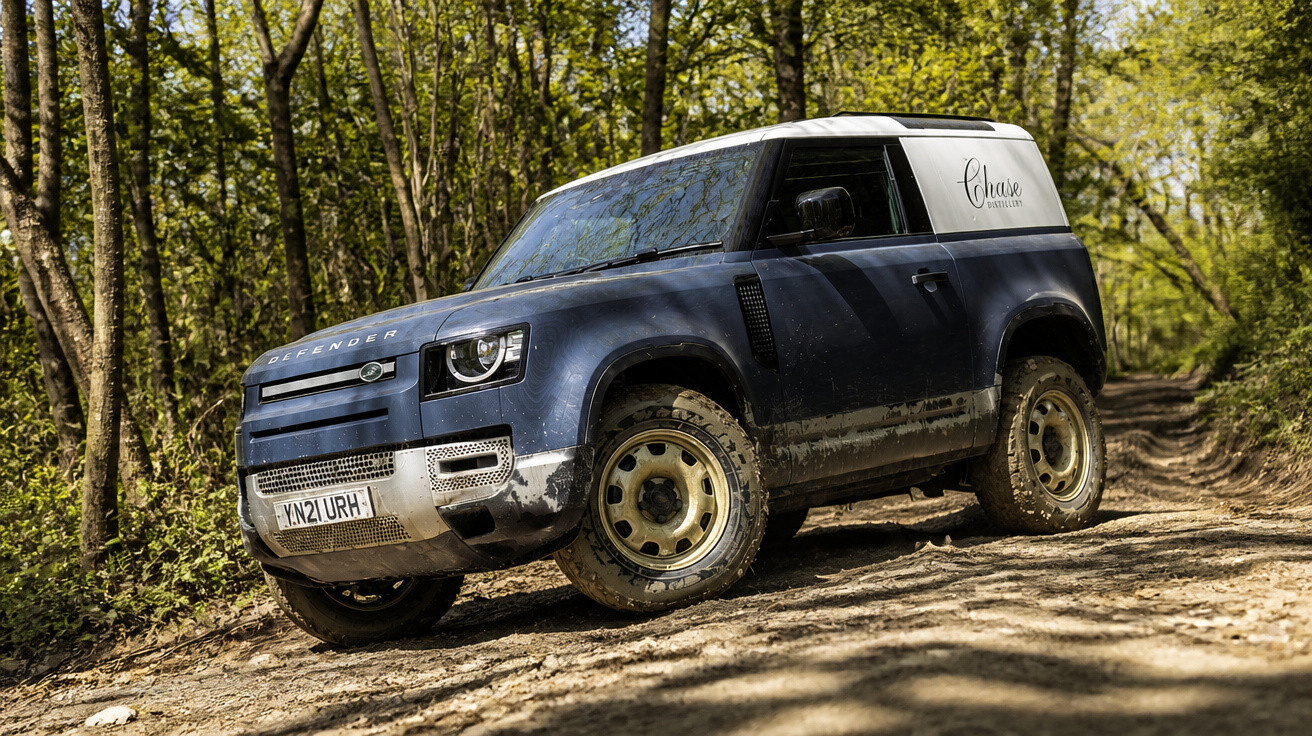
What is the Land Rover Defender Hard Top?
Land Rover’s “Hard Top” badge is simply its way of describing a Defender - TopGear.com’s current Car of The Year - that’s had the rear seats replaced by a large, empty load area.
You can buy it as the short-wheelbase Defender 90 or the long-wheelbase Defender 110. In this form, the new Defender leans hardest into its working-vehicle roots, built to move heavy, awkward and valuable kit across ground that could stop even a tough four-wheel-drive Mercedes Sprinter or Ford Transit - and potentially even proper pick-ups such as the Toyota Hilux and Isuzu D-Max.
The name itself is a throwback, too. Land Rover first used it back in 1950, when it began offering a removable hard top for the old soft-top Series 1.
Load space, payload and cargo features
In practice, yes: it’s a Defender van.
In Defender 90 Hard Top form you get 1,355-litres of load space and a payload of up to 670kg. Step up to the Defender 110 Hard Top and the longer, slightly wider load bay offers more than 2,000-litres; it’ll take a standard Euro pallet and it can carry up to 800kg.
Both versions come with a completely flat load floor, plus useful underfloor room for smart, lockable storage boxes. There are up to six integrated tie-down points to secure your gear, heavy-duty rubber mats you can hose out, and very bright interior lighting. On the 110, the rear doors remain (with blacked-out glass) to make side access easier.
A solid, full-height bulkhead sits behind the front seats, with a small grille so you can still see through the rear window. The point is simple: in a crash, heavy items are far less likely to smack you in the back of the head - and, as Land Rover puts it, it helps “preserve the refined driving experience of the passenger model”.
Driving and powertrains (D200, D250, D300)
Because it shares its mechanicals with the passenger Defender 90 and 110, the Hard Top drives almost exactly the same as the five- or seven-seat versions. It’s still the SUV we once said could be easy to “whisk along a difficult road at a respectable lick” in “almost luxury-car comfort”. That assessment still holds: it’s genuinely excellent.
Power comes from a mild-hybrid straight-six diesel offered in 200, 250 or 300hp outputs. It’s notably smoother and stronger than any four-cylinder diesel. Even the entry-level D200 - which you can only have in the short-wheelbase 90 - produces 369lb ft of torque, is rated to tow a 3.5-tonne trailer, and will run from 0-60mph in around nine seconds when unladen.
Go for the D300 and you get a hefty 479lb ft. It’s hugely capable, but unless you’ll regularly push the 110 close to its maximum payload and towing limits, it may be more than you really need. With no load on board, it’ll do 0-60mph in under seven seconds - a slightly ridiculous figure for a commercial vehicle.
All models use an eight-speed automatic gearbox that shifts smoothly and generally chooses the right ratio. There aren’t any steering-wheel paddles, though you can take control by nudging the gearlever sideways and then pushing for downshifts or pulling for upshifts.
Off-road capability and Terrain Response
We didn’t get the chance to tackle anything truly savage off-road, but Land Rover’s line is that the Hard Top is every bit as proficient as the standard Defender when things turn muddy, snowy, sandy or steep.
There’s no obvious reason to doubt it. ‘Terrain Response’ comes as standard, and if you choose a Defender 110 you can add air suspension for extra ground clearance - up to 291mm - along with improved approach, breakover and departure angles (38, 28 and 40 degrees respectively). Either way, wading depth is a very strong 900mm.
Cabin, buyers and pricing
From the driver’s seat, the cabin feels essentially identical to a normal Defender - right up until you look over your shoulder at a tricky junction and realise there’s no left-rear window, or you try to check blind spots before moving lanes on the motorway.
You sit at roughly the same height as other van drivers, and the enormous door mirrors give a clear view to the rear. If you tend to carry a full load, the optional camera-based rear-view mirror is a useful extra, as it is if you’ve got someone perched on the centre “Jump Seat”.
A Ford Transit (or similar) will accommodate three big builders abreast more easily, but the Defender’s optional middle seat works well enough for shorter journeys - just - as long as you’re not particularly tall or broad. When you don’t need it, it folds down into a comfortable armrest complete with two cupholders and integrated power/USB sockets.
Specification can be raised to almost the same lofty level as a high-end passenger Defender. That gets expensive and feels a bit contrary - a working Defender doesn’t really need fancy leather and thick carpets. The entry-level 90 we drove kept things more honest, with part-manual cloth seats, a non-leather steering wheel and plenty of rubberised surfaces on the dashboard. It all comes across as properly durable, and the shelf-style dash also creates loads of handy storage space.
Even so, it isn’t short on equipment: climate control, heated seats, the large infotainment screen, surround-view cameras and the full set of off-road systems are all standard.
A significant number will end up with businesses and organisations that will use them exactly as Land Rover envisages - construction, infrastructure and telecoms outfits, for example, towing and carrying equipment across rough sites.
But there’s also the image angle. A normal van or pick-up will do the job - and do it effectively - for far less money than a Defender Hard Top. Still, some companies don’t want something ordinary; they want a vehicle that signals something about their brand to customers and passers-by, while still being genuinely useful.
A new Transit would, in pure practical terms, make a better food truck than an old Citroen H van for countless reasons - yet firms continue to buy, restore and convert those French workhorses with coffee machines, pizza ovens and all sorts. The reason is simple: they look cool. The Defender Hard Top trades on the same idea.
Plenty of small business owners also use their work vehicle at weekends, and a Hard Top suits that double life even without rear seats because (a) it’s every bit as quiet, comfortable and polished as the passenger Defender and (b) it looks almost indistinguishable from one. It’s effectively a stealth van, and that brings its own benefits.
Pricing starts at £36,896 for the 90 and £43,771 for the 110, both excluding VAT. Add VAT and you’re at broadly the same money as a regular Defender. Go wild with the options and it’s entirely possible to spend more than £80,000 on a heavily specified 110, but most of what you’ll actually want is standard, so it’s wise to keep a lid on temptation.
The verdict is straightforward: it’s a Defender designed to carry things rather than people, and that’s largely the whole story. Yes, there are cheaper ways to transport loads - even to transport them off-road - but not every business decision is made purely on spreadsheets.
In the UK, around a quarter of all Discoverys sold are the ‘Commercial’ model, which uses a very similar recipe to the Defender Hard Top: remove the rear seats and install a divider. You’d hardly notice because it still looks like a normal Disco.
Land Rover is already seeing comparable demand for the Hard Top, and it may end up representing one in four Defender sales in the UK.
Score: 9/10

Comments
No comments yet. Be the first to comment!
Leave a Comment