
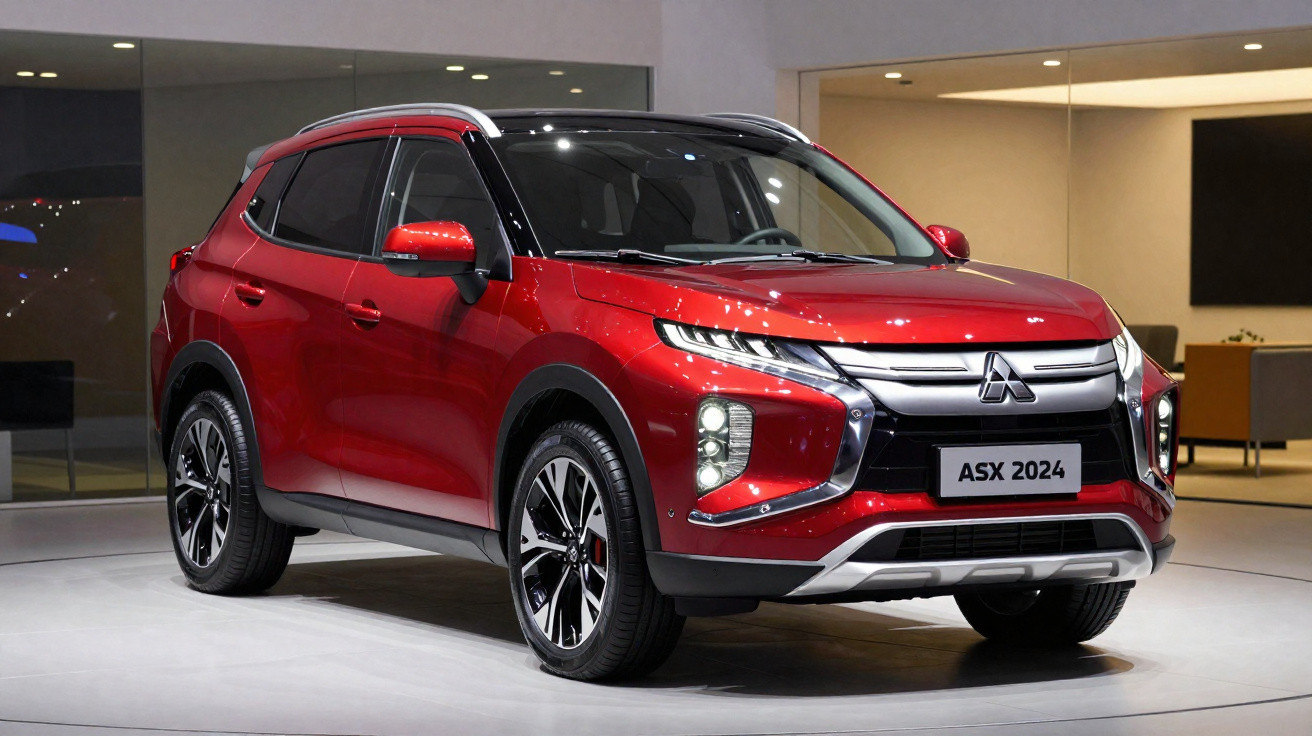
Your eyes aren’t playing tricks on you - and neither are we. This SUV really is a Mitsubishi. At least, judging by the badges.
It is almost impossible to begin a drive of the new Mitsubishi ASX without addressing “the elephant in the room” - an expression that fits this situation perfectly. The thing is, the new Mitsubishi ASX… is a Renault Captur. Quite literally. And it is not an accident; it is designed to be that way.
Replacing the Mitsubishi ASX had become well overdue for the Japanese brand, given that the outgoing model had been on sale since 2010 and had only been updated through one facelift after another.
So, rather than spend a fortune engineering an all-new car just to keep a foothold in Europe, Mitsubishi opted for a simpler route.
Being part of the Renault–Nissan alliance opened the door to “borrowing” the French SUV’s project - especially as it remains one of the most sought-after B-SUVs on the market, with a proven track record across several countries.
On the production line in Valladolid, Spain, this SUV is built (alongside the Captur) in virtually identical fashion until almost the very end. It is only near the final stages that the most noticeable differences appear.
A change of identity
To turn the Captur into an ASX - and with a tightly controlled budget - the familiar French diamond was swapped for the three-diamond Mitsubishi emblem. That is what you will find on the front grille, on the steering wheel, and in the centre of the alloy wheels.
At the rear, the word Mitsubishi is now spelled out in full. However, slightly higher up, where the parking-assist rear camera used to look neatly integrated into the middle of the French diamond, it has now been placed inside an added piece of plastic that feels completely out of place.
Elsewhere on the outside, the Mitsubishi ASX benefits from the same attractive look as its twin, including the LED light signature front and rear with the distinctive “C” shapes. The tougher stance is also unchanged, as are the ride height, bumpers, side skirts, and just about everything else.
ASX doubles down on versatility and space
Step inside the new Mitsubishi ASX and the confusion only grows. In here, aside from the Japanese brand’s logo in the middle of the steering wheel, everything points to you being in a Captur - and that is far from a bad thing.
As mentioned, this SUV continues to be a strong seller in multiple markets, and not without reason. From the driver’s seat, the driving position is spot on, and the space on offer both in the front row and the rear is actually above average for the class.
In the boot, there are 422 litres available for whatever you need to carry. And if that still is not enough, you can slide the rear seats forwards or backwards by around 16 cm, which can free up an extra 69 litres of capacity.
Technology that does the job
In the middle of the dashboard, the touchscreen control monitor is familiar too, even in its more compact version, and it gives access to a range of systems in a straightforward, reasonably intuitive way. Right in front of the driver, the only real omission is a fully digital instrument cluster, which is reserved for versions fitted with a hybrid system.
Even so, the analogue dials frame a vertical, colour trip computer display, complete with the always-useful consumption readouts and monitoring tools aimed at more economical driving.
Best of all, it also inherits some of the features we have long appreciated in many models from the French marque. That includes the card that replaces the traditional key (handy as it can simply stay in your pocket), as well as automatic climate control.
Less common these days is the presence of a conventional handbrake lever, plus the “satellite” control mounted on the right-hand side of the steering column for operating the audio system. At least, on the rare occasions we did not just use the central screen instead, as that is much more practical.
Behind the wheel of the ASX, nothing new
On the move, the Mitsubishi offers no real differences compared with the French model. In other words, it retains an excellent balance between comfort and performance, even when the roads become more twisting. That said, this is not an ASX “Evolution”, but rather a sensible family SUV that can keep things calm and quiet on board.
With the 1.0-litre three-cylinder engine, it is the turbocharger that lifts output to 90 cv. Torque is 160 Nm from 2000 rpm, and power is sent through a six-speed manual gearbox. For performance figures, the brand quotes 14 seconds for 0 to 100 km/h and a top speed of 168 km/h.
Because it does not use a hybrid system with heavy batteries, the Mitsubishi ASX comes in at a total weight of 1276 quilos. With that figure, the 1.0 engine is not overly strained, and for that reason the brand claims average consumption around 5.7 litros.
In our test, however, the final number ended up a little higher, closer to seven litres, largely because we did more urban driving, with traffic, and with no desire to switch off the air conditioning.
Keeping things simple
With the 1.0 engine, Mitsubishi offers two trim levels: Inform and Invite. The test car was an Invite, with a base price of 25 290 euros.
As for the equipment, everything you can see in the images or in our list is included as standard. The only optional extra is one of five metallic paint choices, should you not fancy the dark blue. In the case of this Crystal White, you simply add 450 euros to the final figure.
In the end, even the Mitsubishi ASX price is not especially different from its twin with a French accent. It really just comes down to which badge you prefer. Everything else is the same. That said, this approach does at least keep Mitsubishi in Europe for a while longer.
Comments
No comments yet. Be the first to comment!
Leave a Comment