
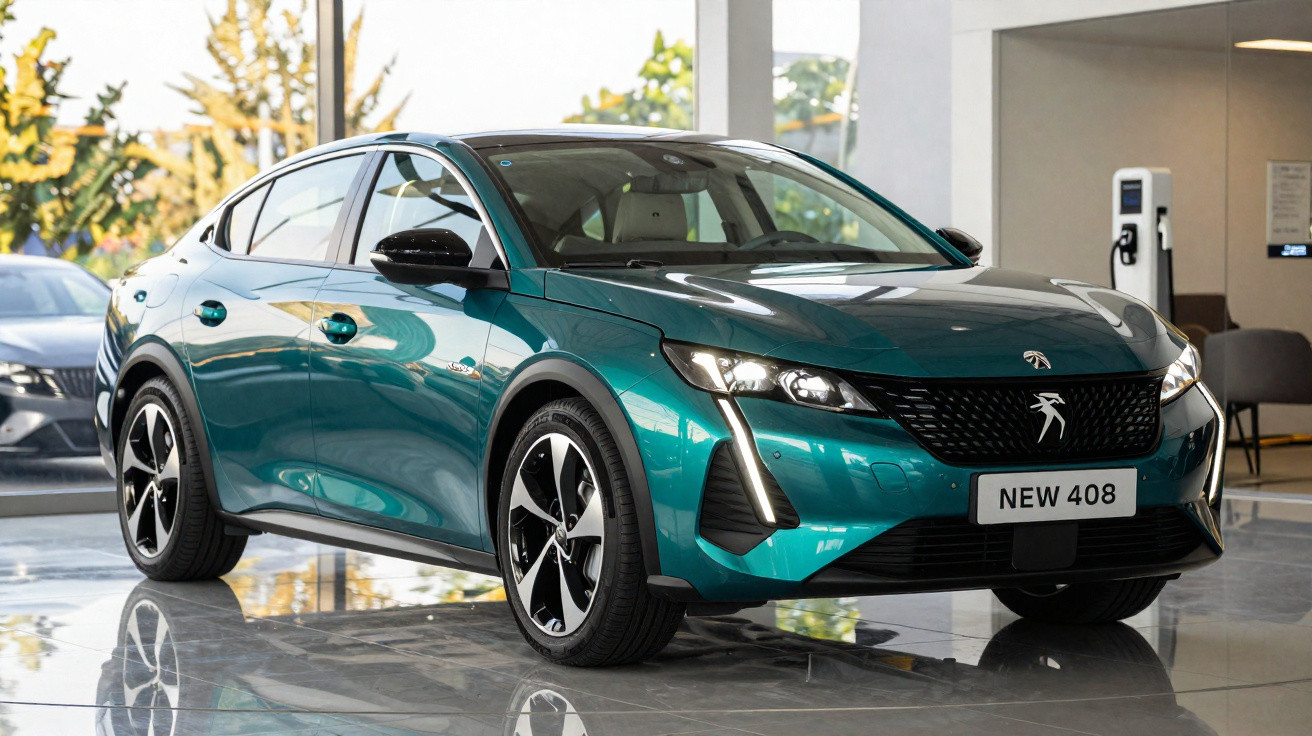
The Peugeot 408 is the latest arrival in a growing niche: the crossover saloon. Peugeot itself describes it as a fastback - a long-standing term for a two-box body style, but with a roofline that drops “quickly” towards the rear - to set it apart from more conventional crossover models and SUVs.
Under the skin it shares the same technical foundation as the Citroën C5 X - the EMP2 platform - and the bodywork also has plenty in common in this blend of estate, SUV and five-door saloon cues.
From the outside, what stands out is the abundance of sharp creases along the sides, along with a long bonnet visually “boxed in” by the raised flanks. Up front, the look is defined by a huge body-coloured grille and very slim headlamps (made possible by Matrix LED technology), while at the back the bumper cut-out is “inverted”.
Although the wheelbase matches that of its Citroën C5 X “cousin” (2787 mm), Peugeot has given the 408 a slightly sportier stance.
As a result, it is around 12 cm shorter (4687 mm), 3.3 cm wider (1848 mm) and almost 1 cm lower (1478 mm). Extra width and reduced height are valuable allies when the aim is greater stability in dynamic driving.
That said, suspension tuning matters just as much. Even with the same hardware, the French engineers say they prioritised cornering effectiveness over outright comfort - something more closely associated with Citroën. For the same reason, the Peugeot’s ground clearance is 6 mm lower.
Only plug-in hybrids and petrol
The engine line-up mirrors the C5 X range - revisit our first drive in the video below - but adds a second, less powerful plug-in hybrid option, and that also means there is no Diesel offering.
Entry-level power comes from the 1.2-litre three-cylinder with 130 hp, alongside two plug-in hybrids with maximum combined outputs of 180 hp (an option not available on the C5 X) and 225 hp.
Both plug-in hybrid versions pair the 1.6-litre PureTech petrol engine - producing 150 hp in the first case and 180 hp in the second - with a 110 hp (front-mounted) electric motor.
The plug-in hybrid Peugeot 408 models use a 12.4 kWh lithium-ion battery (covered by an eight-year or 160 000 km warranty). This should deliver an electric-only range of around 55 km, and in fully electric mode the 408’s top speed is limited to 135 km/h.
The standard on-board charger is rated at 3.7 kW, with an optional 7.4 kW unit available (both single-phase) for an additional cost. A full charge takes between 7.5 hours (from a standard socket, 8 Ah), 3.5 hours (from a reinforced 16 Ah socket at 3.7 kW) and 1h55min (Wallbox, at 7.4 kW).
Another point worth noting is that the new Peugeot 408 is not offered with a manual gearbox at all: every version comes with an eight-speed automatic. And despite its appearance, there are no four-wheel-drive derivatives, nor even the traction-control system Peugeot fits to its SUVs to help progress on more challenging surfaces.
A few months after launch, in the first quarter of 2023, the range will be strengthened with a 100% electric version, just like the Peugeot 308.
The i-Cockpit focus remains
Inside, you’ll recognise the cabin from the new 308, once again built around the i-Cockpit. Its signature is the very small steering wheel, where the upper rim sits below the instruments so they can be viewed above it - effectively serving a head-up display-like role. That is why the Citroën C5 X has an actual head-up display and the Peugeot 408 does not.
The digital instrument cluster measures 10” and is configurable, with multiple display themes including navigation, radio/media, driver-assistance systems and energy-flow information. On GT versions there is also a 3D effect, as already seen on the latest 308.
At the centre of the dashboard sits the 10” infotainment screen, positioned slightly lower than the instruments and angled towards the driver.
Beneath it are digital shortcut switches for frequently used functions, including smartphone pairing. This is wireless, and two phones can be connected at the same time.
Lower down, on the centre console, you’ll find the automatic gear selector - on hybrid versions it includes a “B” position to increase energy recuperation, while the petrol model features an M position for manual gear changes. There is also the drive-mode selector: Eco, Normal and Sport, with Electric and Hybrid added on the plug-in hybrid Peugeot 408 models.
Space for everything and everyone
As with the C5 X, rear passenger space is generous in width - even if three adults will feel a little “snug” - and particularly good for legroom. Headroom is slightly more restricted, largely due to the body shape as it transitions into the large tailgate.
Sound insulation has been given special attention, using front side glass that is thicker than Peugeot’s usual (3.85 mm), while higher-spec versions even feature double glazing on the front windows.
Boot capacity ranges from 536 litres to 1611 litres (including the 36 litres of usable space under the boot floor). With the rear seatbacks folded - split or fully - it can carry items up to 1.89 m long.
That is a very strong figure, although still marginally below the longer Citroën (545-1640 litres).
These volumes apply to the petrol-only version. The plug-in hybrids lose around 60 litres because the boot floor sits 4 cm higher, to accommodate the electric drive components.
When does it arrive?
Sales of the new Peugeot 408 in Portugal begin in the first quarter of 2023. The car will be built in France (Mulhouse), unlike early Citroën C5 X units, which were imported from Chengdu, China - where the 408 will also be manufactured for Asian markets.
With pricing not yet confirmed, it is expected to sit close to the Citroën C5 X in Portugal. That model starts near €35,000 for the most affordable 1.2, rising to close to €45,000 for the 225 hp plug-in hybrid.
Comments
No comments yet. Be the first to comment!
Leave a Comment