
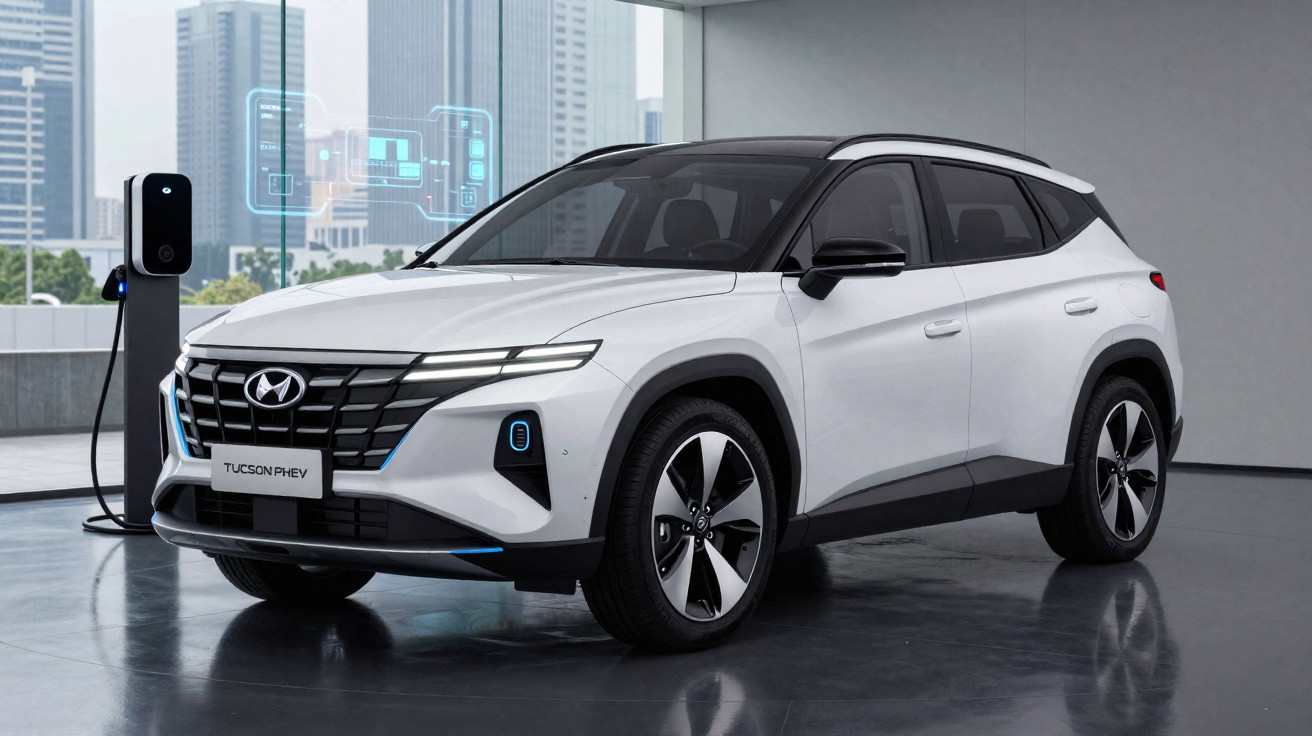
In this fourth-generation Hyundai Tucson, electrification has been pushed firmly to the forefront. In fact, there isn’t a single version on sale that doesn’t feature some form of electrified assistance.
Both the petrol and Diesel engines come paired with a 48 V mild-hybrid system. There is also a full hybrid (follow the link below to read or re-read the test). And then, sitting at the top of the line-up, there’s the plug-in hybrid (PHEV) version we tested here.
With 265 PS of combined maximum output, this is-until the Tucson N arrives-the most powerful variant of Hyundai’s South Korean SUV, which on paper is a strong “calling card”. But is it the most well-rounded version? And does it justify the €48,731 asking price, which is notably higher than the rest of the Tucson range?
Impossible to ignore
Whether you’re looking at the Hyundai Tucson from the outside or sitting inside it, Hyundai has managed to create an SUV that’s very hard to miss. Personally, I’m a fan of its lighting signature, and the sharply sculpted bodywork drew plenty of attention during the days the Tucson was with me.
Step inside and, while I do like the more minimalist look (a complete shift from the previous model), it’s hard not to miss the physical buttons that have been replaced by touch-sensitive controls-ones that demand a longer adjustment period to use confidently.
As for cabin space, the key difference compared with other Tucsons is the smaller boot. From the 620 litres quoted for petrol Tucsons, capacity drops to a still very workable 558 litres. Over the course of the test it proved more than adequate for family needs, and I didn’t have to make compromises when heading away for the weekend.
The numbers look good, but does it convince?
From the driver’s seat of the Tucson PHEV, it quickly becomes clear this isn’t the same as the other versions. With an operating strategy that favours electric running, the Tucson plug-in hybrid stands out for its smoothness and the almost imperceptible way it switches between the combustion engine and the electric motor.
There are two driving modes-“Eco” and “Sport”-alongside the all-wheel-drive terrain settings: “Snow” (snow), “Mud” (mud) and “Sand” (sand). In practice, this makes the Hyundai Tucson PHEV easy to tailor to very different conditions.
In town, “Eco” is clearly the most “appropriate” choice. Using it, I managed to get very close to the claimed 62 km of all-electric range, across journeys that went from tedious traffic jams to quicker suburban dual carriageways.
Once you leave the urban environment behind and select “Sport”, the 265 PS combined output (a 1.6-litre turbo petrol with 180 PS supported by an electric motor rated at 91 PS) doesn’t disappoint-but it doesn’t exactly astonish, either.
Yes, it dispatches 0–100 km/h in a respectable 8.2 seconds, but in outright performance terms the Tucson PHEV always feels closer to the 225 PS Opel Grandland I tested a few months ago than to the Peugeot 3008 GT HYBRID4 with 300 PS that I’ve also driven. In other words, it’s brisk, just not the main point of the package.
From a dynamics perspective, even though it retains the precision and effectiveness of other Tucsons, the PHEV does reveal its extra mass (almost two tonnes, largely thanks to the electric machine and battery). Alongside that, the steering-while still direct and accurate-comes across as more filtered when compared with the combustion-only Tucsons.
As a result, the driving experience isn’t quite as engaging, particularly next to the previous-generation Hyundai Tucson, which had a more mechanical, well-oiled feel and ultimately inspired greater confidence when driving more assertively.
Efficient? Absolutely
Where this plug-in hybrid system truly excels is exactly where many buyers expect it to: efficiency.
The way the 13.8 kWh battery’s charge is managed highlights Hyundai’s long-standing ability to “stretch” electric range. And even in hybrid operation, the Tucson PHEV showed a restrained appetite. Proof came in the 5.2 l/100 km average I recorded at the end of a test where the Tucson was used mainly on the motorway and on A-roads.
Speaking of motorways, the Tucson PHEV feels impressively stable at speed. That said, there is some wind noise that becomes more noticeable when you’re travelling in the quietest mode of all-electric-although it never became excessively intrusive.
Is it the right car for you?
As with any plug-in hybrid, the Hyundai Tucson PHEV only really makes sense if you have the opportunity (and the self-discipline) to charge it frequently, so you can take full advantage of what this drivetrain offers.
If you can do that, and you want an SUV that blends strong efficiency (both in electric mode and when the combustion engine is “called upon”) with performance that’s more than adequate for a family-focused model, then this Tucson PHEV could be a very compelling choice.
Better still, with claimed emissions of 31 g/km and an electric range above 50 km, the Tucson PHEV can qualify for a number of tax benefits when purchased by a company.
Comments
No comments yet. Be the first to comment!
Leave a Comment