
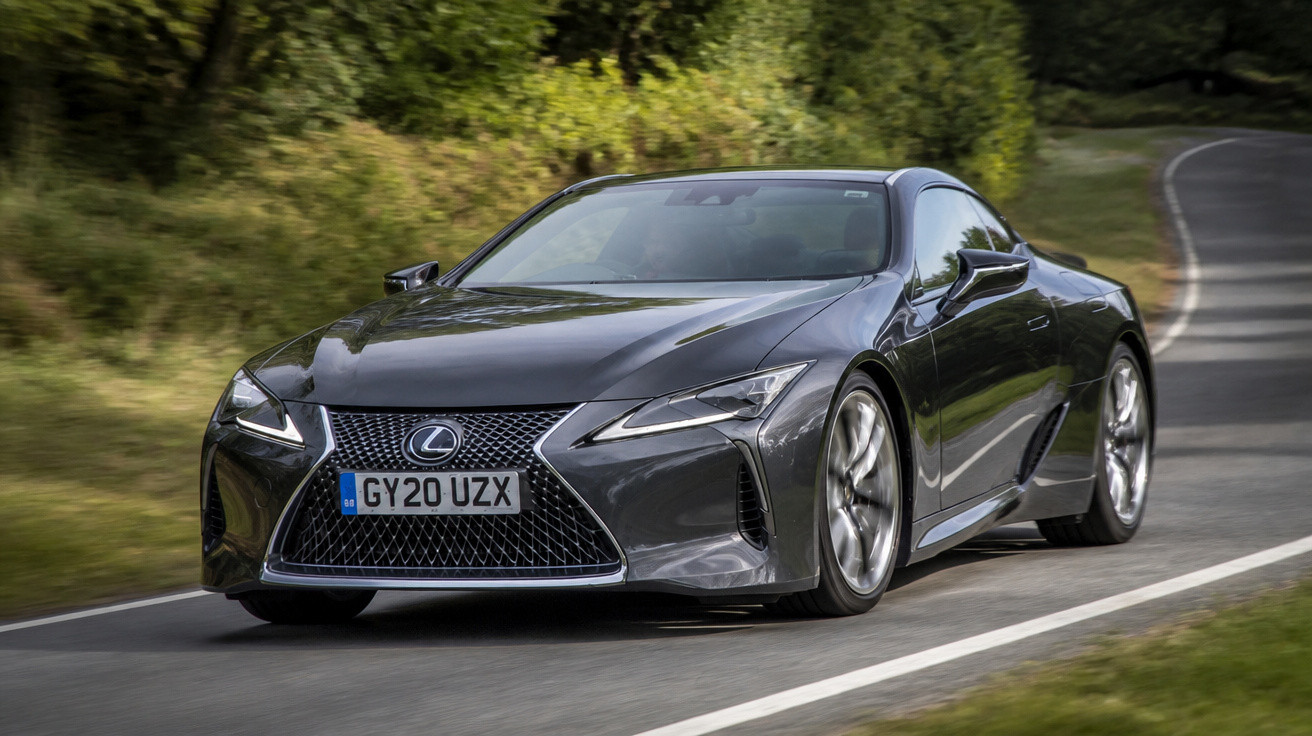
The Lexus LC – it’s been around a few years now, hasn’t it?
Yes. Even so, it wears its age remarkably lightly. For a car that’s four years into its life, it still looks startlingly fresh. It remains one of those machines that feels special simply to stand next to, let alone drive. Rather than going heavy on a mid-cycle facelift, Lexus has kept its luxury coupé (and now the cabriolet) on song through a steady stream of special editions and model-year tweaks.
That approach rings a bell…
It should. Nissan has done much the same with the GT-R, which is essentially the same car it was when it arrived 14 years ago. Make small, carefully targeted changes every year or two, and the model gradually moves on, almost imperceptibly. It’s also, in a way, how evolution works in the natural world. Nothing radical; just continual change.
Are we heading into a Japanese philosophy lecture?
Of course. Lexus frames this as ‘takumi’: “the precision skills of Lexus’s takumi master craftspeople” applied to “continuous, detailed refinement of driving dynamics”. It’s a philosophy that underpinned the LFA, and the connection is more than conceptual too - the LC comes from the same Motomachi factory. That might help explain why you’re reading this Lexus review when you may have previously ignored the ones about the brand’s hybrid SUV offerings. Lexus has even used ‘Takumi’ (capital T) as a special-edition trim on some of those.
Back to the sports car. What are the ‘detailed refinements’?
This is where the proper geekery starts, because the LC’s updates are every bit as finely judged as the GT-R’s. Sensibly, Lexus has largely resisted altering the styling, aside from new forged alloy wheels that focus on reducing mass. Those wheels connect to new aluminium lower arms, plus hollow anti-roll bars and uprated springs.
After removing 10kg of unsprung weight, Lexus has followed up with minor suspension revisions intended to give the LC a keener edge. It was never exactly a soft option, but nor was it the sharpest among the many GT cars on sale. The power steering has been recalibrated, too, and so has the rear-wheel-steering system fitted to the flagship Sport+ Pack cars - like the one here.
For the LC500h hybrid, the changes bring a more usable powerband and a higher rev limit. Meanwhile the 10-speed automatic in the petrol-only LC500 - again, the car you’re looking at here - has been fettled to feel that bit more eager.
That doesn’t sound like much…
In practice, it matters. Dropping 10 kilos from a two-tonne coupé is hardly a transformation into a featherweight, but the combined sharpening of the suspension and drivetrain lifts the LC’s willingness by just the right amount.
Turning it into a full-bore sports car was never the aim - if that were the brief, Lexus would have produced an LC F designed to shatter some kind of sonic threshold - but the result is a car whose driving manners now better match its looks. You might genuinely head out simply for the joy of driving it, rather than only appreciating its strengths while you grind through long commutes.
There is a significant caveat, though: you need the petrol engine, and you need the range-topping Sport+ specification. That pairing is the one that gathers together all the chassis hardware required for the LC to feel its best.
What engine does that mean?
A sizeable V8 - and there’s no turbocharger to be found. There’s a pleasing irony in Lexus, an early champion of hybrid powertrains, now offering one of the few remaining places to buy a big, naturally aspirated engine. In years to come, as climate change further reshapes what we choose to drive, historians may well raise an eyebrow at that. The early 2020s could make for a rather hefty chapter.
Aside from the gearbox revisions, Lexus has left the powertrain untouched. So it’s still a five-litre unit sending 457bhp and 390lb ft to the rear wheels only. Peak power arrives at 7,100rpm, which is just 200rpm below the limiter (and yes, if you really want to, you can lower that yourself via a sub-menu).
It isn’t a car that feels brutally fast, but that’s part of the appeal. Against rivals that are now almost all turbocharged, you can access and enjoy a surprising amount of its performance - accompanied by a properly addictive soundtrack, complete with real, unfiltered crackles and pops if you’re enthusiastic with your downshifts.
But it’s an automatic, isn’t it?
It is. With ten ratios on offer, most owners will sensibly leave it in D most of the time. If you’re driving with a bit more mischief, however, the gearbox logic can be slightly off: it won’t always drop enough gears on the way into a corner, and in the most aggressive mode it can be a touch reluctant to shift back up cleanly on the way out.
To get the best from it you’ll often want to take charge manually - and hope you haven’t left yourself needing seven pulls of the left paddle as a tight bend approaches. And while the updated four-wheel-steer system does an excellent job of helping the LC disguise its weight and carve through turns, you still need to brake early to manage the mass on corner entry.
Anything else that’s new?
The other headline update is that Android Auto and Apple CarPlay are now standard - features that, somehow, weren’t included before, despite Lexus fitting so much kit to the LC that your choices mostly boil down to paint and wheels. Actually pairing a phone, though, may require someone younger and cleverer than me. I could, of course, read the manual, but few premium infotainment systems make simple tasks feel quite so puzzle-like. It remains a sticky obstacle in an otherwise outstanding environment.
Even so, it’s still a genuinely special cabin to climb into, never mind spend time in. The theatrical, pop-out door handles feel slightly better resolved than those in a Jaguar F-Type, and there’s a slim strip of carbon trim on the sills. The front seats look fantastic and properly cocoon you, while the rear pair will just about take shorter adults or work neatly for children and bags. Some plastic switchgear lifted from more ordinary Lexuses doesn’t quite suit the jewel-like surroundings, but overall the interior has matured exceptionally well.
A win for takumi, then.
Without question - though it will remain a niche choice. Lexus sold 82 LCs in the UK in 2020, even if it has moved around 20,000 worldwide since 2017, with three quarters of those being the loud, burbly V8.
It also feels safe to assume that whatever replaces the LC won’t offer such a gloriously old-school engine. As much as it’s becoming a familiar line at the end of performance-car road tests, this really is one to savour while it’s still possible. And you suspect the next update won’t be quite so subtle - or quite so obsessively geeky.
Comments
No comments yet. Be the first to comment!
Leave a Comment