
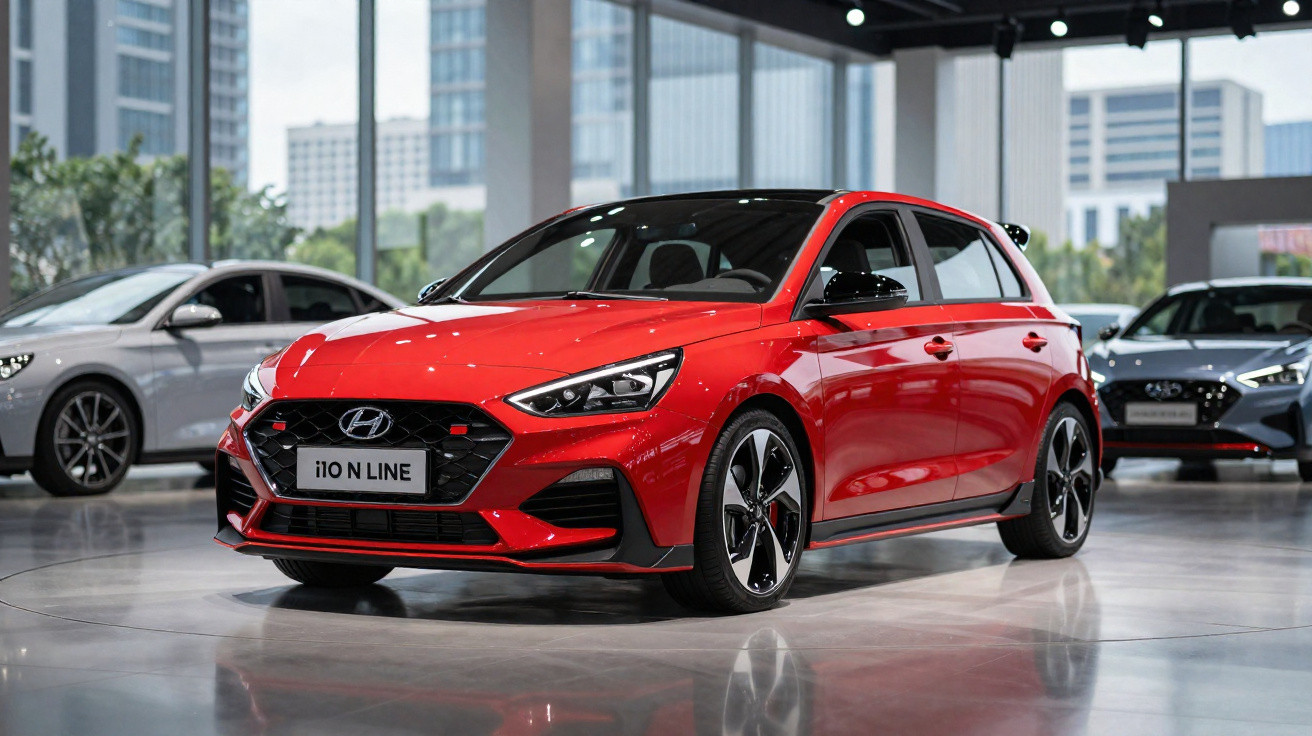
The Hyundai i10 N Line is designed with the city in mind, but it doesn’t only shine in urban surroundings.
Positioned as the sportiest take on the i10, the Hyundai i10 N Line is, in many ways, a modern-day equivalent of the Fiat Cinquecento Sport.
Hyundai has followed a familiar formula: it took a capable city car, gave it a tougher, more aggressive look and-unlike what Fiat did back then-added a bit more power as well.
The key difference is that, in the nearly 30 years separating the little Fiat’s launch from the i10 N Line, city cars have moved on dramatically. They are no longer purely urban tools, and during the days I spent behind the wheel of the i10 N Line I was able to confirm that for myself.
Small but spacious
Now in its third generation, the Hyundai i10 has ditched the MPV-style shape of Hyundai’s older city cars, but it certainly hasn’t forgotten what its predecessors taught it about making the most of interior space.
Over the days I drove the i10 N Line, I used it as a “family car”, and I have to admit the small South Korean model surprised me in a good way.
The rear seats are perfectly adequate for fitting a child seat, or for carrying two adults without any real complaints about legroom or headroom.
Reasonably sized doors make it easier to strap the little ones into their seats, and even the 252 l boot (a benchmark figure for the segment) allows for a few family outings without having to choose between taking the pushchair or the luggage.
City car with supermini traits
Ever since I first drove the Hyundai i10, I’ve kept the same view: this South Korean city car feels like a scaled-down supermini, and that impression is reinforced once you step inside.
Unlike some other city cars, there’s no exposed metal on show. The styling swaps youthful flair for a more restrained look (even in this version, which adds sportier details), and the ergonomics are well judged.
As you’d expect in this class, the plastics are hard to the touch, yet they look like decent quality. The sense of solidity is also strong, something backed up by the near-total absence of squeaks and rattles, even on (very) broken surfaces.
Nippy yet economical
The moment I settled into the driver’s seat, that “mini supermini” feeling returned: the driving position is very much that of a “proper car”-you’re not perched too high, nor are you sat pressed against the door as happens in some city cars.
On the move, the small 1.0 l turbo three-cylinder engine more than holds its own, offering a pleasing willingness that highlights its ability on faster roads.
Overtakes are dealt with easily, and the motorway’s outside lane isn’t “off limits”. In town, meanwhile, the three-cylinder’s responsiveness and the i10’s agility are ideal for weaving through traffic.
Best of all, despite being happy at a brisk pace, the little 1.0 T-GDi didn’t prove thirsty. Around town, I saw an average of 6,5 a 7 l/100 km, but it was out on the road that it impressed most.
After plenty of kilometres spent outside its “natural habitat”, the average settled at 5,3 l/100 km.
Well behaved
Point the Hyundai i10 N Line at a more winding stretch of tarmac and it doesn’t disappoint, presenting itself as a well-judged, balanced package.
The brakes inspire confidence, and the front axle reacts quickly to changes of direction. The steering could be slightly heavier and offer more feel, but if it were, low-speed manoeuvres would be less comfortable than they are.
Even with firmer damping, body roll could also be a touch better controlled, but then you’d lose the i10 N Line’s strong compromise between comfort and stability.
All told, the Hyundai i10 N Line gives up a bit of the interaction and fun you’d expect from true pocket rockets, instead positioning itself as an easy, confidence-inspiring car to drive-whether in town, on the open road, or even at higher speeds.
The price of exclusivity
Starting at 18 140 euros, the Hyundai i10 N Line is a reminder that genuinely affordable cars are becoming increasingly rare.
Yes, the i10 N Line comes well equipped, it’s a very well-rounded option, and it represents a kind of “endangered species”: the sportier city car.
Even so, models from the class above-such as the Dacia Sandero, the Kia Rio, or even the Hyundai i20-offer cheaper versions, and what they “lose” in power, equipment, or even entertainment value they “gain” in more rational strengths, like interior space.
In fact, once you look at it that way, it becomes easier to understand why so many manufacturers are turning their backs on this segment.
Comments
No comments yet. Be the first to comment!
Leave a Comment