
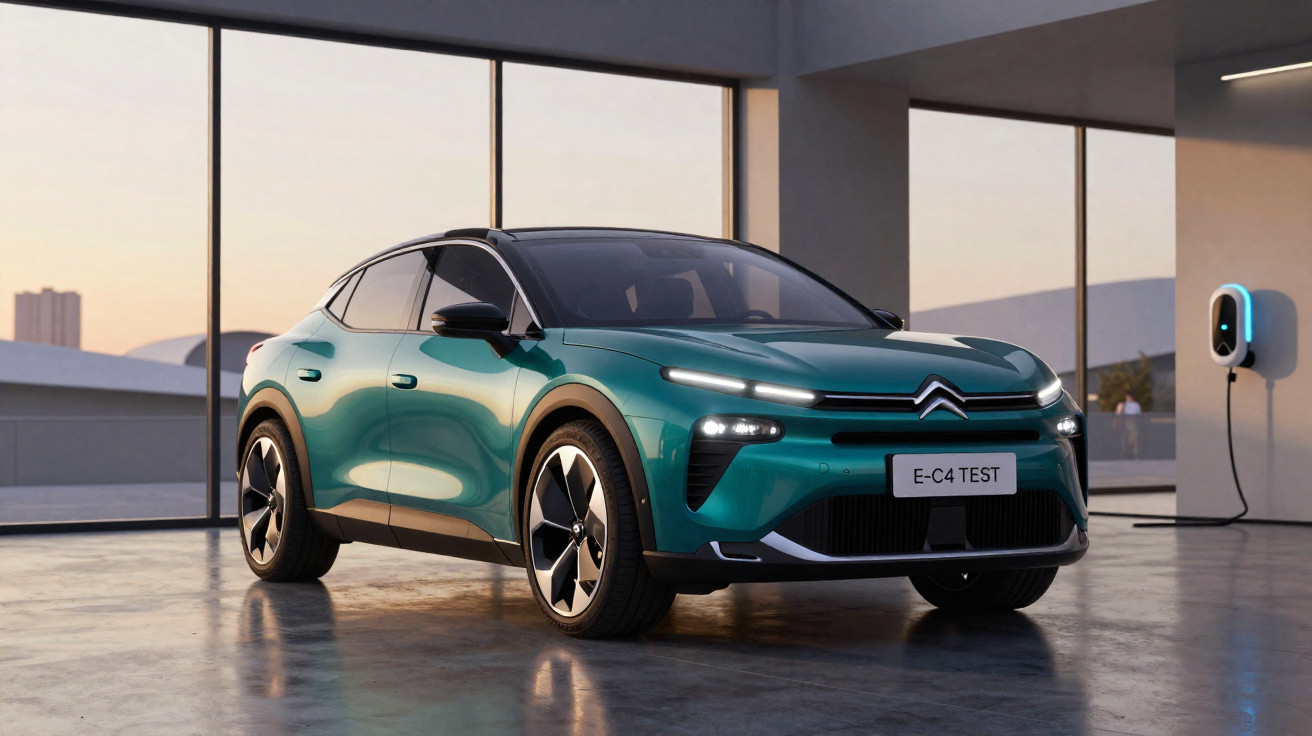
The Citroën ë-C4 sets out to be the electric alternative to the combustion-engined C4 versions and, in doing so, it also takes aim at potential rivals such as the Volkswagen ID.3 and the Hyundai Kauai EV.
With that in mind, can the ë-C4 stand out both against its in-house siblings and against those external competitors?
Time to put it to the test.
The same in (almost) every way
I’ll admit it: trying to spot styling differences between the ë-C4 and the other combustion-engined C4s - which have already been through Razão Automóvel’s garage - can be a frustrating exercise. After all, there aren’t many.
On the outside, it essentially comes down to the blue accents, the lack of exhaust outlets and, naturally, the badges. Inside, aside from dedicated menus within the infotainment system and the gearbox’s “mode B”, there’s very little to distinguish it from the combustion versions.
Space on board remains generous, the build quality is beyond criticism, and even the boot keeps the same capacity: 380 litres, which is right on the class average.
The electric drivetrain
The real separation between the ë-C4 and its “siblings” is, of course, under the bonnet. There you’ll find a 100 kW (136 hp) electric motor producing 260 Nm, powered by a 50 kWh battery.
It’s the same electric powertrain used in the Peugeot e-208/e-2008 and the Opel Corsa-e/Mokka-e - models we’ve also had the chance to test.
With its 50 kWh battery, the ë-C4 claims a 350 km range, a figure that places it squarely in the middle of the segment. But once you move from the brochure to real life, does it deliver?
As far as range is concerned, I ended up some distance from the official number, managing 280-300 km per charge in normal use. In this area, the ë-C4 would benefit from having a few additional energy-regeneration settings.
That’s because, unlike cars such as the Kauai EV (or even the Twingo Electric), Citroën’s offering relies solely on “mode B” - where regeneration is stronger - to help you stretch the range.
Even so, the drivetrain’s efficiency was a pleasant surprise: consumption averaged 18.6 kWh/100 km in town, while the overall average at the end of this test settled at 15 kWh/100 km.
When it comes to performance, 0–100 km/h takes 9.7s (it improves slightly in Sport mode). However, at 1616 kg, the weight doesn’t do the 136 hp and 260 Nm any favours, meaning the results feel merely middling.
Still, Citroën’s claims are not far off what the C4 with the 1.2 PureTech 130 hp delivers (9.4s).
All of this means you can use the ë-C4 day to day much like a “normal” car, without major worries about range - above all else.
Heavier, better dynamics?
Contrary to what you might expect, the extra mass of the battery and, in particular, its placement low in the platform - lowering the centre of gravity - ended up improving the ë-C4’s dynamic behaviour compared with the other C4s.
No, comfort hasn’t been sacrificed (thankfully), but the balance between comfort and stability comes out better. Even so, there are EVs that are more “curve-friendly” than the ë-C4, such as the Hyundai Kauai EV or the Mazda MX-30.
A matter of numbers
It’s impossible to talk about the Citroën ë-C4 without addressing price. In the Shine version tested here (one of the higher trims), the ë-C4 starts at 40 217 euros. Meanwhile, the petrol C4 with 130 hp, an automatic gearbox and the same equipment level comes in at… 29 267 euros!
What’s more, while it’s a well-rounded option among the ever-growing number of electric choices on the market, the Citroën ë-C4 falls a little short of the class benchmarks and the latest arrivals.
Among the new challengers is, for example, the Renault Mégane E-Tech EV40 - 130 hp, 40 kWh battery, 294 km of range - with prices starting at 35 850 euros, while the more affordable ë-C4 Feel begins at 37 817 euros. Even if the larger battery could, potentially, deliver a longer range.
Is it the right car for you?
Choosing between the Citroën ë-C4 and the combustion-engined C4s depends heavily on how you plan to use the car. If your regular journeys are mostly urban and suburban, the ë-C4 may be the right pick, even taking the sizeable price gap into account.
Yes, it costs more than the equivalent petrol C4, but the potential savings are significant - not only in charging costs, but also on the tax side (EVs still do not pay IUC) and even at the point of purchase, if you can benefit from incentives for buying an electric car.
Note: the interior and exterior images are official manufacturer photos and do not exactly match the tested vehicle.
Comments
No comments yet. Be the first to comment!
Leave a Comment