
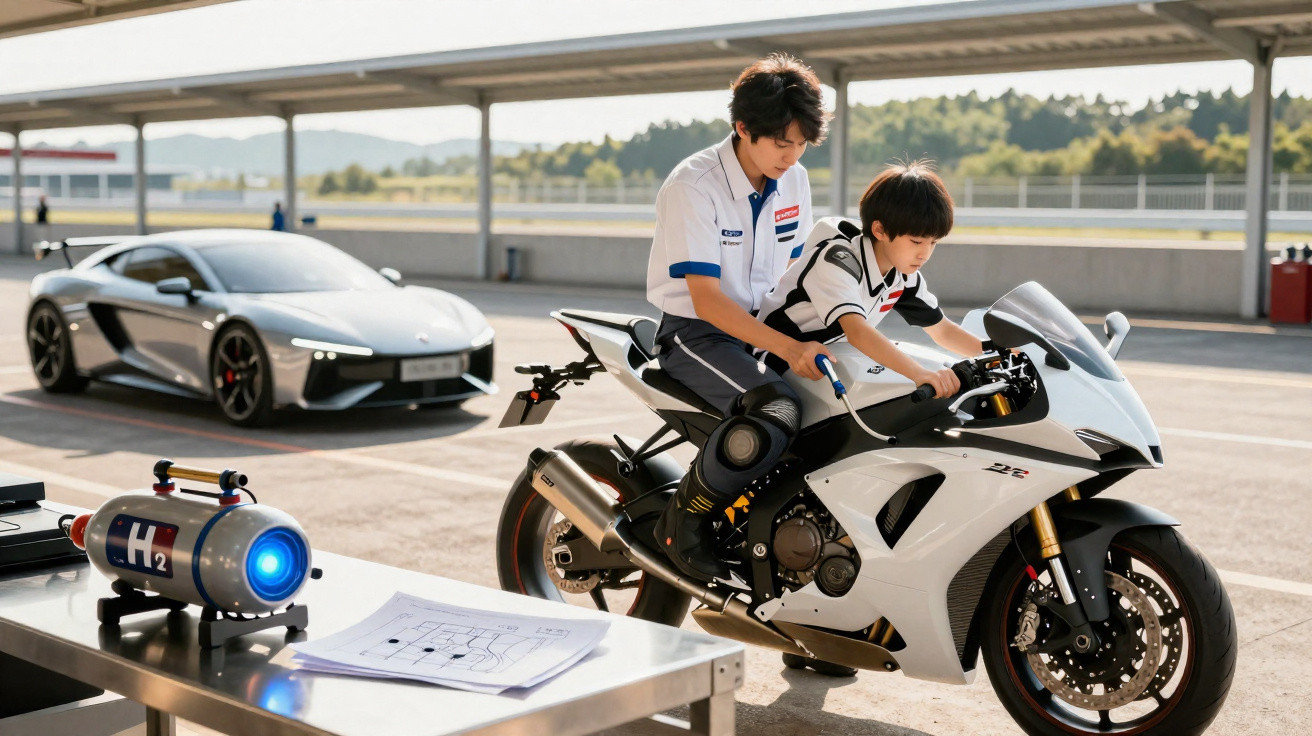
With a regulatory framework that prioritises outcomes over specific technologies - unlike what tends to happen in Europe - Japanese brands are putting money into developing alternatives that could preserve the “old” internal combustion engine.
Toyota, Subaru, Mazda, Kawasaki and Yamaha have recently announced a joint venture designed to speed up the development, production and rollout of hydrogen as a carbon-neutral alternative for combustion engines.
Electrification is the future, but…
This is not a lack of faith in electrification. Instead, it is about identifying answers for markets and real-world use cases where BEVs (battery electric vehicles) are not a viable option, while still upholding the commitment made by almost every manufacturer: achieving carbon neutrality.
By way of example, Toyota has announced an investment of 10 000 million euros up to 2025 in BEV models. This major outlay will be matched by increased development work on the two technologies that currently use hydrogen as an energy source: the fuel cell and the hydrogen-fuelled internal combustion engine - we explain the differences further on.
“These brands believe that sharing knowledge and investment could accelerate the implementation and spread of the ‘hydrogen society’.”
As a result, the hydrogen-fuelled internal combustion engine is becoming an ever more deliberate bet.
As you can see in this animation, these engines are very similar to the ones we have known for more than 100 years, traditionally running on petrol (the Otto cycle), but now adapted to use hydrogen as the fuel.
Hydrogen motorbikes? The advantages
In the motorcycle industry, this approach may be even more significant. Despite numerous announcements and pledges to transition, the biggest names in motorcycling have been slow to bring electrified alternatives to market that truly replace their traditional models.
“The energy transition in motorcycles is far behind the car sector”
The reasons are straightforward. BEV technology is not yet competitive for two-wheeled vehicles. For now, it is impossible for an electric motorcycle to match its combustion counterparts on power, handling - heavy battery packs undermine the agility these vehicles are known for - range and, just as importantly, price.
However, commitments to carbon neutrality are moving forward, as is the prospect of restrictions on vehicles with conventional engines - particularly in cities. Those pressures risk pushing the motorcycle industry into a “dead end”.
Against that backdrop, hydrogen combustion engines emerge as an alternative, promising environmentally neutral impact without the drawbacks associated with batteries (weight, cost and range).
For Kawasaki, this investment has been accompanied by the announcement that its range will be fully electrified by 2035.
That electrification will be total, but only in certain markets: the USA, Europe, Australia and Japan. Crucially, major markets are excluded, including some of the largest Asian countries and South America.
For a brand that sells around 380 000 motorcycles per year, this will be a herculean task. Hydrogen engines could help, because Kawasaki can spread the development costs of this technology across its other business units: ships, aircraft and, of course, motorcycles.
One fuel, two technologies
It is essential to separate the two technologies in which hydrogen can be used as a fuel. The best-known option is Fuel Cell technology, or, if you prefer, the fuel cell - explore it in detail.
This is a system in which hydrogen, via a module (the fuel cell), is brought into contact with oxygen. When these two elements react inside the module, an electric current is produced, which then powers the vehicle’s systems and electric motors.
In practice, it is an electric vehicle just like a BEV, except that its motors are supplied by a fuel cell (FCEV).
There is also the technology mentioned in connection with this joint venture: there is no fuel cell and no electric motors. Instead, a conventional internal combustion engine (ICE) burns hydrogen.
Its operating principle is very similar to the engines we know from traditional models, with the key advantage being the replacement of fossil-fuel combustion by hydrogen.
Hydrogen applications in the future of transport
Just like 100% electric vehicles (BEVs), fuel cell vehicles (FCEVs) also face major challenges: refuelling infrastructure and the origin of their energy. BEVs currently have an advantage here, as they are at a more mature stage.
Setting FCEV challenges to one side, there are clear benefits to this technology, particularly in transport, whether on the road or at sea.
In land transport, it could enable a move away from Diesel engines while avoiding BEV constraints: range, charging speed, battery size and weight (which reduce space for cargo).
In maritime transport, the benefits are even more tangible. Replacing ships’ enormous engines - which burn heavy fuel oil and are more polluting than millions of cars on the road - with Fuel Cell units would be a major step forward in tackling air pollution.
The motorsport of the future
Top-tier motorsport categories, such as Formula 1 and MotoGP - where our Miguel Oliveira competes - have already stated that they intend to achieve carbon neutrality.
Alongside hydrogen, synthetic fuels can also be considered in this process. One brand investing heavily in this route is Porsche.
As we can anticipate, these technologies could deliver what matters most: protecting the environment while maintaining the competitiveness and spectacle that motorsport has always offered us. Is there a future for motor racing?

Comments
No comments yet. Be the first to comment!
Leave a Comment