
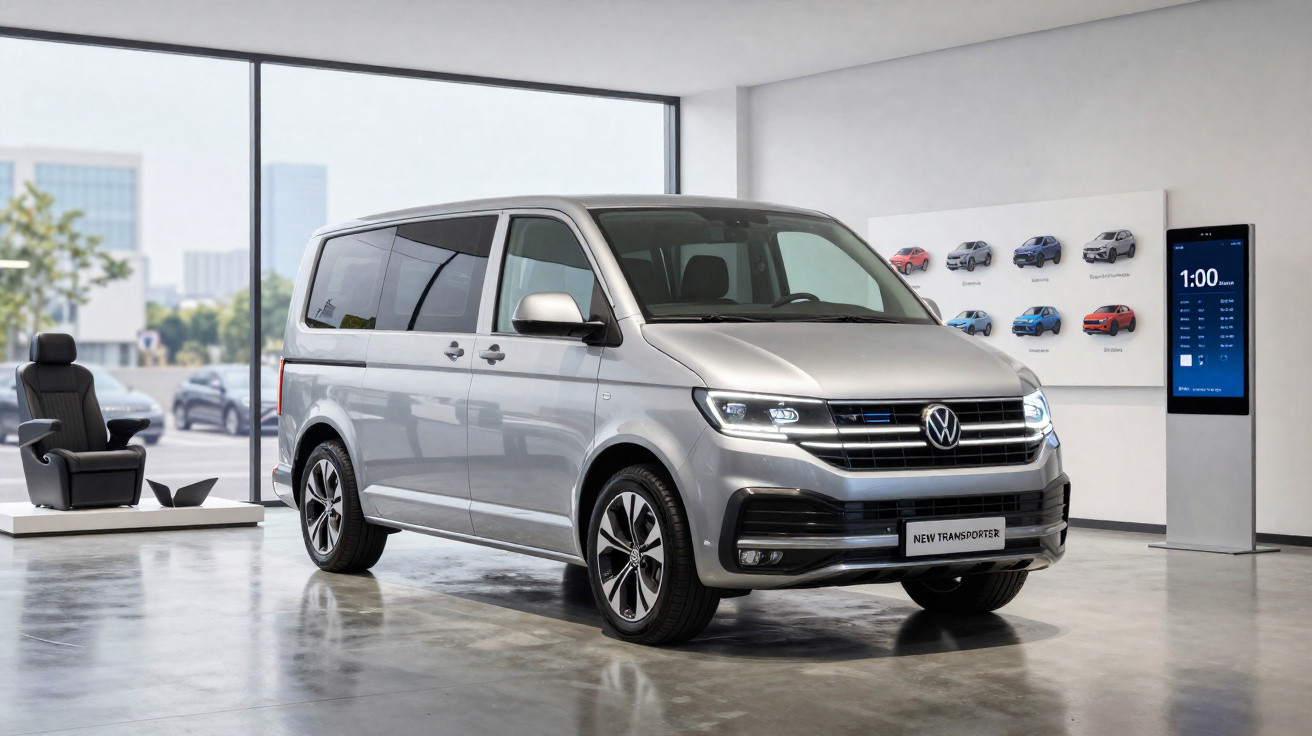
The Volkswagen Transporter may be “just” a van, yet it carries an extraordinary weight of heritage. Go back far enough and you arrive at the celebrated, iconic Type 2 - better known to many as the “Bread Loaf”.
That legacy matters even more because the Transporter is also the sales leader in its segment, so the arrival of a new generation is always a notable event.
Against that backdrop, Volkswagen’s decision to join forces with Ford in developing the seventh-generation Transporter may seem unexpected. In effect, the long-time rivals - Transporter and Transit (Custom) - have now become close relatives.
Versions and powertrains for every need
The new Transporter shares almost everything with the Ford Transit Custom - the platform, the body structure and the engine line-up - with the clearest visual difference being the front end.
This kind of approach is nothing new: manufacturers have been sharing light commercial vehicles for decades. Even so, in this particular class Volkswagen and Ford have, until now, largely gone their own way.
By mirroring the Transit Custom so closely, the Volkswagen Transporter is able to offer a broad spread of powertrains too: Diesel, plug-in hybrid and fully electric. That also means it sits alongside the ID. Buzz Cargo in Volkswagen’s electric van range.
The plug-in hybrid Transporter is due in the first quarter of 2026, and its electric-only range is expected to be up to 60 km (WLTP). For Ford’s equivalents, up to 56 km (WLTP) is quoted.
Volkswagen is also planning an all-wheel-drive electric version, plus a lower-output electric option with a smaller battery. Those variants are also scheduled to arrive in the first quarter of 2026.
A variety of bodystyles will be offered: Cargo (panel van) with up to 3 seats (optional); CrewVan, designed for mixed passenger-and-load duties, with up to 6 seats; and a double-cab chassis.
Then there is the Caravelle passenger carrier, seating up to nine, which can be configured for roles such as a shuttle service or a high-capacity taxi.
There are also two wheelbases - standard and long (+400 mm). Whichever version you choose, it is larger than the outgoing generation (T6.1).
The standard model has grown by 146 mm to 5.05 m overall, while the wheelbase itself increases by 97 mm to 3.1 m. Width is now 2.032 m, which is 128 mm wider than the T6.1.
In a van, the key question is payload and capacity. The standard-length Transporter offers 5.8 m³ of load volume, rising to 9.9 m³ with the long body and high roof.
Depending on specification, maximum payload reaches up to 1.33 tonnes, while towing capacity can be up to 2.8 tonnes - an increase of 300 kg versus before.
First impressions
In Athens, Greece, we drove three versions: the e-Caravelle (210 kW or 286 hp), the e-Transporter (160 kW or 218 hp) and the Transporter Cargo (2.0 TDI, 125 kW or 170 hp).
Modern commercial vehicles are a world away from the rough-and-ready vans of the past, and the Transporter’s first on-road takeaway is how easy it is to drive.
Despite their generous dimensions - in both standard and long forms - all three feel closer to a light passenger car than you might expect.
Light steering, paired with a tight turning circle - 11.9 m for the standard model and 13 m for the long-wheelbase version - makes even awkward, confined manoeuvres straightforward.
Cabin space is another strong point. Whichever variant you choose, the interior packaging is excellent, including in the three-across front-seat configuration: there is more than enough room for everyone.
The low noise levels in the electric versions particularly stand out, reflecting solid build quality and very effective sound insulation.
As with many EVs, the instant torque delivery makes progress smooth and effortless.
That said, the Diesel engine matched with the automatic gearbox should not be overlooked - it proved consistently responsive and even enjoyable, even if it cannot match the electric models for refinement and immediacy.
When will it arrive?
The Volkswagen Transporter and Caravelle are already on sale in Portugal with Diesel and electric powertrains. The new Transporter starts from €30,800 (+ VAT), while the new Caravelle starts from €43,000 (+ VAT).
First customer deliveries are expected from March. The plug-in hybrid powertrain is due to launch in the first quarter of 2026.
In Portugal, the Transporter will be offered only in base trim, whereas the Caravelle will be available in Base, Life and Style versions.
Comments
No comments yet. Be the first to comment!
Leave a Comment