
For anyone who loves the sound and feel of mechanical music-like those who have taken refuge in this video-there is good news and bad news. Let’s start with the good.
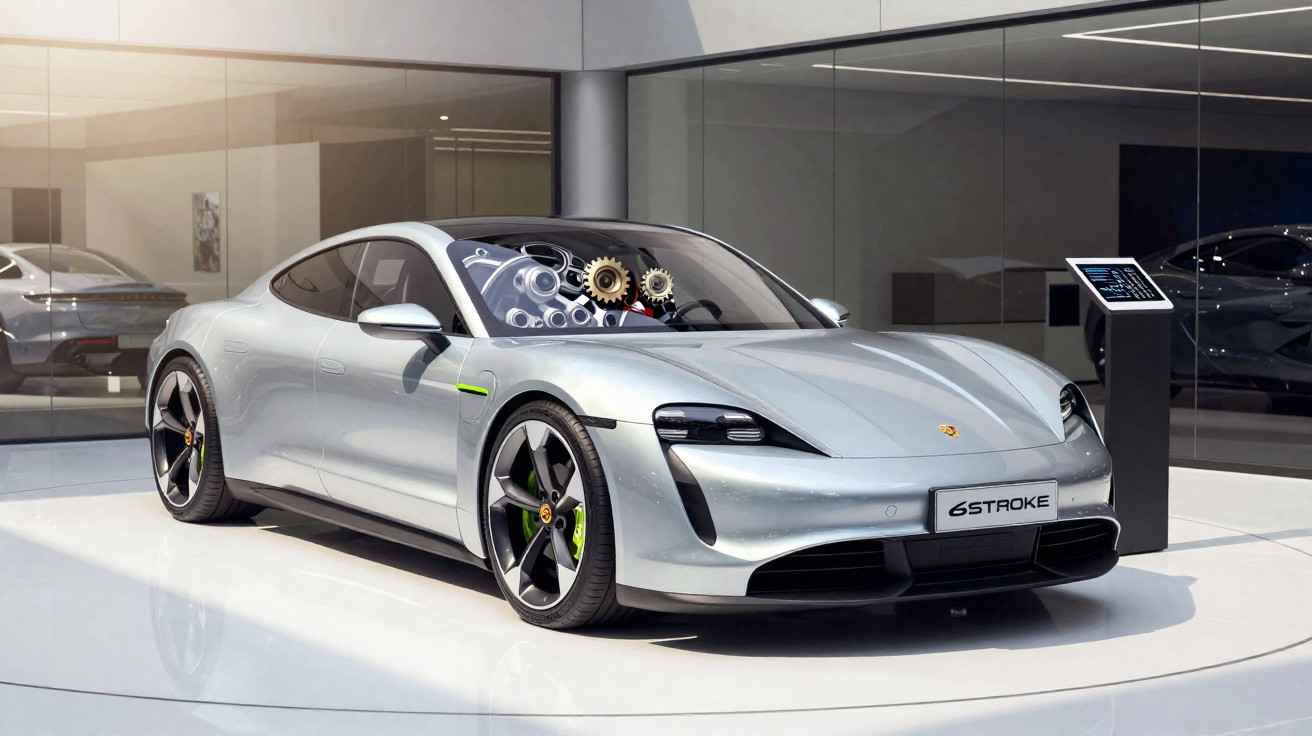
Behind the scenes at Porsche, work on combustion engines has not stopped. The German marque has just patented what it describes as the world’s first six-stroke engine.
The patent application was filed on 23 February 2024 under number 18/585 308, but it has only now been made public by the U.S. Patent and Trademark Office. You can read the document in full on the website.
Why Porsche is betting on combustion engines again
Porsche’s move matters on three separate levels: technical, economic and political. Technically, it shows the company’s engineers believe there is still more performance and efficiency to extract from this mature technology. Economically and politically, it also signals that there is a longer-term plan for these engines-otherwise it would be difficult to justify allocating resources to develop them.
How does a six-stroke engine work?
We will leave the bad news until the end. First, it is worth taking a closer look at the idea and the reasons Porsche has pursued a six-stroke engine-starting with the basics.
As you know, modern cars are fitted with four-stroke engines. In other words, to complete a full combustion (work) cycle they go through four phases (strokes): intake, compression, combustion/expansion and exhaust. It has been that way for more than 130 years.
During intake, the air–fuel mixture enters the combustion chamber. During compression, that mixture is squeezed to extract the best return from the third phase: expansion (created by ignition and the resulting combustion of the air–fuel charge).
This expansion phase is where the engine generates the push (work) that keeps it turning. Finally comes exhaust, where gases are expelled from the combustion chamber so fresh charge can enter and the cycle can repeat-thousands of times per minute.
Put another way, in today’s four-stroke combustion engines, only one stroke (expansion) produces work. That means that over what are ~~four~~ two full crankshaft revolutions, only one delivers driving force to the wheels.
Doubling compression and expansion within the cycle
This is precisely where Porsche’s engineers decided to rethink the formula. The six-stroke engine duplicates the compression and expansion phases, which also increases the number of work-producing phases per cycle. In practical terms, the combustion process can be viewed as two three-stroke sequences: intake, compression and expansion; then compression, expansion and exhaust.
So how did Porsche achieve this? In the filed patent, the connecting rod is not attached directly to the crankshaft.
Instead, Porsche’s engineers explain that by linking the connecting rod to a secondary gear, they introduce an additional compression-and-expansion movement into the engine’s normal sequence-taking it from four strokes to six in total.
"Thanks to this gear, there are two more compression and expansion strokes before the exhaust phase."
In theory, this change could deliver a meaningful improvement in output and efficiency compared with the combustion engines we know today.
What the extra strokes can-and cannot-deliver
Even so, adding two strokes does not mean the engine’s performance would simply double. The second compression and expansion phase would be less intense than the first. The compression ratio is expected to be lower (because of the geometry of the motion) and because exhaust gases from the initial combustion event would still be present.
That said, there may be significant gains in emissions, thanks to a more thorough burn of the mixture. For now, only Porsche’s engineers can give firm answers.
Now for the bad news…
Whenever combustion-engine enthusiasts hear about a new concept, it is tempting to open a bottle of champagne. More performance and better efficiency are always reasons to celebrate.
But the gap between announcements and real-world production can be huge-and sometimes the party is delayed or never happens at all. One example is variable compression ratio technology: despite many patents and prototypes, it took almost a century before it appeared in a mass-produced model.
In 2016, Nissan unveiled the first variable compression ratio engine, and it was fitted for the first time to the Infiniti QX50 in 2017. It is still produced today and powers several models from Nissan’s premium division. As you can see, the distance between promises and reality can be enormous.
Will Porsche’s six-stroke engine technology end up with a similar fate? Only time can answer that.
What is certain, however, is that combustion-engine development continues-from mainstream manufacturers to the most exclusive brands.
There are plenty of examples, and they do not mean the end of belief in electric vehicles, nor do they mean combustion engines are no longer useful.
Contrary to what some sectors might prefer, the car market still seems to be heading towards a future in which the mobility needs of millions of people will not be solved by a single approach. The answer is plural, and it is becoming more effective. The planet benefits.
Source: USPTO

Comments
No comments yet. Be the first to comment!
Leave a Comment