
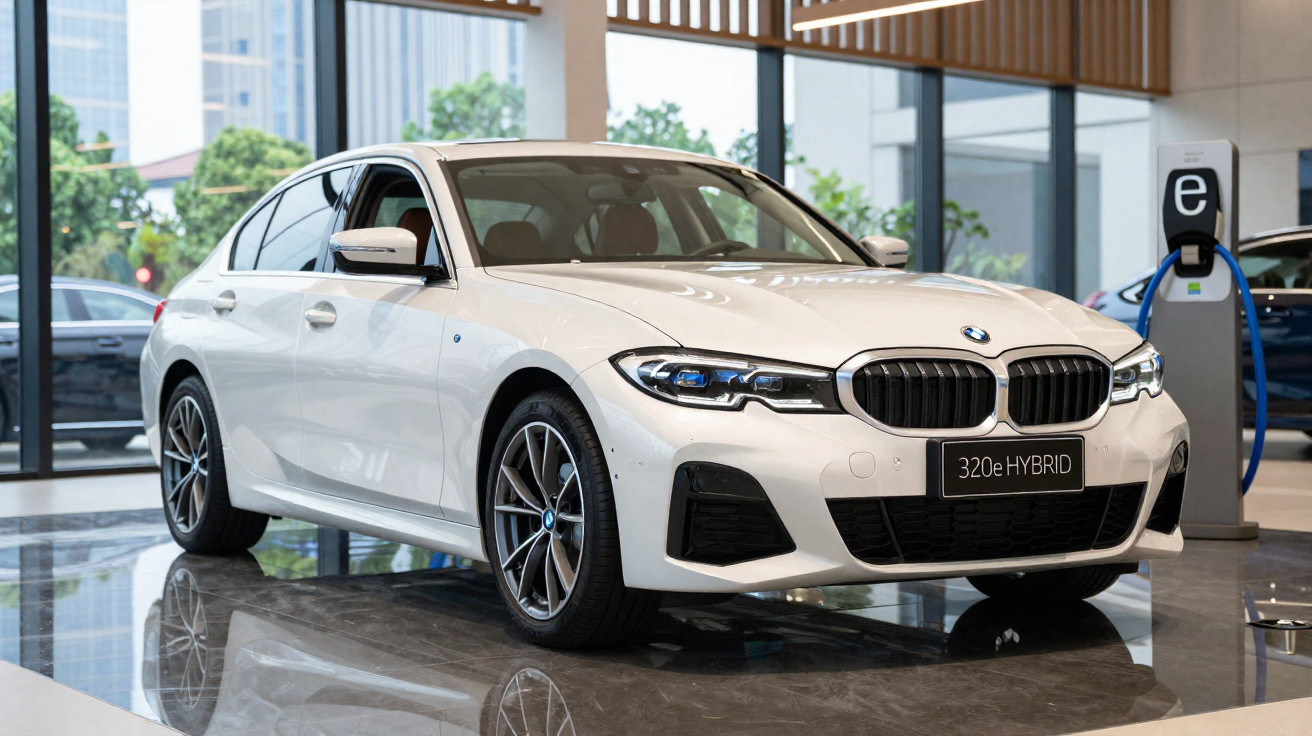
BMW has introduced a new entry-level plug-in hybrid version of the 3 Series, the 320e, which sits alongside the already familiar - and more powerful - 330e. With a starting price broadly in line with the equivalent Diesel model, the 320d, this 320e looks like it has “everything it needs to go right”.
Considering the 330e costs almost €5,000 more yet has carved out a compelling place within the 3 Series range, this newcomer - which even uses the same 2.0-litre turbocharged petrol engine - arrives with enough going for it to be “taken very seriously”.
On paper, the strengths of this new 3 Series plug-in hybrid seem more than enough to win us over. But does it also deliver what it promises out on the road? That’s exactly what I’m going to answer in the lines below…
Hybrid drivetrain with 204 hp
Powering the BMW 320e is the same 2.0-litre, four-cylinder petrol engine that underpins the 330e, although here it’s tuned to “just” 163 hp.
Working alongside the combustion engine is a 113 hp electric motor, bringing total combined output to 204 hp and 350 Nm.
With all torque sent to the rear axle, the BMW 320e needs only 7.6s to sprint from 0 to 100 km/h and goes on to a top speed of 225 km/h.
Thanks to a 12 kW battery located beneath the rear seats, it’s possible to cover around 55 km in 100% electric mode, while total driving range is approximately 550 km.
Three driving modes available
Three driving modes are available (Sport, Hybrid and Electric). Battery management can be handled in two different ways: you can preserve charge to use later, or you can have the petrol engine actively recharge the battery.
Select Sport and the steering gains weight, while throttle response and the gearbox become a touch more immediate. In real-world driving, the transmission holds onto gears longer before upshifting and downshifts more readily.
This is the mode best suited to making the most of the car’s dynamic potential, and the 320e consistently runs both motors together to deliver the maximum power on offer.
In Hybrid, provided there’s enough charge in the battery, you can drive using only the electric motor. Even so, the system’s electronic management will generally call the petrol engine into action at around 100 km/h.
That changeover is almost always smooth, but when the combustion engine starts, there’s a noticeable rise in cabin noise - even though the interior is very well insulated and retains the refinement we’ve come to expect from Munich’s brand.
Finally, in Electric mode the petrol engine stays off, leaving the electric motor to provide the 320e’s drive. The smoothness is impressive.
Capped at 140 km/h, this mode is best suited to town use and, naturally, is not particularly advisable for dual carriageways or motorways, where the battery drains very quickly.
On top of the possibility of deducting the full amount of VAT (up to a maximum of €50,000, excluding VAT), there’s also the reduced rate of autonomous taxation on car-related expenses, which drops by half.
For instance, if a BMW 320d is taxed at a rate of 35%, the 320e plug-in hybrid comes in at just 17.5%.
Is it the right car for you?
Taking all of this into account, it’s hard to ignore the BMW 320e as a company-car proposition. But is the decision equally straightforward for private buyers? The answer is simple: no. And here’s why…
For private owners - without the discounts and advantages available to businesses - the purchase price of this 320e ends up being almost the same as the equivalent Diesel model, the 320d. In that scenario, the choice should be guided by running costs, which will depend on each person’s needs.
With a plug-in hybrid, the lower day-to-day costs are only really assured if you can charge at home and if your driving is mainly urban or, at most, mixed.
If you don’t have somewhere to charge every day and you cover a lot of kilometres daily, it may still make sense to keep looking at the 320d. It already features 48V mild-hybrid technology and can completely deactivate its four-cylinder engine up to 160 km/h, enabling very impressive consumption.
Comments
No comments yet. Be the first to comment!
Leave a Comment