
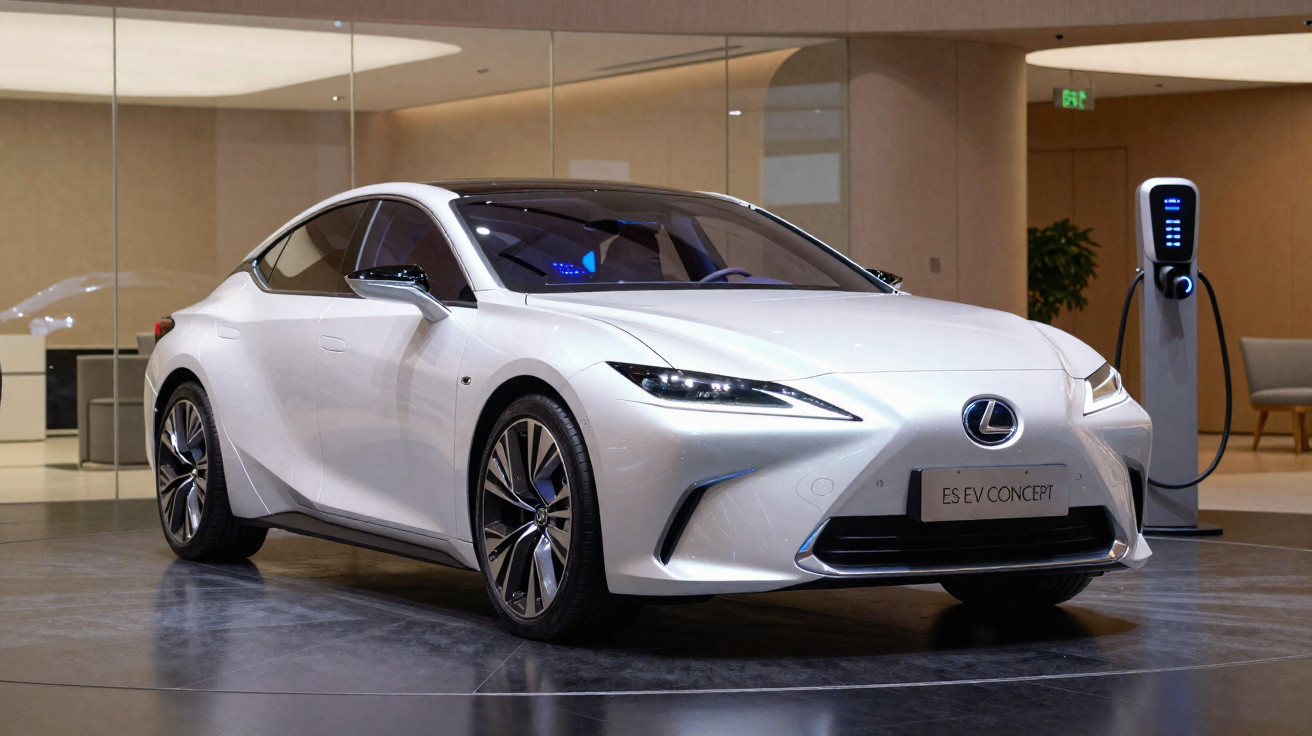
For many years, talking about electrification at Lexus was almost the same as talking about hybrids. The Japanese brand built much of its European identity around this technology, while BMW, Mercedes-Benz and Audi moved faster towards fully electric cars.
That gap is now beginning to narrow. Lexus is not about to drop hybrids, which still make up most of its line-up, but it is preparing to give electric models a far more prominent role.
The clearest early sign is the new ES. For the first time in nearly four decades of history, the saloon will be offered with 100% electric powertrains, meaning the RZ will no longer be the brand’s only option in this area, following the end of the electric UX at the end of 2025.
The ES takes on a new role
Unveiled at the 2025 Shanghai Motor Show, the eighth-generation ES is now starting to arrive in the European market. As well as replacing the current model, it positions itself as one of the central pillars of Lexus’s renewed electric strategy.
For the first time, the range includes two electric versions. The ES 350e uses a front-mounted motor producing 224 hp with front-wheel drive. Above it sits the ES 500e, with two motors, DIRECT4 all-wheel drive and 343 hp.
For buyers who are not yet ready to give up an internal combustion engine, a hybrid alternative will remain. In Portugal, the ES 350h pairs a 2.5-litre petrol engine with an electric system, for a combined output of 247 hp.
The RZ is no longer on its own
The RZ was the first model developed from the ground up to embody Lexus’s electric strategy. Its update brought more power, longer range, quicker charging and new technologies, including electronic steering with no conventional mechanical link between the steering wheel and the wheels (steer-by-wire).
With the arrival of the electric ES, Lexus now covers two distinct segments: a family SUV and an executive saloon. It is still a limited offering compared with the main German rivals, but it marks a meaningful shift for a brand that, until recently, relied almost entirely on hybrids.
More electric models, but not at any price
Even so, accelerating electrification does not mean every project goes ahead. The LF-ZC, the concept that previewed a next-generation electric saloon and Lexus’s next technological phase, has been cancelled.
It was a pragmatic call. The manufacturer chose to focus resources on models with stronger global demand potential, especially SUVs, at a time when premium and luxury saloons continue to lose relevance.
The message is telling: Lexus wants to increase the share of electric cars, but it does not intend to do so simply to meet a timetable. The transition will continue model by model, and only where the brand believes there are customers.
Comments
No comments yet. Be the first to comment!
Leave a Comment