
The compact car segment keeps expanding. There are more choices than ever and they no longer stop at combustion engines: hybrids and electric models are steadily gaining ground in one of the most hotly contested parts of the European market - just look at sales over the last three months.
Even so, the main names have barely changed over the past few decades. The Renault Clio, Peugeot 208, Dacia Sandero and Volkswagen Polo have largely been the ones shaping the story. Among EVs, some of those familiar badges return and others join them too, such as the Renault 5 and, in future, the Volkswagen ID. Polo.
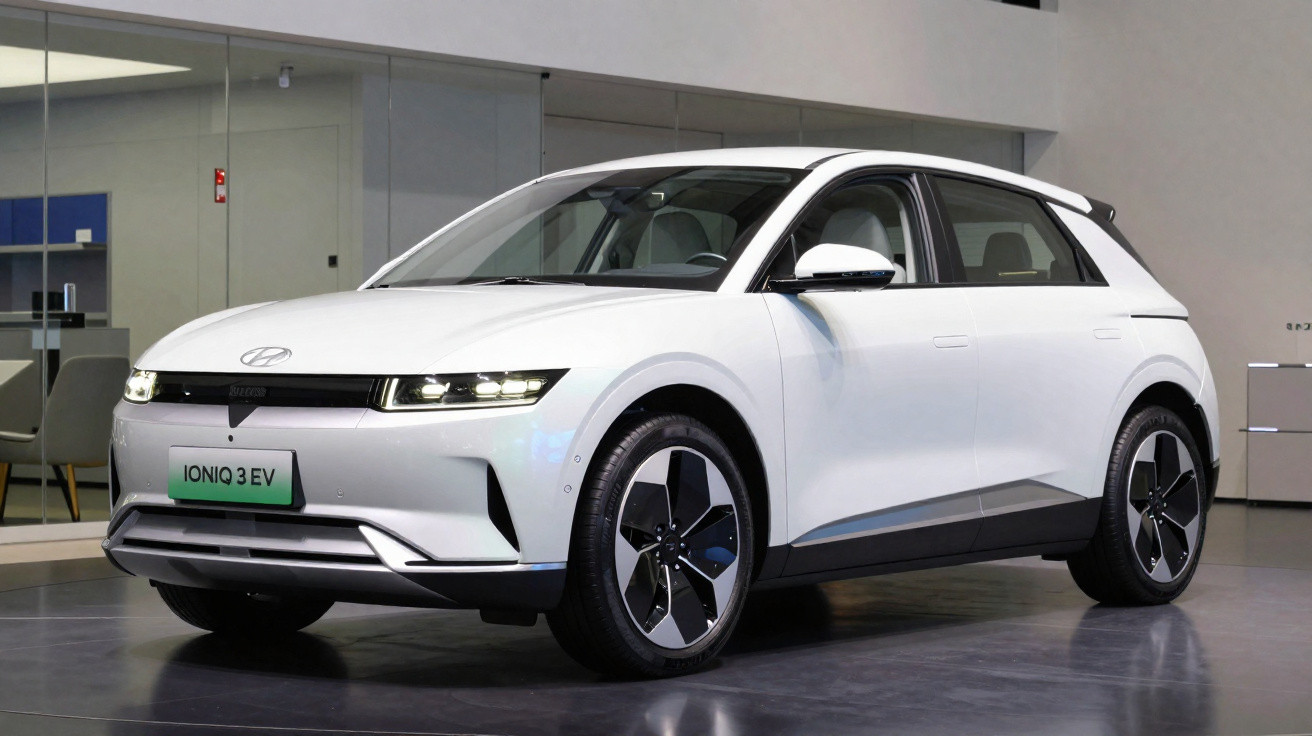
Hyundai wants to disrupt that status quo by continuing to broaden its line-up and doubling down on electric cars with a new arrival. It’s called the Hyundai IONIQ 3, it’s a 100% electric hatchback, and we’ve already been to see it.
It looks like an IONIQ 3 N, but it isn’t
As I mentioned in the featured video, this car’s visual presence can be misleading. It looks like a smaller “brother” to the IONIQ 5 N, but it’s not. Rather than putting performance front and centre, the new IONIQ 3 adopts Hyundai’s fresh “Art of Steel” design language, inspired by the purity of steel and the sharp creases associated with the material.
And because we were alongside an N-Line version, the styling is turned up a notch: more pronounced bumpers are paired with 19″ alloys and a rear diffuser that stands out more than you’d typically expect in this sort of offering.
At the back, there’s also a prominent spoiler. That’s not exclusive to this trim - it will be shared across the range. The goal is to cut aerodynamic drag and help extend electric range, which is one of this model’s headline strengths. More on that below.
Plenty of storage spaces
Hyundai designed the IONIQ 3’s cabin to feel more like a lounge, with multiple storage areas and an overall layout that aims to be intuitive - an approach the brand had already explored with the IONIQ 5.
A clear example is what Hyundai calls the Megabox: an additional 119-litre compartment under the boot floor, intended to take items as bulky as a suitcase. All told, the IONIQ 3 claims up to 441 litres of boot space, putting it among the roomiest options in its class.
Best range in the segment
Under the bodywork, the key talking point isn’t the platform - it’s the familiar Hyundai Group E-GMP architecture, used here with a 400 V electrical system. Instead, attention falls on the Long Range model’s range, which may well be the best in the segment.
With a 61 kWh battery, the new Hyundai IONIQ 3 is quoted at more than 490 km between charges.
Stacked against direct rivals, it becomes clearer why this could be one of the longest-range EVs in the class. Take the CUPRA Raval and the Renault 5 E-Tech, for instance: their largest batteries are 52 kWh and they quote up to 450 km and 416 km of range, respectively. That said, the Renault 5 is preparing to receive a version with a larger battery.
Back to “our” Hyundai: the Standard Range uses a smaller 42.2 kWh battery, yet it still promises up to 335 km of range.
Power outputs don’t exactly excite: the IONIQ 3 Standard Range is rated at 107.8 kW (147 hp), while the Long Range drops to 99.5 kW (135 hp). Regardless, torque is the same in both cases, at 250 Nm.
When it arrives in Portugal
Hyundai has not yet announced a launch date for the new IONIQ 3, nor confirmed when it will reach the various European markets. Pricing is also still under wraps, but it’s expected that the most affordable version will come in below €30,000, in line with other budget-friendly electric cars now “landing” across the European market.
Comments
No comments yet. Be the first to comment!
Leave a Comment