
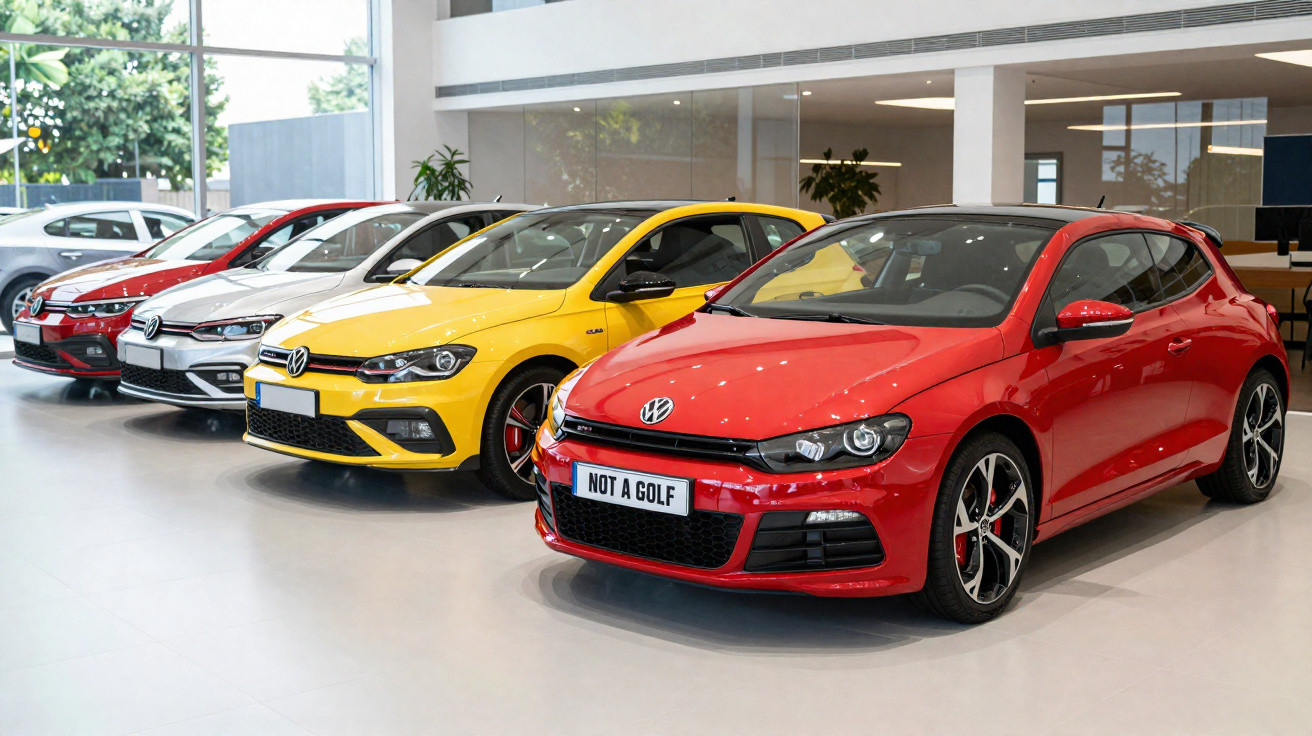
Talking about the GTI badge almost inevitably brings the Volkswagen Golf GTI to mind. After all, in 1976 it effectively set the template for what we now call the hot hatch: a practical small family car with performance that, up to that point, had largely been the preserve of more overtly sporting-and more expensive-machines.
As shorthand for Gran Turismo Injection (the exact wording can vary by language), it fused an acronym already associated with performance (GT) with an “i” that highlighted the adoption of electronic fuel injection at a time when most engines still relied on a carburettor. Before long, the letters outgrew their original technical meaning and came to stand for far more than a particular fuelling system.
In the years that followed, GTI helped define an entire class of cars and even appeared on sporting models from other manufacturers. Even so, the strongest and most familiar link remains the Golf in particular, and Volkswagen more broadly. It is hardly surprising that, for many people, “Golf” and “GTI” are effectively interchangeable.
Still, the impact of the first Golf GTI-one we have already driven-encouraged Volkswagen to apply the badge elsewhere. Some of those models are well known; others have slipped from memory. What follows is a look at the GTIs that were not the Golf.
Scirocco GTI (1976)
The Scirocco GTI was among the earliest Volkswagens to wear the designation, arriving virtually alongside the Golf. Its calling card was the three-door coupé body, yet underneath it was identical in all the ways that mattered.
It shared the same platform and the 1.6-litre engine producing 110 hp and 140 Nm of torque. Even so, it never achieved the Golf’s status, although it did go on to gain a second generation with the same engine. Later, it adopted the 1.8-litre, 139 hp unit from the second-generation Golf GTI. In some markets, it was marketed as the Scirocco GTX.
Polo GTI
Where the Scirocco gained the GTI badge immediately after the Golf, the Polo had to wait. Volkswagen’s supermini only received the GTI designation for the first time towards the end of the 1990s. Before that, the Polo’s sporting slot was filled by the legendary, popular-and at times infamous-Polo G40.
From that point on, the Polo GTI became a regular fixture in what many consider one of the most entertaining categories of car to drive: the pocket-rockets. The thinking is essentially the same as the hot hatch idea, just scaled down-the Mini Cooper S (1963) is often cited as the car that launched this category, even earlier than the hot hatch.
In the gallery below, you can see every generation of the Volkswagen Polo GTI:
Volkswagen Lupo GTI
The first Polo GTI (1998) soon faced serious competition from within Volkswagen itself: in 2000, the brand introduced the Lupo GTI.
It used the same 1.6-litre engine with 125 hp, but the car was shorter, several dozen kilograms lighter (975 kg)-which translated into 0.5s less in the 0 to 100 km/h sprint while matching a 205 km/h top speed-and it was, simply, more fun to drive.
Little wonder it was hailed as the enthusiasts’ choice and the true successor to the original… Golf GTI.
Volkswagen up! GTI
Decades after the Lupo, Volkswagen applied the same philosophy to its successor. Unveiled in 2017, the Volkswagen up! GTI revived the idea of a light, straightforward, enjoyable-to-drive pocket-rocket-a kind of modern tribute to the original concept behind the first Golf GTI.
With a 1.0 TSI engine producing 115 hp and a kerb weight only just over a tonne, the up! GTI claimed 8.8s from 0 to 100 km/h and a 196 km/h top speed. When it arrived in Portugal, the team at Automotive Reason drove it at the Palmela Kart Circuit, a layout well suited to its compact footprint-an experience worth revisiting.
There are more GTIs that weren’t the Golf
The Volkswagen GTIs above made it to our market, but they were not the only ones. Between prototypes and models sold in other parts of the world, the GTI badge ended up being carried by additional vehicles.
One of the most intriguing examples is the Volkswagen Passat GTI prototype (first generation), created to test whether the Golf GTI formula could be transplanted into a larger estate car. In the end, the German brand chose not to proceed, having concluded there was no viable business case for a Passat GTI.
Returning to production cars, other Volkswagens wore the GTI badge outside Europe. Perhaps the best known is Brazil’s Gol GTI-Gol, not Golf.
Launched in 1988, it differed from the Golf by using a 2.0-litre, 120 hp engine mounted longitudinally rather than transversely, while retaining front-wheel drive. It went through two generations and multiple versions, with the most powerful reaching 153 hp. Like the Golf GTI, it is also an icon for the brand on Brazilian soil.
Staying in Brazil, the Volkswagen Pointer GTI was probably one of the most unexpected interpretations of the badge. Sold in some Latin American markets during the 1990s, it came from an industrial partnership between Volkswagen and Ford (Autolatina) and was essentially a facelifted fifth-generation Ford Escort made to resemble a Volkswagen. It used a 2.0-litre engine with around 115 hp.
Finally, there is the North American Jetta GLI, which inherits almost everything from the Golf GTI except the letters on the boot lid. Across several generations-from the 1980s to the present day-the Jetta GLI has received the same chassis and suspension upgrades, along with similar powertrains (some tailored to the US market). In essence, it is a three-box Golf GTI.
Comments
No comments yet. Be the first to comment!
Leave a Comment