
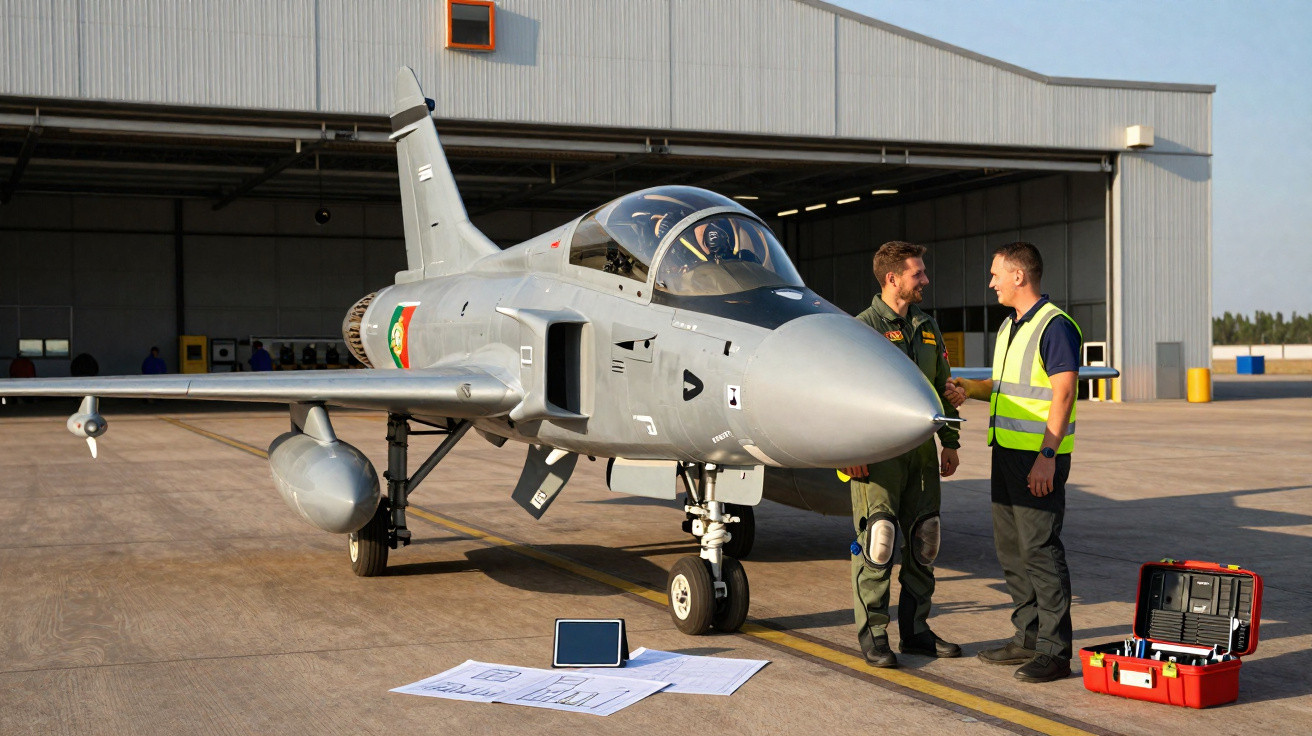
As the Portuguese Air Force weighs up candidates to replace its current F-16 fighter fleet, Sweden’s Saab is working to position-and accelerate-the Gripen E offer by putting forward a local-production package centred on cooperation with Portugal’s OGMA.
Saab, OGMA and local Gripen E production for the Portuguese Air Force
According to reporting in Portuguese media, the two companies have already signed a Memorandum of Understanding aimed at sketching out an arrangement similar to the one previously agreed with Embraer (which is OGMA’s majority shareholder) for the fighter selected by the Brazilian Air Force. If carried through, the approach would allow Lisbon to bring a broad network of domestic industrial players into the programme.
Although no formal procurement process has yet begun, Saab executives have publicly argued that the Gripen E would be an “excellent product” for equipping the Portuguese Air Force. They also stress that the service is already familiar with Saab’s reliability because it operates other Saab-made systems.
One of those executives, Gripen business vice-president Daniel Boestad, said that while Lisbon still needs to take a final decision, Saab is prepared to enable national production of the aircraft. In his words: “OGMA has great potential to produce the Gripen”.
Boestad also defended the aircraft’s broader strengths as a potential Portuguese fighter, emphasising adaptability as much as classic performance. As he put it: “It’s a completely different aircraft, one of the most important and modern. I’m not just referring to flying fast or manoeuvring quickly, but to the ability to adopt new technologies (…) The speed of change, the speed of adaptation, is fundamental for the future. That was the main factor when designing this aircraft. We designed the Gripen’s computer systems in a completely different way from other aircraft so we can make these changes very quickly.”
From Saab’s perspective, that argument is particularly relevant when setting the Gripen E against US competitors-most notably the stealthy F-35. The executive’s claim is that there is a basic distinction: the customer could specify what software it wants to add to the fighter and, within a very short period, engineers could make the necessary changes so that capabilities are available in days rather than months or years.
Potential numbers, configurations and indicative costs
So far, however, it remains unclear how many fighters the Portuguese Air Force would ultimately buy, or which weapons and integrated systems would be included. For that reason, Boestad said it would be impossible at this stage to state what Portugal would need to invest if it chose the Gripen E-though he pointed to Thailand and Brazil as reference cases.
In Thailand’s case, the purchase of four aircraft was confirmed in August 2025 for around €495 million. In Brazil’s case, 36 aircraft were acquired for approximately €3.87 billion.
The F-35 bid as an alternative
Alongside Saab’s efforts to sell the Gripen E as Portugal’s future fighter, it is worth noting that Lockheed Martin has also been promoting the F-35, backed by strong support from Washington to press Lisbon once a decision is due.
As previously noted, introducing that platform would be seen positively by some because it would align Portuguese capabilities with a large share of European countries that have selected the F-35 for their future fighter fleets. That, in turn, could improve interoperability and smooth potential future pathways towards acquiring a sixth-generation aircraft.
Even so, the US stealth fighter also faces several hurdles that Portuguese military authorities have already highlighted-some of them extending beyond purely technical and economic considerations. As we reported last December, General Cartaxo Alves, Chief of Staff of the Portuguese Air Force, said in an interview that delivery timelines would be long if the F-35 were chosen. He also stated that the costs associated with purchasing and operating it would be significantly higher than those of the Swedish contender.
That would inevitably affect how many aircraft could be procured and the roles they would play later on, narrowing the service’s ability to fulfil its missions. In the same interview, General Alves did not confirm how many aircraft would be bought, but he referenced a range of 14 to 28 units which, by his estimates, would require an investment of between €3 billion and €4.8 billion-still below the €5 billion the government was prepared to allocate for this purpose.
A third competitor: the Eurofighter Typhoon
Beyond the high-profile Gripen and F-35 candidacies, Portugal is also looking at a third option: the Eurofighter Typhoon, marketed by Airbus.
At the end of October last year, the company announced that a Memorandum of Understanding had been signed with the Portuguese Aeronautics, Space and Defence Industries Cluster (AED Cluster Portugal). The stated aim was to move forward with its own proposal, signalling that it was ready to begin the studies required to set out a plan that would also include Portuguese companies in aircraft production.
At the time, the Eurofighter consortium was seeking to build on the momentum created by Germany’s acquisition of 20 additional aircraft, along with the jets included in Spain’s Halcón I and Halcón II programmes-covering the variants known as Tranche 4 and 5. In addition, a new export sale had been completed outside the core group of European countries that took part in developing the aircraft, with the United Kingdom selling 20 units to Turkey following Prime Minister Keir Starmer’s visit to Ankara.
Images used for illustrative purposes.
You may also be interested in: The Portuguese Air Force began operations with its new A-29N Super Tucano after completing pilot training in Brazil

Comments
No comments yet. Be the first to comment!
Leave a Comment