
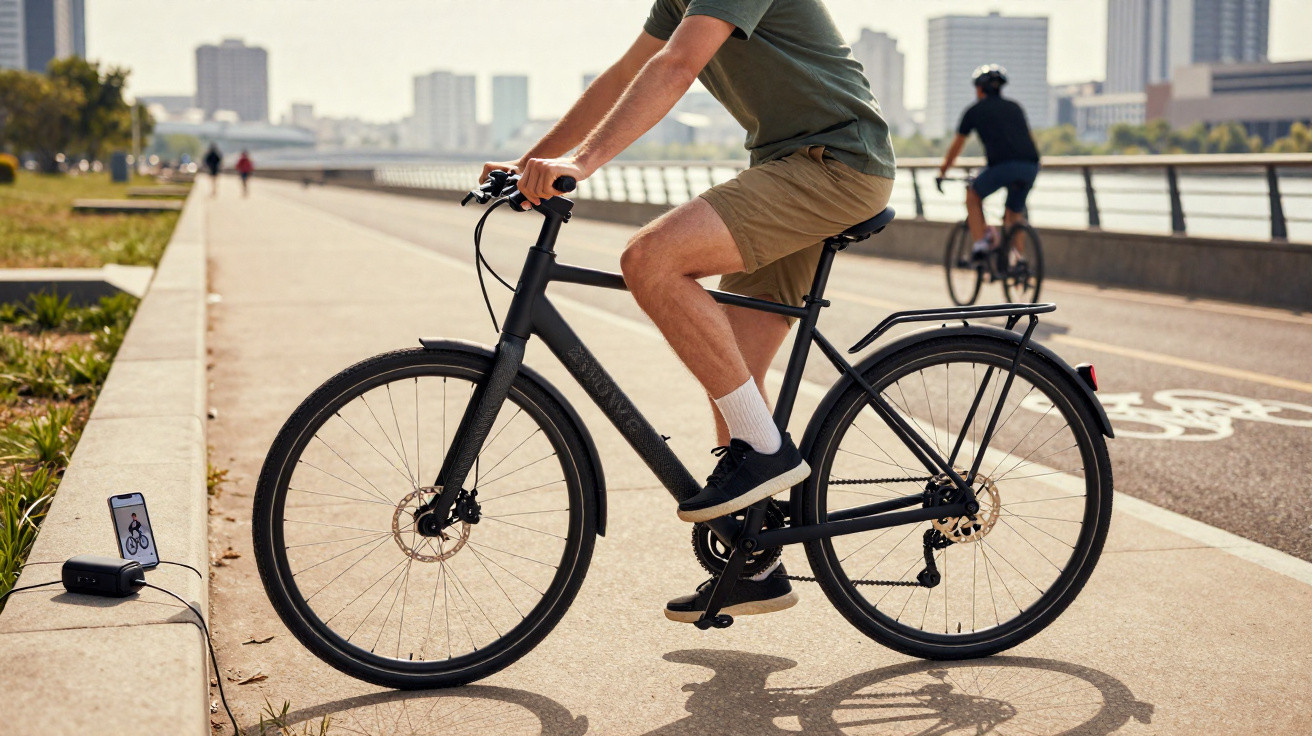
ENGWE is switching lanes with the N1 Air: instead of a “fun” e-bike on chunky tyres, it’s aiming for a light, understated commuter that looks noticeably more premium. The idea is both simple and bold-make carbon more attainable without stripping away what matters for everyday riding. After three months of commuting, here’s what the N1 Air is genuinely like out on the road.
For a long time, ENGWE has been linked with playful e-bikes-often well equipped, sometimes a little rough round the edges, yet still easy to like day to day. With the N1 Air, the Chinese brand is clearly targeting a different crowd: commuters and city riders looking for a light, modern bike that doesn’t need tractor-sized tyres to earn respect.
The N1 Air isn’t trying to be a cargo bike, nor a mountain bike in disguise. It’s meant to be a proper *commuter*: light enough to carry up stairs, quick enough to slip through traffic, and straightforward enough to use daily without turning maintenance into a ritual. To pull that off, it brings some serious talking points: a carbon frame, a premium look, a removable battery, a claimed torque sensor, and built-in security features.
Sound familiar? That’s because we already tested its bigger sibling, the N1 Pro, when it launched back in February. When ENGWE offered us time with the N1 Air, we took it-starting at €1,449, does it really deliver? Here’s our test, broken down point by point.
Unboxing and setup: no drama
The N1 Air arrives in a fairly compact box and it’s well protected for shipping. ENGWE has done this properly: the instructions are clear (our unit had an English booklet, but a French version can be downloaded via a QR code), and every tool you need is included in a small pouch.
Allow 30 to 45 minutes depending on how comfortable you are with basic mechanics. You’ll fit the front wheel, attach the handlebars, screw in the pedals, and set the saddle height. Nothing complicated-and it’s even easier (and faster) with two people. ENGWE also has an assembly video on its YouTube channel, which makes the paper manual almost redundant.
The front headlight is controlled directly from the handlebar control pad. By default, it switches on automatically as ambient light drops. The rear light, meanwhile, operates like a standalone lamp: it has its own battery, topped up via a small solar panel, and it also triggers once it gets dark. That means you’ll want to park the bike in daylight now and then to avoid any unpleasant surprises.
Don’t call me MapFour again!
At launch, the N1 Air and N1 Pro were sold under the ENGWE MapFour name. The goal was to group ENGWE’s more premium bikes together and make the brand’s very extensive catalogue easier to navigate.
On 25 November, ENGWE decided to strengthen that separation by turning MapFour into an independent company, distinct from ENGWE. R&D, production, sales, and marketing are now separate from the parent business. However, MapFour still lists the N1 Air and N1 Pro-both fully developed by ENGWE-which is why those models have now dropped the MapFour label.
The new MapFour intends to position itself exclusively at the high end and is expected to launch new products from 2026.
Carbon fibre that changes the whole experience
At 15.6 kg including the battery, the N1 Air is nowhere near the 25–30 kg (or more) you see with many conventional electric bikes. And that difference isn’t just marketing: when you lift it to carry it up stairs, it’s immediately obvious. If you live in a flat or regularly need to carry your bike, that’s a genuinely weighty advantage.
That low weight comes from a T700 carbon-fibre frame. The frame alone is said to weigh 1.28 kg, about the same as a laptop. ENGWE also claims this carbon provides stiffness 11 times higher than an equivalent aluminium frame. In real-world terms, that translates into strong power transfer when pedalling and improved damping of road buzz.
The N1 Air’s styling is a clear break from more traditional models. No oversized tyres, no tough-looking fat-bike stance-instead you get a clean, restrained, almost minimalist silhouette. The one-piece frame, with no visible welds, looks both polished and high quality. The lines flow well, and the slightly tapered top tube adds a subtle sporting edge.
The battery sits neatly inside the down tube, to the point where you could easily mistake the N1 Air for a non-electric bike. Only the LCD display on the bars and the rear hub motor give the game away. It’s a smart approach, as it helps the bike avoid drawing attention.
On the finishing front, the cable routing integrated into the frame adds to the tidy, premium feel. With carbon, welds are naturally invisible, and overall the bike comes across as well made. Our test unit came in a handsome “ink green” shade, which we found discreet and classy. There are two versions: a classic step-over with a higher top tube (our test bike) and the step-through (ST) with a lower step-in height for easier access.
A discreet motor that still does the job
The N1 Air uses a 250 W rear motor producing 40 Nm of torque. On paper, that can look modest next to competitors advertising 60 or 80 Nm. But on a bike this light, 40 Nm is more than enough for most urban riding.
Assistance is controlled via an effective torque sensor, giving a natural, fluid pedalling feel despite the rear-hub layout. You get five assistance levels, from Eco through to Turbo. In town, level 2 or 3 is plenty to cruise at 25 km/h without working too hard. Level 5 makes climbs feel easy-as long as they don’t exceed about 10–12%.
Go beyond that and you start to see the motor’s limits, so you’ll need to contribute more effort yourself. Luckily, gradients like that are fairly uncommon in most city centres. The motor is also impressively quiet: you’ll only notice a faint electric whirr, and even that is often drowned out by traffic noise.
Range: between the claim and real life
ENGWE quotes 100 km of range from the Samsung 36V 10Ah (360 Wh) battery. That could be achievable on flat terrain with a lightweight rider. In everyday conditions-where you weigh more than 80 kg and regularly use assistance level 3 or above-things look a bit different.
In our testing with a rider just under 100 kg fully kitted out, we saw real-world range fluctuate between 60 and 75 km depending on usage. Ride mostly in level 2 or 3 on flat or gently rolling routes and you can get close to 70 km. Lean heavily on levels 4 and 5 and it drops to around 60 km. Overall, the N1 Air’s range is comfortably adequate and it can handle 3 to 4 days of commuting without complaint.
You can charge the battery on the bike or remove it to charge indoors. Removal is straightforward using the locking key. The pack weighs roughly 2.3 kg, which is still manageable to carry upstairs. A full charge takes between 5 and 8 hours. That’s on the slow side and we would have liked a faster charger. Still, plug it in when you get home in the evening and it’s ready the next morning-so for daily use it remains workable.
Braking and drivetrain: traditional kit that gets it done
The N1 Air runs 160 mm mechanical disc brakes front and rear. In everyday riding they do the job, with progressive bite, but they’re clearly a step behind hydraulic systems-especially when you need hard, fast stopping. Mechanical discs also need more frequent adjustment and can lose effectiveness in the wet. That’s the trade-off for keeping the bike’s price in check. After a few days of bedding-in, braking becomes more decisive.
You’ll still need to anticipate emergency stops more than you would with hydraulics. For relaxed commuting it’s fine. But if you ride quickly, carry loads, or deal with a particularly hectic city, the hydraulic option makes sense. It costs €100 more, bringing the price to €1,549.
Gearing is handled by a 7-speed Shimano derailleur. It’s a proven, dependable setup. Shifts are acceptable, although we occasionally heard a bit of crunching when changing under load. Nothing worrying, but smoother shifting would have been welcome. The seven gears are enough for typical urban scenarios and complement the electric assist effectively. The 700×38C tyres strike a solid balance between comfort and speed: wide enough to take the edge off rough tarmac, not so wide that they slow the bike down. The tread suits city use, with good grip on dry and wet asphalt alike.
Clear-cut urban comfort
In daily use, the N1 Air proves to be a very strong transport companion. Its low weight makes it responsive and easy to handle in traffic. Filtering between cars is effortless, and tight turns are dealt with confidently thanks to a very short turning circle. The adjustable handlebars are a real plus, allowing a fairly upright posture-which we prefer for everyday journeys.
The carbon frame genuinely helps to mute vibrations. Over cobbles and typical city imperfections, the difference versus an aluminium frame is noticeable. The ride feels less harsh and more refined. Of course, it doesn’t match a bike with suspension, but it largely avoids the tooth-rattling feel as long as you stick to tarmac or paved streets.
On broken surfaces and poorly maintained roads, it’s a different story. You’ll have to accept sharper jolts, made worse by a saddle that becomes less forgiving. In fact, our backside quickly demanded a silicone seat pad to make longer rides more pleasant.
The LCD screen on the left side of the bars shows the essentials: speed, battery level, assistance mode, and mileage. It stays readable even in bright sunlight. The three-button control pad is easy to use, even with gloves on. ENGWE has also included practical mounting points, with threaded bosses for a bottle cage and a rear rack. It’s a shame the rack isn’t included as standard.
Useful connected features
The N1 Air includes Bluetooth and a 4G connection to work with the companion app (iOS and Android). The 4G service is free for one year, then costs €40 per year. Among the available features, real-time GPS tracking is a genuine “plus”. If the bike is stolen, you can follow its location. Geofencing lets you set permitted zones: if the bike leaves them, an alarm triggers on the bike (flashing light and siren) and you receive a notification on your phone. You can also make the bike ring remotely, which is particularly handy in a crowded car park.
The electronic locking system lets you secure the bike from the app. Once locked, the electric assistance can’t be activated. You can also enable a motion-detection alarm: if someone tries to move the locked bike, it emits an audible alert.
The app also includes GPS navigation. Once you set a destination, directional arrows appear on the N1 Air’s display to guide you. It works reliably and is convenient, even if the suggested route isn’t always the fastest.
ENGWE N1 Air: the Presse-Citron verdict
With the N1 Air, ENGWE has produced a very appealing bike. Its featherweight build, smart design, and careful finishing are impressive at this price point. In the city it’s nimble, quiet, and comfortable on tarmac. Assistance is generally smooth and adds real value in terms of riding feel. The anti-theft and tracking tools are reassuring and help justify part of the cost.
It isn’t without weaknesses, though. While the carbon frame does take the edge off typical urban surfaces, the lack of suspension is obvious on rougher tracks. The motor’s assistance is satisfying as long as climbs stay within roughly 10 to 12%. Beyond that, you’ll need strong legs. Finally, range is decent, but you do need to remember to charge the battery before bed, as it can take up to 8 hours. A quicker charger would have been welcome.
Lastly, the mechanical brakes require more attention, particularly for emergency stops. They remain dependable for normal urban riding, but would clearly benefit from hydraulic calipers. Our test unit didn’t have them, but ENGWE offers hydraulics as a purchase option.
Priced at €1,449 (€1,549 with hydraulic brakes), the N1 Air is an excellent gateway into carbon urban e-bikes-as long as you accept the compromises of a “lightweight first” approach and don’t expect it to be a cushy trekking bike or a natural hill-climber.
ENGWE N1 Air
€1449
Overall score: 9.2
| Category | Score |
|---|---|
| Design & ergonomics | 9.5/10 |
| Everyday comfort | 9.0/10 |
| Range | 8.5/10 |
| Connected features | 9.0/10 |
| Performance / price ratio | 10.0/10 |
What we like
- Comfortable ride
- The bike’s low weight
- Successful design
- Very respectable range
- Straightforward assembly
What we like less
- Saddle is a bit firm
- 4G connection becomes paid after one year
- Rear rack is optional
- Hydraulic brakes are optional
Subscribe to CyberGhost

Comments
No comments yet. Be the first to comment!
Leave a Comment