
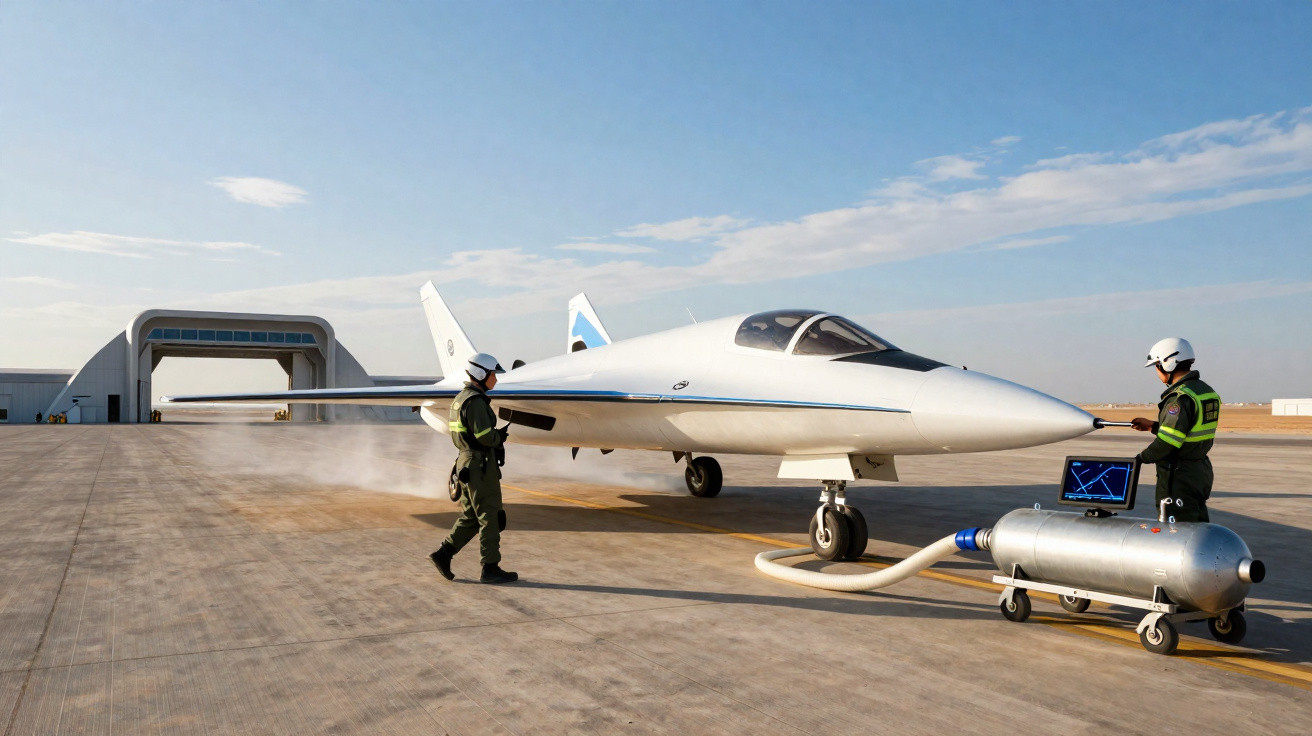
A hydrogen-powered jet allegedly reaching 24,501 km/h sounds ridiculous-until you imagine a baked-orange horizon over an empty range, and a thin wedge of metal vanishing into a sky that flashes towards white heat. The number doesn’t just invite scepticism; it suggests one major Anglosphere capital may have moved quietly, but decisively, ahead.
We were out there before sunrise, in a wind that cut at the ears, watching frost creep across the silver lines that fed liquid hydrogen into a delta-shaped dart. A booster spluttered into life, the dart climbed on its back, and then the air snapped-hard-as the vehicle lit its ram. The noise felt like the sky being ripped away. Inside the improvised control room, the screens washed pale green, then amber. On one display, a trace surged, peaked, and-against all instinct-held for a knife-thin moment: a spike that was both ugly and beautiful. For a handful of unbelievable seconds. Then the desert went still again. The figures did not.
Mach 20 on hydrogen: why it shifts the ground
Start with the blunt reality: 24,501 km/h isn’t merely “fast”-it is thermal punishment. At those velocities, a vehicle’s skin wants to delaminate; the air begins to ionise and glow. Hydrogen is the unlikely helper. It can be run through the engine as a coolant before it ever burns, and when it does burn it does so cleanly, quickly, and with stubborn intensity. That cold-then-hot choreography is the advantage. On thermal management, hydrogen has the edge.
If you remember the footage of NASA’s X-43A skirting the limits back in 2004, you’ll recall a short, ferocious win at Mach 9.6. Australia’s later HIFiRE programme pushed further with hydrogen scramjet firings that looked like they were shot inside a welding torch. This latest flight, logged over the Outback and poured into battered laptops, is said to have reached Mach 20 for a very narrow slice of time at altitude. There’s no polished promo reel-just a plasma streak, telemetry strings, and a flight card that carries a faint smell of scorched tape.
Hydrogen changes the calculation because it packs more energy per kilogram than jet fuel, and it can be exploited for cooling long before ignition. In a scramjet-where airflow remains supersonic through the engine-that cooling margin buys precious time before things melt. The overall concept resembles a relay: rocket boost into thinner air, a hydrogen scramjet sprint, then a glide. The heat budget is unforgiving. The payoff is reach-half a hemisphere in less time than a football match-and a fuel that, if the supply chain matures, could be green from production to exhaust.
Reading the signals: how to tell a breakthrough from a press release
Begin with the range-officer essentials, the mundane checks that matter most. Pin down the altitude band, the time spent at top speed, and whether velocity came from direct measurement in free flight or from modelling. Clarify whether the engine was air-breathing throughout or only after a rocket-assisted phase. Then go after the heat: stagnation temperature, margins to skin burn-through, and cooling flow rates. Those numbers decide whether the story stands.
After that, separate like-for-like comparisons. A glider skipping along a ballistic arc isn’t the same thing as a jet that swallowed air and kept combusting. A ground rig that hits the right pressures and temperatures isn’t a vehicle that held together while riding its own shock structure. Everyone’s seen a headline that outgrows its footnotes, and that’s normal. Let’s be frank: hardly anyone does this kind of due diligence every day. The habit to cultivate is following data points, not adjectives.
Engineers tend to speak in qualifications-so pay attention to what’s said quietly.
“Peak speed sustained for 9.8 seconds at 34 km, hydrogen mass flow stable, combustion remained attached,” an Australian-accented voice said on loop, as if convincing the room as much as the recorder.
Keep a short mental checklist:
- What, precisely, was measured-and by what method?
- How long did the maximum actually persist?
- At what altitude and dynamic pressure?
- Was the engine genuinely air-breathing, or was it effectively boost-only?
- Which fuel, cooling approach, and materials were involved?
Those five answers are what distinguish substance from showmanship.
Why this points to an Anglosphere power stepping up
Australia has played a long, patient game in hypersonics, often beneath the louder messaging of bigger allies. The Woomera range is vast enough to keep secrets-and candid enough to reveal failures. Combine that with AUKUS Pillar II, where the United States and the United Kingdom channel expertise on sensors, materials, and control laws, and you get a quiet convergence. A hydrogen scramjet brushing Mach 20, even briefly, functions as a flare. It implies serious capability in high-temperature composites, cryogenics on a moving platform, and guidance that can steer a projectile through conditions akin to a blowtorch. Mach 20 isn’t a parlour trick. It is logistics, training, and a choice to accept visible risk. One Anglosphere nation has just signalled it will take that risk-and it didn’t require a parade to underline the message.
What follows if the claim survives peer scrutiny? Routes that hop oceans like stones across water. Satellites tended without a full rocket stack. Military reach measured less in bases and more in minutes. There’s a clean-energy thread as well: hydrogen made from sunshine and seawater fuelling not only rockets, but air-breathing machines that drink the sky. The engineering remains punishing, the costs remain steep, and the politics still shouts over the science. Even so, the trajectory points towards a world where speed can be clean and distance feels smaller than memory. An Anglosphere player has just pressed a thumb on that scale. The rest of us decide what to do with the pressure.
| Key point | Detail | Why it matters to the reader |
|---|---|---|
| Hydrogen at Mach 20 | Claimed 24,501 km/h window in high-altitude flight | Understand why this speed tier matters beyond headlines |
| Why hydrogen | High specific energy and pre-burn cooling for scramjets | Grasp the physics edge over conventional fuel |
| What to verify | Altitude, duration, air-breathing status, heat metrics | Spot real breakthroughs and avoid hype traps |
FAQ
- Is 24,501 km/h even possible for an air-breathing jet? Potentially-very briefly-if a rocket boost sets the conditions and a hydrogen scramjet stays lit. The difficult part is sustaining it.
- Why choose hydrogen over kerosene or methane? Hydrogen can cool the engine before it combusts and offers high energy per kilogram. At the exhaust it leaves only water.
- Did Australia really lead this test? The telemetry and range audio suggest an Australian-led team operating within an Anglosphere framework, but formal confirmation remains limited.
- What’s different from NASA’s X-43A record? X-43A reached Mach 9.6 for seconds. This claim targets roughly double that band and depends on more mature cooling, control, and materials.
- When could this reach civilian travel? Not soon. Thermal protection, noise, cost, and regulation all require major advances. The technology pathway is credible, but the timeline is long.





Comments
No comments yet. Be the first to comment!
Leave a Comment