
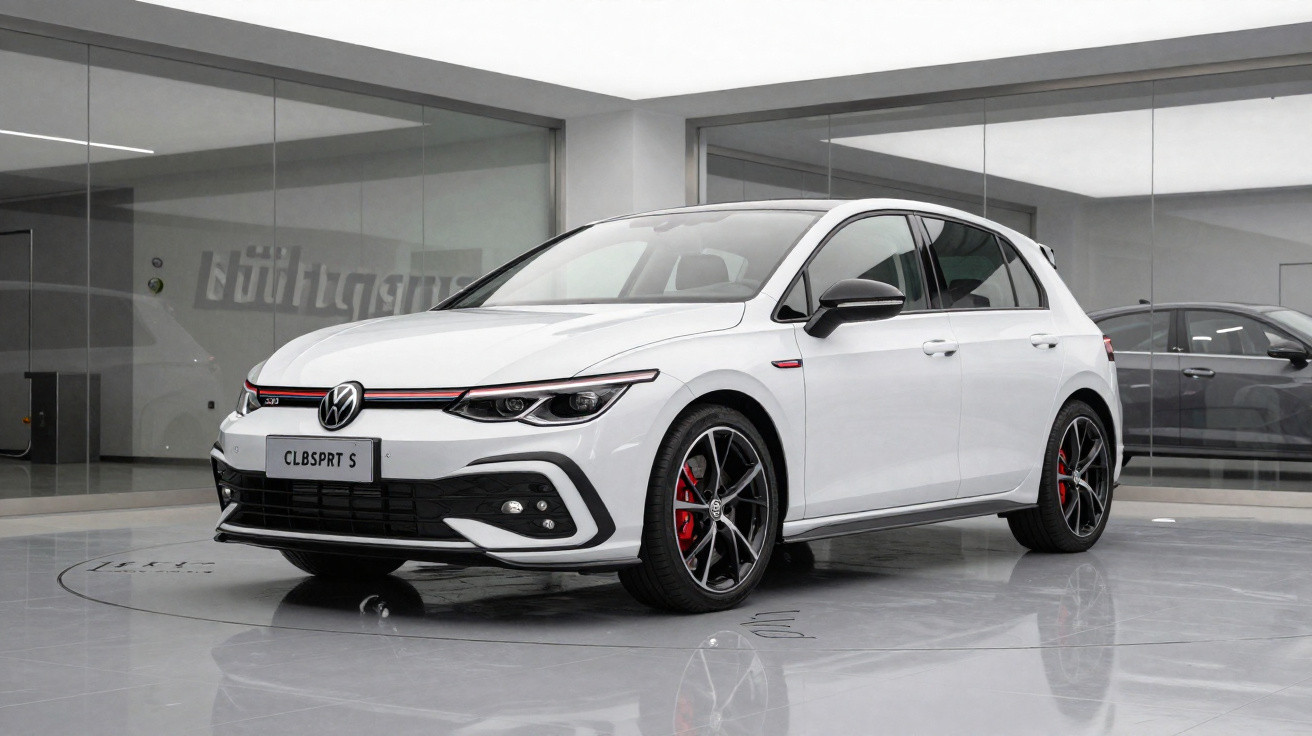
The Volkswagen Golf is marking 50 years, but that’s not today’s topic. Instead, we’re heading back to the icon’s more recent past-its seventh generation-to meet and drive what is, quite possibly, the greatest Golf GTI ever made: the Clubsport S.
The Volkswagen Golf GTI Clubsport S is, in many ways, the Porsche 911 GT3 of the hot hatch world. It’s a car honed with outright performance in mind, built around one specific mission: to become the fastest front-wheel-drive car on the legendary Nürburgring-Nordschleife.
Nürburgring-Nordschleife: the mission
And in 2016 it delivered, beating the first turbocharged Honda Civic Type R (FK2) around the German circuit with a time of 7min49,21s (20,6 km). The very car that set that record is the one Guilherme Costa had the chance to drive-and he walks you through it all in the video below:
Golf GTI Clubsport: the recipe
If there’s a single model that lit the fuse for this kind of extreme hot hatch, it’s the Renault Mégane R.S. R26.R (2008). This was the radical car that first abandoned the usual “small family hatch” brief to chase, obsessively, the title of fastest front-wheel-drive machine in the “Green Hell”. Nothing was left to chance in that pursuit.
Renault Sport stripped the Mégane of anything that didn’t serve the goal. The rear seats were removed, a roll bar was added, and even the rear glass windows were replaced with polycarbonate items. In the end it shed more than 120 kg and took the record-opening the door to an all-out arms race.
SEAT and Honda were among the first to answer, with the Leon Cupra and the first turbocharged Civic Type R. Volkswagen wasn’t about to sit on the sidelines. After all, it’s the brand behind the Golf GTI-“the” hot hatch.
More power, less weight
The direction was clear: turn the Golf GTI into a circuit-hungry Clubsport S. The formula relied mainly on two ingredients working together: more power and less mass.
On the power front, output rose from 230 cv to 310 cv (with 380 Nm of torque), extracted from the EA888-Volkswagen’s turbocharged 2,0 l four-cylinder engine that still powers both the Golf GTI and the Golf R today.
Weight-saving measures (and what came back)
On the weight side, Volkswagen didn’t hesitate. It started by deleting the Golf GTI’s rear bench. Then it fitted a smaller battery and removed sound-deadening material, the boot floor panel, the parcel shelf, the mats, and the bonnet struts. An aluminium subframe replaced the usual steel one.
Some of what was saved inevitably returned: it gained a strut brace, a net behind the seats, and fresh carpeting in the rear. And it’s impossible to miss the roll bar positioned behind the two occupants.
In the end, the Golf GTI Clubsport S trims a modest 30 kg versus a GTI, declaring 1285 kg (DIN; or 1360 kg if we include the driver and luggage required by the EU standard). Even so, its power-to-weight figure remains very strong: 4,15 kg/cv.
Result: devastating
Even without going as far as some Renault Sport efforts, Volkswagen was confident. The hardware changes and chassis recalibration gave the Golf GTI Clubsport S exactly what it needed to go after the desired benchmark.
It’s worth underlining what it achieved in 2016. Not only did it become the fastest front-wheel-drive car at the Nürburgring, it also managed to lap the legendary circuit quicker than far more serious machinery such as the BMW M4 (F82) of the time (430 cv and rear-wheel drive).
Just as important, the Golf GTI Clubsport S was a manual (six-speed gearbox). Volkswagen judged that the 20 kg saved with the manual transmission outweighed the DSG’s speed advantage.
More than eight years have passed since the Volkswagen Golf GTI Clubsport S made history and, as you’d expect, that record has since been beaten… several times. Today, it sits “in the hands” of the Honda Civic Type R (FL5) with a time of 7min44,881s (20,832 km).
If the lap time has been eclipsed, the driving experience remains sharper and more immersive-making this GTI feel far more special than the others. That’s exactly what Guilherme keeps coming back to in the video above.
Adding to the sense of occasion, Volkswagen built only 400 examples of the GTI Clubsport S, and the unit we drove-specifically the one that set the record-is number 000.
All that’s left is to hope Volkswagen gives its engineers the green light again to create something as special as this.
Comments
No comments yet. Be the first to comment!
Leave a Comment