
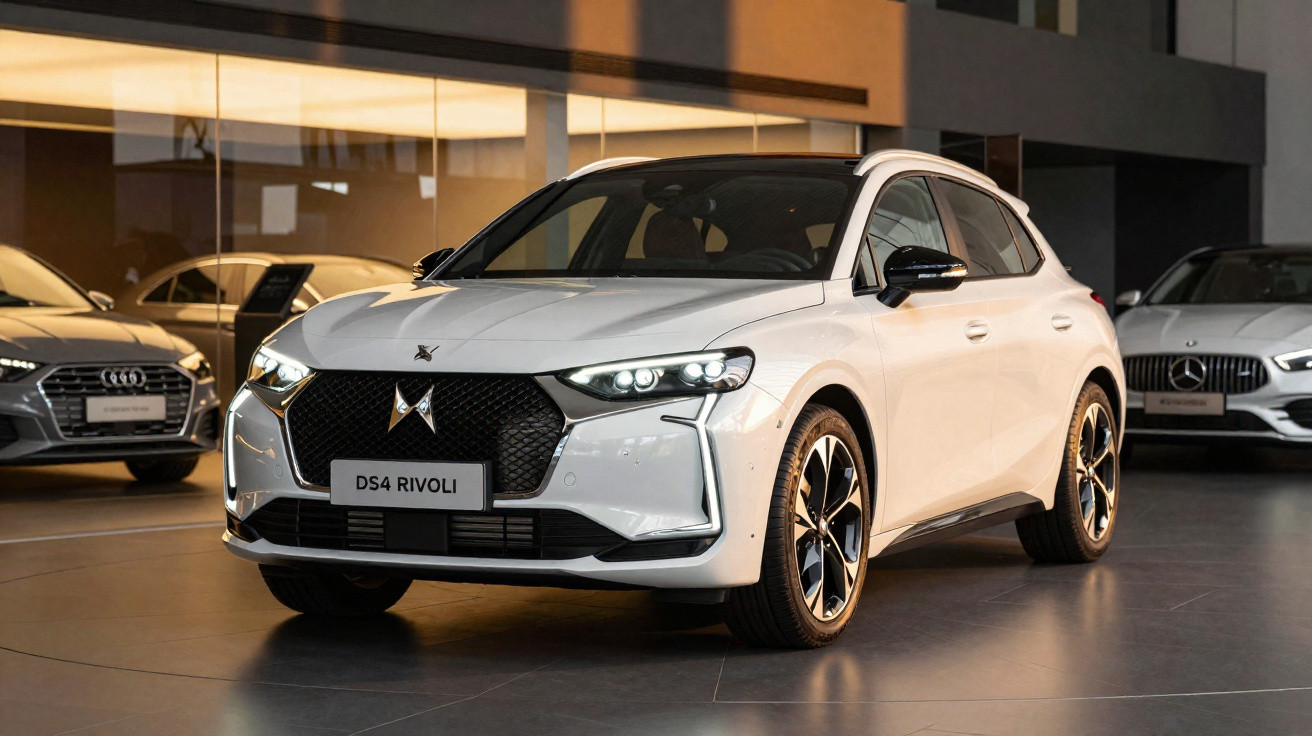
After an initial generation that began life as a Citroën and ultimately became a DS Automobiles model - a brand officially established in 2014 - the DS 4 is back.
The new version is chasing the same target as its predecessor: to “steal” market share from the three German premium compact hatchbacks - the Audi A3, the BMW 1 Series and the Mercedes-Benz A-Class.
But does the DS 4 have what it takes to take on those German options? To find out, we tested it here in flagship Rivoli trim, with the most powerful petrol engine available (and petrol-only): the 1.6 PureTech producing 224 cv and 300 Nm.
A successful blend of styles
Visually, I have to admit that I not only find the DS 4 more striking than its German rivals, but also more contemporary.
I can’t help spotting a few “crossover genes” in DS Automobiles’ approach and, judging by the looks the DS 4 drew as it went by, the French brand seems to have pulled off the tricky job of creating a car that doesn’t fade into the background.
French-style luxury
If the DS 4’s exterior earned praise, the cabin deserves it too. The materials feel good to the touch, look the part and even… smell appealing.
In this area, DS Automobiles arguably goes one better than some Germans, with the DS 4 presenting an interior that appears more upmarket than what you’ll find in an Audi A3 or a Mercedes-Benz A-Class.
Build quality is also at a solid standard, though this is where DS Automobiles still hasn’t quite matched its German competition. The same is true for ergonomics - a field where the French marque has been making steady progress.
As for space, the DS 4 doesn’t set the benchmark, but it doesn’t disappoint either. Its generous 1.83 m width means two adults can travel comfortably in the rear, and headroom and knee room are also very satisfactory.
In the boot, the 430-litre capacity is more than adequate and comfortably ahead of the 380 litres offered by the Audi A3 and BMW 1 Series, as well as the Mercedes-Benz A-Class’s 370 litres.
Comfort comes first
The longer I spent behind the wheel of the DS 4, the clearer it became that this French contender can go toe-to-toe with German premium models without copying them - and that’s immediately obvious once you settle into the driving seat.
Its stronger focus on comfort is unmistakable - I wouldn’t be surprised to find a similarly supple ride in a car one or two classes higher, despite the 20-inch wheels. And while it gives up some of the sharp dynamic edge associated with the German trio, it remains capable when the road turns interesting.
“The DS 4 is so comfortable that the only reason we avoid potholes is fear of damaging a tyre or a wheel.”
On twisty routes, don’t expect something especially incisive or entertaining to drive. What you get instead is a stable, secure and comfortable car, with steering that feels a little light and damping tuned primarily for comfort.
That said, the DS 4’s dynamic strengths come through most clearly on long motorway stints or main roads. There you enjoy a level of stability typical of German models, without having to put up with their characteristically firm ride. Noise isolation is also close to faultless.
Thanks to this, covering big distances in the DS 4 is, above all, a relaxing experience. Even when the surface is rougher, the suspension lets you glide over imperfections as if they simply weren’t there.
Powerful, but thirsty
With 224 cv and 300 Nm, this is the most powerful petrol DS 4, with only the DS 4 E-Tense - the plug-in hybrid variant - able to match it for power, a version we have also driven.
Paired exclusively with an eight-speed automatic gearbox that’s smooth and well judged, this engine delivers seriously brisk pace - 0 to 100 km/h takes 7.9s and top speed is 235 km/h.
However, as the saying goes, “there’s no rose without a thorn”, and delivering 224 cv without any form of electrification means the 1.6 PureTech turns out to be somewhat “thirsty”. DS Automobiles claims an average of 6.6 l/100 km (WLTP cycle), but in reality I had to drive very carefully to get close to that figure.
Whenever I chose “Sport” mode and leaned on the DS 4’s dynamic ability, the average hovered around eight litres, and in normal use it isn’t hard to see 7–7.5 l/100 km.
It’s also possible to record 5.8 l/100 km, but to do so you need to select “Eco” mode (which, thankfully, doesn’t overly “strangle” the engine’s response) and adopt a much calmer (and slower) driving style.
Is it the right car for you?
Given the popularity of the Audi A3, BMW 1 Series and Mercedes-Benz A-Class, many will wonder who DS Automobiles expects to buy the DS 4.
The French model is, above all, a reactionary choice - an alternative to what has become the “norm” among premium offerings in the C-segment.
It’s an alternative defined by its head-turning design, the higher level of comfort on board and even by its… standard equipment, which is far more generous than what the Germans have trained us to expect.
If this engine’s higher fuel consumption could be a drawback, there is good news: the French line-up doesn’t lack powertrain options - petrol, diesel and plug-in hybrids - with some of them also enabling a more accessible price point.
Comments
No comments yet. Be the first to comment!
Leave a Comment