
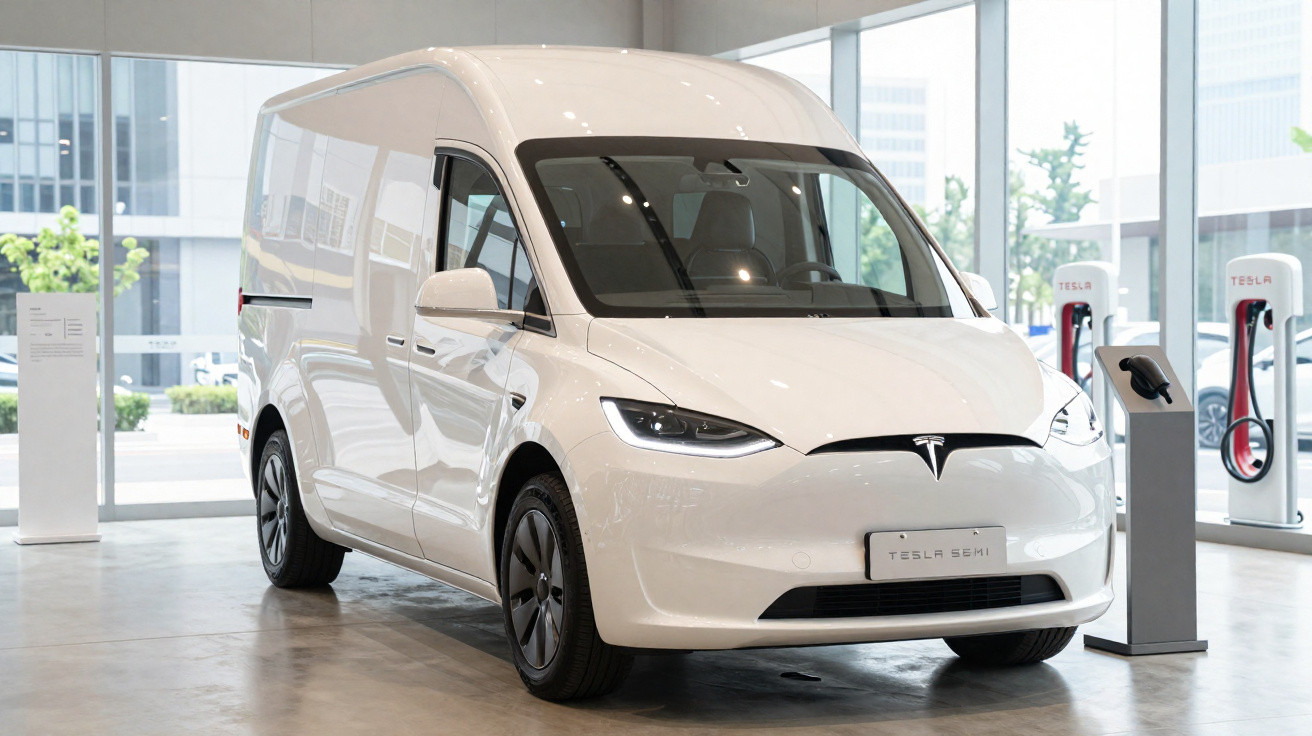
The new Tesla lorry is simply called the Semi - taken from the term semi truck, meaning the articulated combination of tractor unit and trailer. And as a new lorry (or, more accurately, a super lorry), it arrives with figures that are genuinely eye-opening and far more upbeat than the rumours suggested.
What the Tesla Semi promises
Super Performance
Just 5.0 seconds from 0 to 60 mph (96 km/h) is the sort of number you’d normally link to sports cars, not heavy goods vehicles. Tesla says that’s three times quicker than comparable diesel lorries on the road today.
Even more striking is that it can repeat the same run in only 20 seconds when fully loaded - in other words, carrying a little over 36 tonnes (80,000 lb). By comparison, an equivalent diesel lorry takes around a minute.
And the claims keep coming: the American brand also states that the Semi can climb 5% gradients, fully laden, while holding a steady 105 km/h, comfortably ahead of the diesel benchmark of 72 km/h.
Super aerodynamic
The Tesla Semi’s aerodynamic drag coefficient (Cₓ) is remarkable: just 0.36. That stacks up well against the 0.65–0.70 typical of today’s lorries, and it’s even lower than the 0.38 quoted for a Bugatti Chiron, for instance. Naturally, being a lorry it loses out on frontal area - the other key factor in aero performance calculations - but it’s still an impressive result.
Keeping drag low is crucial for reducing energy use, which for the Tesla Semi translates directly into greater range. The American brand is quoting around 800 km of range, fully loaded at motorway speeds, equating to consumption of 2 kWh per mile (1.6 km). As you’d expect, the Semi also includes multiple energy recuperation systems, and it can recover up to 98% of kinetic energy.
Tesla argues that this range more than covers most real-world transport requirements. In the United States, close to 80% of freight journeys are under 400 km.
Super charging
The big question hanging over the Tesla Semi’s practicality was, of course, charging time. Tesla’s answer is straightforward: after the Superchargers comes the Megacharger, which can deliver enough energy in 30 minutes for a 640 km range.
With a network of these chargers placed strategically at truck stops - enabling top-ups during drivers’ breaks or while loading and unloading - long-haul, 100% electric freight starts to look far more achievable.
Cab design and safety in the Tesla Semi
Super interior
When Tesla says the cab is designed “around the driver”, it means it quite literally: the driver sits in a central position - à la McLaren F1 - flanked by two huge screens. This centre-seat layout delivers excellent visibility, and the Tesla Semi is fitted with a suite of sensors intended to remove blind spots. As shown, there are no mirrors - will it be able to gain type approval like that?
Super safety
The battery packs sit low in the vehicle, helping to keep the centre of gravity down, and they’re reinforced to improve protection in the event of an impact. Sensors also monitor trailer stability, responding by applying positive or negative torque to each wheel independently, while also working with the braking system.
And, being a Tesla, Autopilot is part of the package. The Semi includes autonomous emergency braking plus lane departure warning and lane keeping. Autopilot also enables platooning: one Semi can lead, with several others following autonomously.
Super reliability (?)
In theory, with no engine, gearbox, exhaust after-treatment systems, or differentials, the Tesla Semi should be far more reliable than comparable diesel lorries - and maintenance costs ought to be dramatically lower.
However, reports suggest Tesla’s cars are still a long way from that utopia. Can the Tesla Semi convince?
Even if maintenance and repair costs don’t end up as low as the brand claims, there’s no denying that fuel costs should be substantially reduced. Electricity is unquestionably cheaper than diesel. According to Tesla, an operator can expect savings of 200 thousand dollars or more (at least 170 thousand euros) for every million miles travelled (1.6 million kilometres).
Production is planned for 2019, and the Tesla Semi can already be pre-ordered with a 5000 dollar deposit (4240 euros).

Comments
No comments yet. Be the first to comment!
Leave a Comment