
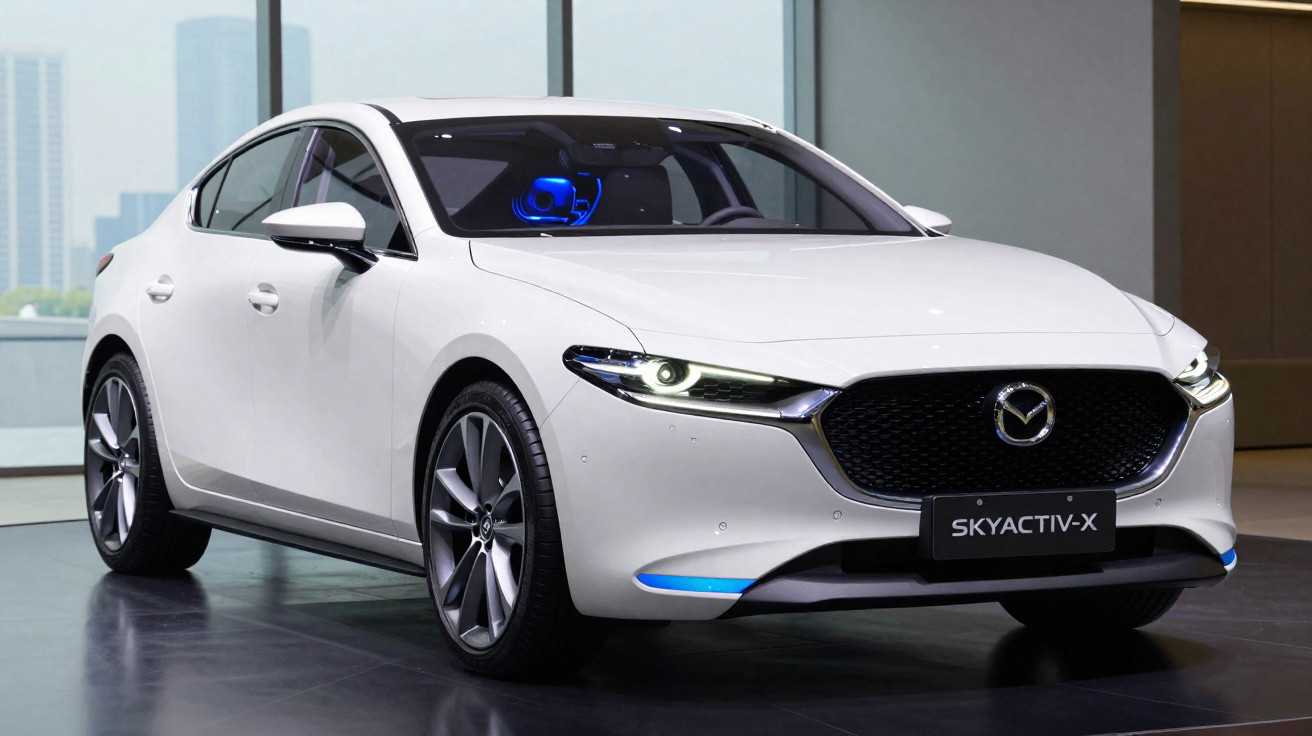
At a time when almost the entire industry seems determined to consign the internal combustion engine to the history books, Mazda is doing the opposite - and doing it cheerfully.
It is not the first time Mazda has taken the road less travelled, and the last time it did so, it turned out to be right. Will it happen again? The Japanese brand clearly thinks so.
That commitment to combustion was announced last year with a new generation of SKYACTIV-X engines. And we were able to experience the new SKYACTIV-X engine - in the real world - ahead of its official market launch in 2019.
Get ready: this is a long, technical read. If you make it to the end, there will be a reward…
Internal combustion engine? What about electric cars?
The future is electric - and Mazda’s decision-makers agree with that statement. Where they part company with some forecasts is the idea that the combustion engine was “dead”… yesterday.
The key word is “future”. Until the 100% electric car becomes the new normal, the transition to electric mobility worldwide will take decades.
What’s more, electricity generation from renewable sources will also need to grow, otherwise the promise of zero emissions from electric cars risks being an illusion.
In the meantime, the “old” internal combustion engine will still carry a large share of the burden of cutting CO₂ emissions in the short to medium term - and it will remain the most common powertrain type for decades to come. That is why it must continue to improve. Mazda has made it its mission to extract every last drop of efficiency from the combustion engine in pursuit of lower emissions.
“Committed to the principle of the right solution at the right time”, as Mazda puts it, the brand keeps looking for the best answer - not the one that looks best on paper, but the one that works in the real world. That is the context behind SKYACTIV-X, its innovative - even potentially revolutionary - internal combustion engine.
Revolutionary - why?
Because SKYACTIV-X is the first petrol engine capable of compression ignition - just like a Diesel engine… well, almost like a Diesel engine, but we will come to that.
Compression ignition - meaning the air/fuel mixture ignites instantly, without a spark plug, when compressed by the piston - has long been a kind of holy grail for petrol-engine engineers.
And for good reason: compression ignition is far more desirable, because it happens much faster, effectively burning all the fuel in the combustion chamber at once. That allows more work to be extracted from the same amount of energy, improving efficiency.
Faster combustion also enables a leaner air/fuel mixture in the combustion chamber, meaning far more air relative to fuel. The advantages are easy to grasp: combustion occurs at lower temperatures, producing less NOx (nitrogen oxides), and less energy is wasted warming the engine up.
The problems
The catch is that compression ignition in a petrol engine is extremely difficult - not for lack of attempts by other manufacturers over recent decades, but because none arrived at a commercially viable solution.
Homogeneous Charge Compression Ignition (HCCI), the concept underpinning compression ignition, has so far only been achieved at low engine speeds and low loads. In practical terms, that means spark ignition (via the plug) is still needed at higher revs and under heavier load. The other major headache is controlling exactly when compression ignition happens.
So the real challenge becomes delivering a smooth handover between the two ignition types, which forced Mazda to refine and manage the many factors that enable petrol compression ignition with a lean mixture.
The solution
The “eureka” moment - or perhaps the moment it finally sparked? - came when Mazda’s engineers questioned the conventional idea that compression combustion does not need spark plugs at all: “if the transition between different combustion modes is difficult, do we even need to make that transition in the first place?” That is the foundation of the SPCCI system - SPark-Controlled Compression Ignition.
In other words, even for compression combustion Mazda still uses spark plugs, which makes the shift between compression combustion and spark combustion seamless. But if it uses a plug, can it still be called compression ignition?
Yes - because the spark plug is primarily a control mechanism for when compression ignition occurs. In other words, the elegance of SPCCI is that it combines a Diesel engine’s combustion method with the timing control of a spark-ignition petrol engine. Shall we applaud? We shall.
The objective
The engine is engineered to create the required temperature and pressure conditions in the combustion chamber up to the point where the air/fuel mix - extremely lean at 37:1, around 2.5 times leaner than a conventional petrol engine - sits on the brink of ignition at top dead centre. The spark plug’s spark is what sets the sequence in motion.
That spark ignites a small, richer air/fuel pocket (29:1) injected later, creating a fireball. This pushes pressure and temperature even higher in the chamber, so the lean mixture - already close to detonating - cannot resist and ignites almost instantaneously.
"This level of control over ignition embarrasses me. Mazda can do this at over 5000 rpm and I can’t even light a barbecue on the first try…"
A solution that now looks obvious - but it demanded new “tricks”:
- Fuel must be injected at two distinct moments: one for the lean mixture that will be compressed, and another for the slightly richer mixture that will be ignited by the spark plug.
- The fuel-injection system needs extremely high pressure to ensure rapid fuel vaporisation and atomisation, dispersing it immediately throughout the cylinder and minimising compression time.
- Every cylinder uses a pressure sensor that continuously monitors the controls mentioned above, correcting any deviation from the intended effects in real time.
- A supercharger is used - the key ingredient to keep compression high, because SKYACTIV-X uses the Miller cycle, which reduces compression and enables the desired lean mixture. The extra power and torque are a welcome side effect.
Advantages
SPCCI makes it possible to extend compression combustion across a much broader rev range, meaning higher efficiency in more real-world situations. Compared with the current SKYACTIV-G, the brand promises fuel consumption improvements of between 20% and 30% depending on use. Mazda also states that SKYACTIV-X can match - and even surpass - the fuel economy of its own SKYACTIV-D Diesel engine.
The supercharger raises intake pressure, delivering stronger performance and sharper engine response. Greater efficiency over a wider operating window also means the engine can run at higher revs, where more power is available and throttle response is better.
Despite the complexity of what is happening, the constant use of the spark plug has - intriguingly - enabled a simpler design: no variable valve timing or variable compression ratio is required. Better still, this engine runs on 95 RON petrol, because fewer octane points are better for compression ignition.
Finally, behind the wheel
This article is already long - but it needs to be. To understand the “buzz” around this engine, you have to understand why it is a genuinely notable step forward for combustion technology. We will have to wait for 2019 to validate every Mazda claim, but given what was promised and delivered with SKYACTIV-G, expectations are high that SKYACTIV-X will do what Mazda says it will.
Fortunately, we have already had an early taste. A dynamic drive was planned with prototypes fitted with SKYACTIV-X, disguised under the familiar Mazda3 bodywork - even though they had little to do with the Mazda3 we know. Even the underlying platform architecture beneath that bodywork was already second generation.
We drove two prototype versions - one with a manual gearbox and one with an automatic, both six-speed - and we were also able to compare them with today’s Mazda3 2.0 producing 165 hp with a manual gearbox, to better pinpoint the differences. Luckily, that was the first car I drove, making it easier to judge the strong engine/gearbox pairing (manual).
The contrast between SKYACTIV-X (the future engine) and SKYACTIV-G (the current engine) could not be clearer. Mazda’s new unit feels noticeably more energetic at any engine speed - the extra torque is obvious. Like the “G”, the “X” is a 2.0-litre engine, but with more impressive figures. Mazda is targeting power in the region of 190 hp - and you can feel it on the road.
Its responsiveness stood out, even from very low revs. The highest compliment, though, is that despite being a development unit, it already feels more convincing than many engines currently on sale.
Any worries that Diesel-like compression ignition would bring Diesel-like traits - higher inertia, a narrow operating band, or a particular sound - proved completely unfounded. If this is the future of combustion engines, then bring it on.
Inside the prototype - unmistakably the cabin of a car still in development - there was a screen mounted above the centre console showing three numbered circles. They would switch on or off depending on the ignition type or mixture being used:
- 1 - spark ignition
- 2 - compression ignition
- 3 - the leanest air/fuel mixture, where maximum efficiency was achieved
It was striking how often compression ignition occurred - it would switch to spark ignition only when we pushed into the highest rev ranges or planted the throttle fully.
As for mode 3, it clearly demanded more disciplined driving, particularly with the manual gearbox, where it was difficult - or perhaps my right foot lacked sensitivity - to make the circle number 3 appear on the screen. The automatic gearbox - with ratios tuned for the North American market - was less enjoyable to use, but made it much easier to “light up” circle number 3.
Fuel consumption? We don’t know!
I asked, but nobody would give hard numbers. The trip computer had been “strategically” covered with tape, so for now we can only rely on the manufacturer’s statements.
One final note: the prototypes already incorporated the new architecture - stiffer and capable of a more refined cabin experience. It is worth remembering these were development vehicles, so it was surprising that they already felt more polished and better sound-insulated than today’s production Mazda3 - the next generation promises a lot…
New Mazda3 should be the first SKYACTIV-X
Most likely, the Mazda3 will be the first model to receive the innovative SKYACTIV-X, so only sometime in 2019 will we be able to properly verify the engine’s efficiency gains.
On design, Kevin Rice, head of Mazda’s European design centre, told us that the overall look of the Kai Concept is production-feasible - meaning it is not far from the final version of the future Mazda3. Just forget the mega wheels, the tiny mirrors, or the exposed lighting elements…
"85 to 90% of the Kai Concept’s design solutions could make it into production."
You made it to the end of the article… at last!
As Rui Veloso would say, a promise is a promise. So here is a kind of payoff: an epic kamehameha that brings to mind what is happening inside the SKYACTIV-X engine’s combustion chambers.
https://youtu.be/GdOlTsRHVdI?t=35s
Comments
No comments yet. Be the first to comment!
Leave a Comment