
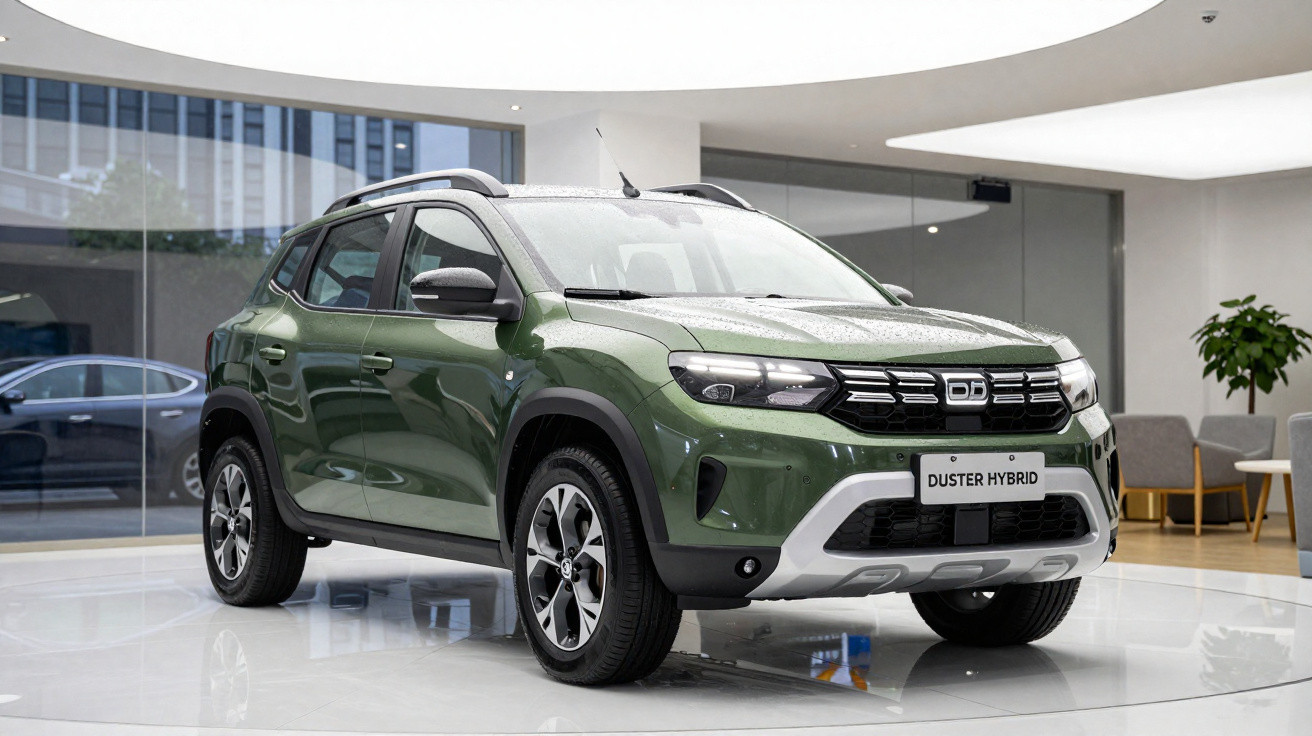
The Dacia Duster Hybrid could have had a truly unbeatable price, but Portuguese taxes have beaten it.
Portugal’s car taxation system is, to put it mildly, unusual. Over the years it has tripped up models that have done little to deserve it, and the new Dacia Duster Hybrid is a perfect case in point.
The irony is hard to miss: although this is the most efficient and least polluting engine option in the range, it’s also the one that ends up paying the most tax. That completely undermines the whole logic of choosing the hybrid, which ought to be the most tempting version for buyers.
For those reasons - and plenty of others - the Duster Hybrid is, in all likelihood, the best car Dacia has ever built. But for everything I’ve just explained, the hybrid is a long way from being the one I’d take home. Watch the video, where I break it all down.
Everything about the Duster is new
There’s no need to remind you how successful the Dacia Duster has been since it launched back in 2010. A quick walk down any street is enough to see it has become one of the Portuguese public’s favourite choices - and this third-generation model, which is brand new, is following the same path.
With more eye-catching styling, a completely redesigned cabin and a much richer equipment list, this generation brings more than enough strengths to justify the strong start it has made.
We’ve already gone over the new Duster from top to bottom and looked closely at the details of the interior. For that reason, this test won’t be centred on those aspects.
If you still want to clear up any doubts, I suggest watching the video we recorded at the international launch of this SUV, where we cover all those points.
What I do want to underline is the boot capacity, which has grown to 474 litres even though the car’s overall size hasn’t changed much. On the hybrid versions, that figure drops to 430 litres, because of where the battery is packaged.
Even so, it’s a solid number that should cope with almost all typical family duties. If outright space is your top priority, then it may be worth looking at Dacia’s newest model, the Bigster, which we’ve also seen in person.
Goodbye Diesel. Hello electrification
One of the biggest constraints of the second-generation Dacia Duster was its underpinnings: the platform was based on an evolution of an older Clio architecture, all in the name of keeping costs in check.
For this third generation, the Duster has moved to the CMF-B platform used by the Sandero and Jogger - and by the Renault Captur and Arkana - which opens up a broader set of options, starting with hybrid versions like the one shown in the video.
That’s also why Dacia decided to drop Diesel engines entirely, even though they were especially popular with buyers of the four-wheel-drive variants. But after driving the 4×4, believe me when I say it won’t be an issue.
The Duster line-up starts with the dual-fuel (petrol/LPG) version, called ECO-G 100. It uses a turbocharged 1.0-litre three-cylinder engine producing 100 cv. At the same time, it claims 1300 km of range thanks to two fuel tanks: 50 litres of petrol + 50 litres of LPG.
Next up come the TCe 130 versions, which use a turbocharged 1.2-litre three-cylinder engine paired with a 48V mild-hybrid system, plus a small electric motor/generator and a 0.8 kWh battery, for a maximum output of 130 cv.
This powertrain is only offered with a six-speed manual gearbox, and it’s the only one available with the four-wheel-drive system.
Is the hybrid worth it?
Even with all these options, the focus here is the Dacia Duster Hybrid - the exact version I had the chance to feature in this video. It pairs a four-cylinder petrol engine (1.6 l capacity and 94 cv) with two electric motors (one for traction and another acting as a starter motor and generator), delivering a combined 140 cv.
It also comes with a 1.2 kWh battery and the familiar Renault Group multi-mode gearbox, which has no clutch but provides four ratios for the combustion engine and two for the traction electric motor. Together, they enable 15 distinct operating modes.
Always responsive regardless of engine speed, the biggest selling point of this hybrid system is its fuel consumption: in mixed use it’s fairly easy to stay below 5 l/100 km. On that basis alone, this would be the Duster to buy. However, the price leads me to a different conclusion - but we’ll get to that.
One thing is beyond doubt: whichever version you choose, you’re getting a vehicle that is versatile, tough and feels well planted on the road. In that respect, the leap on from the second-generation Duster is enormous.
Still, because nothing is perfect, there are two downsides worth flagging: the seats feel too firm to me, and Dacia could have done a better job with cabin insulation so aerodynamic noise isn’t as noticeable.
Tax rules change the game
Now, let’s talk pricing. The new Dacia Duster range opens at 19 900 euros for the ECO-G 100 in Essential trim, and at 24 050 euros if you choose the TCe 130. The Duster Hybrid starts at 29 000 euros, although the tested car, because it included some options, is priced at 31 726 euros.
At this level, I end up ruling out this Duster variant. Yes, it’s the most fully equipped version of the Romanian brand’s SUV. But I can tell you with confidence that the Duster Hybrid is not 10 mil euros better than the dual-fuel version.
Of course, the blame for this pricing position isn’t really Dacia’s - it lies with Portuguese taxation, which manages to be remarkably inventive.
Because it’s based on engine capacity, the Vehicle Tax (ISV) heavily penalises the Duster hybrid version, which uses a 1.6-litre petrol engine. So, despite being more efficient and less polluting than the 1.2 TCe 130 cv, it pays 364% more tax. And naturally, that ends up reflected in the final price.
With all that in mind, if I were considering buying a Dacia Duster, the version I’d most likely take home would be the 1.2 TCe 130 cv. Even so, it’s the one that seems to offer the best value for money.
Comments
No comments yet. Be the first to comment!
Leave a Comment