
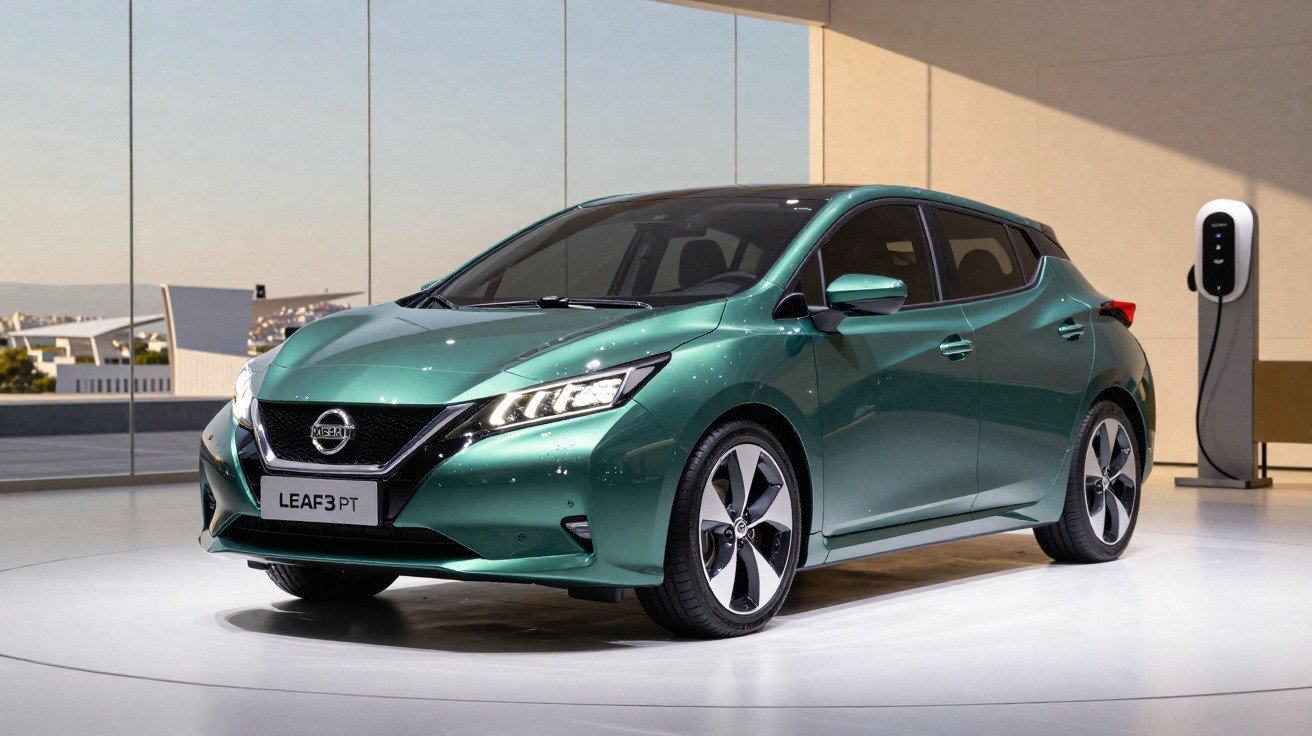
Following the arrival of the all-electric Micra, Nissan continues to refresh its line-up by introducing the third-generation Leaf in Portugal.
First launched in 2010, the Nissan Leaf spent several years as the “father” of electric mobility, with more than 700,000 sold worldwide - including 280,000 in Europe alone. It now returns to the Portuguese market with prices starting at €39,900.
Expectations for this model are understandably high, and we have already had the chance to drive it both in Portugal and abroad. Here is what we made of it:
A very Nissan-looking exterior
The Leaf’s exterior marks a clear break from its predecessors. Nissan has completely moved away from the traditional hatchback silhouette, replacing it with a fastback crossover profile that better matches current tastes and, crucially, improves aerodynamic efficiency - the drag coefficient (Cx) is 0.25.
The brand has also opted for a more distinctive lighting signature, featuring a black strip that links the headlamps and graphic touches inspired by the Nissan logo. At the rear, the light clusters combine two horizontal elements with three vertical ones, and that layout is deliberate: it nods to the number 23, regarded as a kind of lucky number for Nissan.
Interestingly, compared with the previous generation, the new Nissan Leaf is 13 cm shorter (4.35 m), 1 cm taller and 2 cm wider. Even so, it is roomier than ever. The boot is proof, with total capacity rising from 422 litres to 437 litres - an increase of 15 l.
Inside, there is little to nothing left of the Leaf we used to know. In front of the driver, there is now a pair of 12.3 in screens for the instruments and infotainment, or, on higher-spec versions, two 14.3 in displays.
On connectivity and tech, the new Japanese EV includes wireless Android Auto and Apple CarPlay, a Bose premium audio system, and a panoramic roof that can switch between opaque and transparent at the press of a button.
Over 600 km of range
Built on the CMF-EV platform, the Leaf is offered with two battery options - 52 kWh and 75 kWh - delivering WLTP ranges of 450 km and 622 km, respectively.
As for powertrains, the version with the smaller battery is “driven” by a 130 kW (177 hp) electric motor producing 345 Nm of torque, enough to go from 0 to 100 km/h in 8.5 seconds. The larger battery is paired with a stronger motor rated at 160 kW (218 hp) and 355 Nm, cutting the same sprint to 7.8 seconds.
Charging-wise, the 75 kWh battery supports DC fast charging of up to 150 kW, enabling up to 420 km to be recovered in just 30 minutes. With the 52 kWh battery, maximum DC charging power is 105 kW, allowing a 20% to 80% top-up in around 30 minutes, equivalent to 277 km. On AC, both batteries accept charging at up to 11 kW.
When does it arrive?
The new Nissan Leaf comes in three trim levels:
- Engage: the entry point to the range.
- Advance: adds a panoramic roof, a head-up display and two 14.3 in screens.
- Evolve: the flagship version, featuring 19 in wheels, synthetic-leather seats and a nine-speaker Bose sound system.
The third-generation crossover can already be ordered in Portugal from €39,900. The launch campaign, valid until 31 July, includes three years of maintenance, while the battery warranty remains at eight years. Deliveries begin this month. See all prices:
Comments
No comments yet. Be the first to comment!
Leave a Comment