
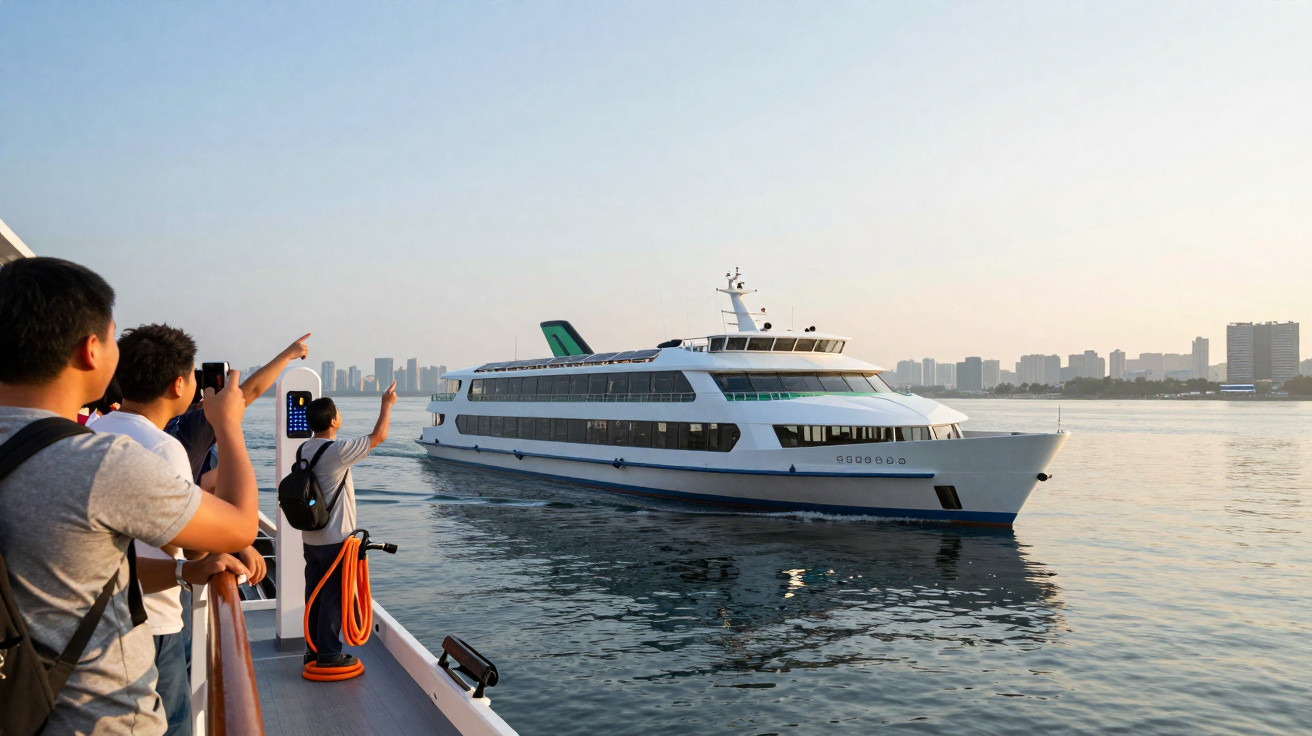
Cranes groan, gulls shriek, and engines splutter into life on every side. Yet out on the pier, the largest vessel you can see sits in complete stillness, its lights shining like a city at night. There’s no roar. No exhaust. Only a faint electric whirr you’ll miss unless you fall quiet and really listen. Dockhands hesitate. Phones lift into the air. A child calls out, “Is it really running?” This time the reply is yes. And when the giant finally eases off the quay-with 2,100 passengers aboard-the sea tells the tale before the news does.
A silent giant in a noisy world
What stands out first isn’t its scale, but what’s missing: the familiar heavy, oily soundtrack that usually comes with departure. This fully electric passenger ship-the biggest of its kind in South America-pulls away like a moving block of flats, leaving barely a ripple behind. From the decks, the shoreline doesn’t vanish into a smudge of fumes; it stays crisp, as though someone wiped the sky clean. You can even make out conversations from three decks away.
On the quay, a sailor chuckles that it feels “wrong” not to catch the smell of fuel when something this big starts moving. Still, he’s filming too, just like everyone else. That’s the odd electricity of the moment: equal parts disbelief and quiet pride. In a region associated with oil, vast hydroelectric dams, and tangled politics, South America is suddenly out in front in the push for cleaner maritime transport. Not as a lab experiment or a glossy concept clip-on real water, with real people queueing up for lunch.
Behind the poetry of that departure sit hard numbers. The battery system is less like what’s under a car bonnet and more like a power station that floats. These are enormous packs designed to carry more than 2,100 passengers over busy routes without burning a single drop of marine fuel onboard. The builders say the ship can reduce local CO₂ emissions by thousands of tonnes each year compared with a conventional ferry of the same size. That isn’t a neat marketing line; it’s thousands of tonnes of smoke that never reaches the air above coastal cities already struggling to breathe.
The record it has just claimed is straightforward: it is the largest fully electric passenger ship in service in South America, and among the biggest currently operating anywhere. It also sends a message to ports from Buenos Aires to Belém: the rules are shifting. Once a giant can sail in near-silence, everything else starts to sound dated-old technology, old excuses, old habits.
How do you move a floating city on batteries?
From afar, it could pass for any contemporary passenger vessel: a white hull, tiered decks, and long lines of windows. The real difference is beneath your feet. Where you’d normally find cavernous tanks of bunker fuel, engineers have fitted huge battery rooms-shielded and cooled like the core of a data centre. Charging isn’t done at some hidden offshore platform; it happens alongside, using high-capacity connections that feed the ship like a phone on an ultra-fast charger.
Day-to-day operations run on a strict rhythm. Overnight, while cleaners work through corridors and galley teams prepare breakfast, power flows into the ship in near silence. On certain routes, rapid charging slots are squeezed between turnarounds, drawing shore power from grids increasingly shaped by South America’s strengths: hydropower, coastal wind, and inland solar. That’s where the narrative changes from a nice green novelty into a regional plan. The vessel isn’t merely cleaner-it taps into an energy system that is already changing.
The figures create their own little drama. A diesel ferry of this size can consume thousands of litres every day. With that comes the vibrations underfoot, the constant low growl, and the haze that hangs over crowded terminals. Here, the air inside feels strangely neutral-no burnt-fuel scent clinging to your clothes. Noise levels fall so far that announcements don’t have to compete with engines. Crew members say end-of-shift tiredness feels different too: less like spending hours next to a lorry engine. For passengers, the payoff is deceptively simple-a more relaxed body, fewer headaches, and conversations that don’t require raised voices.
Underneath that calm sits a rationale that is both financial and political. Fuel prices swing wildly, and shipping operators have spent years trying to ride those surges. Electricity is easier to budget for, particularly when port authorities negotiate predictable long-term supply. For South American governments wanting to show climate progress without asking voters to give up essential travel, a highly visible electric flagship is appealing. It’s a way of saying: we’re still moving-just in a different way.
What this changes for travelers, cities and the sea
Anyone who has sat on a packed ferry with an engine hammering beneath plastic seats knows how punishing short crossings can be. This electric giant changes the experience in small, meaningful steps. The first “method” is almost comically straightforward: remove the source of the rumble. Once that constant vibration disappears, designers gain room to rethink interiors. Lounges can stay quieter. Windows can run broader. People who often feel seasick say it’s closer to gliding on a train than jolting on a bus.
Ports along the route have had to learn new habits as well. High-voltage charging isn’t like topping up a car. Teams follow strict procedures when connecting the ship, repeating the same sequence at every stop like a well-practised routine. There’s also a new role on the quay: technicians focused on the point where the grid meets the hull-inspecting cables, tracking temperatures, and spotting small irregularities before they turn into major headlines. It’s not glamorous, but it’s how record-setting becomes everyday work.
Even so, the complications are real. Not every port has enough grid capacity to power a battery-hungry behemoth several times a day. Some terminals have needed transformer upgrades, new cabling, and fresh negotiations with utilities already stretched thin. Nearby residents wonder who will end up paying for that. Environmental groups look past the clean wake and push tougher questions: where the batteries come from, and what happens once they reach end of life. Let’s be honest: hardly anyone really does that every day-sit down and read the fine print of a 600-page environmental impact assessment.
This ship sits squarely in that tension. It’s a leap forward, yes, but also a compromise between what we imagine and what can realistically be built in 2026.
One engineer working on the project put it bluntly on launch day:
“This isn’t a miracle. It’s just the first time we had enough courage, policy and money in the same place to try something at this scale.”
That triangle-“courage, policy and money”-is the real engine behind the glossy clips. Coastal cities see benefits: less local pollution, a greener brand for tourism, and a way to protect essential routes before tighter rules squeeze fossil-fuelled ships. Shipbuilders see a market that could keep them alive in a world where simply making bigger, dirtier engines no longer adds up. Travellers, at least at first, mostly notice better photos for social media and a calmer crossing. Then public health agencies start measuring air quality around ports, and those results begin to matter to real people with real lungs.
Practically speaking, what should a curious reader remember when they hear “world’s largest electric passenger ship”? A few down-to-earth points help separate reality from hype:
- Battery propulsion doesn’t wipe out emissions by magic; it relocates them to wherever electricity is generated.
- Early adopters spend more upfront, but they also influence standards and reset expectations.
- Comfort onboard is often the first benefit the public can genuinely feel.
A record that asks more questions than it answers
By the time the ship finishes its first full day in service, the record is already yesterday’s news. Passengers step off, suitcases rolling through quiet passageways, eyes on their phones, thinking about taxis, dinner, meetings. For them, the headline becomes a memory of a smooth ride, a quieter nap, and water that seemed a touch clearer near the harbour wall. Yet something sticks. If a 2,100-passenger giant can run on electrons, perhaps the obstacles we repeat to ourselves are less immovable than we assume.
Shipowners elsewhere will study the numbers relentlessly. Reliability. Turnaround times. Maintenance costs. If a major failure comes, it will travel faster than any press release. That’s the delicate moment we’re in: inspiration and scepticism sharing the same table, arms folded. South America-so often treated as a follower in heavy industry-now hosts a floating prototype the entire sector is watching. On a blustery afternoon, that’s a lot to carry on one sleek hull.
Most of us have lived through the arrival of a new thing in our town-a tram extension, a bike-share scheme, an odd-looking bus-followed by older relatives shaking their heads, certain it won’t last. Then you blink and, ten years later, it’s impossible to picture the place without it. This electric record-breaker may be exactly that sort of object. Not the final word, but the starting signal. And the real question-hanging over every diesel engine still coughing away in the world’s ports-is disarmingly simple.
What happens when silence becomes the new normal at sea?
| Key point | Detail | Why it matters to the reader |
|---|---|---|
| Record size | More than 2,100 passengers carried by a 100% electric ship | Gauge the scale of the shift compared with classic ferries |
| Environmental impact | Major reduction in local CO₂ emissions and port-side fumes | Understand the practical benefits for health and coastal city air |
| New travel experience | Less noise, fewer vibrations, comfort closer to a modern train | Picture what passengers will actually feel onboard |
FAQ:
- Is this really the world’s largest fully electric passenger ship? It’s currently the largest known fully electric passenger vessel operating in South America, and among the biggest globally, though records may evolve as new ships launch.
- How far can a ship like this travel on a single charge? Range depends on route, speed and sea conditions, but these vessels are usually designed for regular regional crossings with charging cycles built into their schedules.
- Is the electricity always “green”? Not always. The environmental gain depends on the local energy mix, though many South American grids already rely heavily on hydropower and growing renewables.
- Are electric ships more expensive for passengers? Tickets might not jump overnight; operators tend to spread higher investment costs over years and may benefit from lower fuel and maintenance bills.
- What happens to the huge batteries at the end of their life? They can be repurposed for stationary storage or recycled, and shipbuilders are under pressure to develop clear second-life and recycling pathways.




Comments
No comments yet. Be the first to comment!
Leave a Comment