
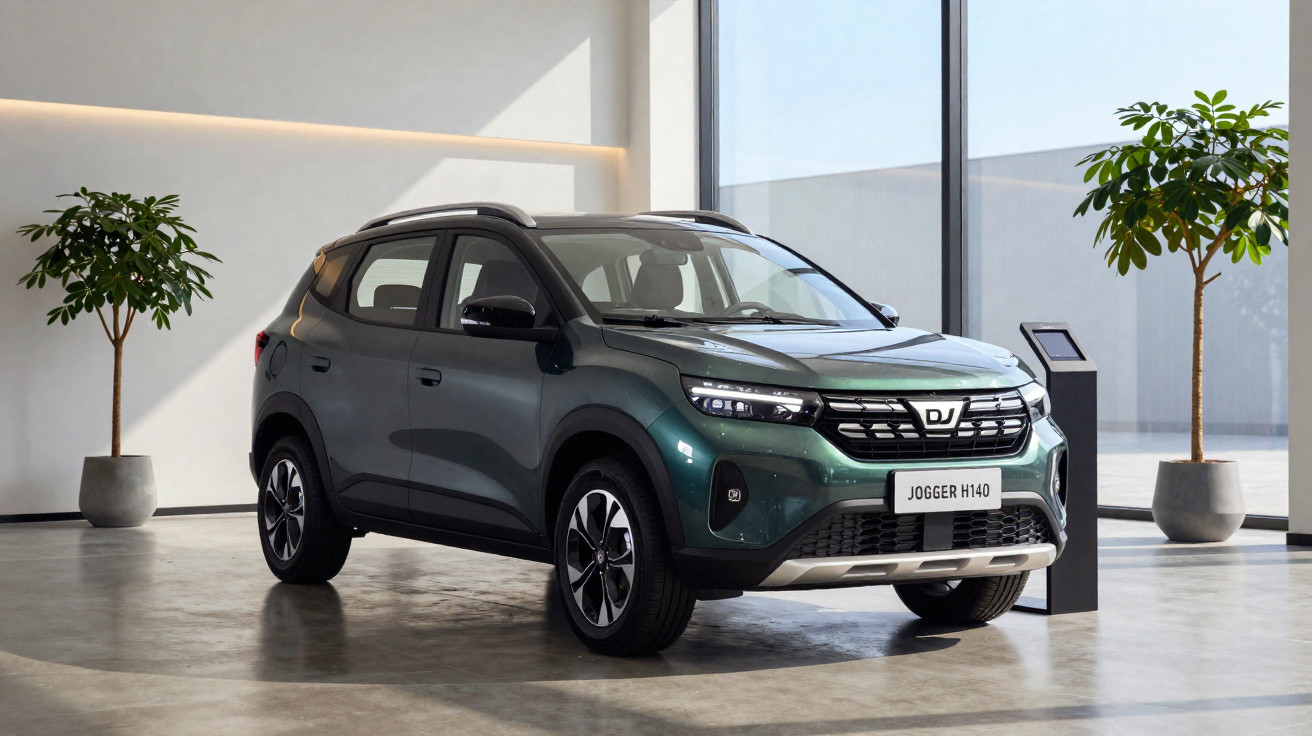
Is the Dacia Jogger Hybrid 140 the best value for money on the market? Probably.
At first glance, the Dacia Jogger Hybrid 140 might look like just another Jogger among the many already on our roads - but appearances can be misleading.
Beneath the familiar bodywork sits a hybrid powertrain, the first hybrid system in Dacia’s history. And for its first hybrid, the Romanian brand followed a “recipe” it knows well: it turned to technology first launched (and proven) by Renault.
As a result, the new Jogger Hybrid 140 uses the same drivetrain as the Renault Clio E-Tech Full Hybrid - a model that has already been through Razão Automóvel’s garage.
Dacia presents the Jogger Hybrid 140 as “the most affordable hybrid family car on the market”, yet its strengths go beyond price alone - even if that price is €28 800.
That became clear during the international launch of the Dacia Jogger Hybrid 140, held in Portugal, which gave us the chance to get our first drive “at home” around the Lisbon area.
Space for (almost) everything
Unlike many models that become hybrid versions and end up losing practicality, the Jogger Hybrid 140 hasn’t had its cabin space compromised by electrification. The reason is simple: it was engineered from the outset to accept a hybrid system.
By fitting the small 1.2 kWh battery where the spare wheel would normally sit, Dacia not only kept the seven-seat layout - the only Jogger Hybrid 140 configuration that will be sold in Portugal - but also avoided any reduction in boot capacity.
In the rear, there’s enough room to install two child seats without fuss, and even the third-row seats allow genuinely comfortable travel - certainly more so than what you get in many seven-seat SUVs.
The cabin floor height has also remained unchanged, which is particularly welcome when you need to climb into the third row.
The sound… of silence
Although this is a conventional hybrid (it isn’t plug-in), it can still run in 100% electric mode - even if only for short bursts.
It’s in these quieter moments that the Romanian model’s solid feel stands out most. The build quality leaves little to criticise, even if the materials aren’t especially pleasing - most are hard and not particularly nice to the touch - suggesting durability should be a strong point. Wind noise is a bit more noticeable, but it never becomes truly irritating.
Compared with other Jogger versions, the Hybrid 140’s cabin changes are limited to the automatic gearbox selector and a new 7" digital instrument cluster. The latter proved comprehensive and easy to read - something that, these days, can’t always be said of similar displays.
How much does it use?
Because it’s a hybrid, the first question is inevitably how economical the Dacia Jogger Hybrid 140 really is. And yes - it showed a very restrained thirst.
On a route that included long motorway stretches as well as climbs through the two main mountain ranges near Lisbon - Sintra and Arrábida - consumption stayed consistently below five litres, dropping as low as 4.3 l/100 km.
With this being only a brief first drive, we couldn’t confirm what consumption will look like when using the Jogger to its full family potential, so we’ll need another opportunity for a longer test.
Proven technology
As mentioned earlier, the Dacia Jogger Hybrid 140 adopts the Clio E-Tech Full Hybrid’s mechanical package. In other words, up front there’s a naturally aspirated 1.6 l four-cylinder engine producing 90 cv, paired with two electric motors. One delivers 50 cv, while the other is a high-voltage starter-generator. Power for the electric motors comes from a 1.2 kWh battery.
Together, the system produces a combined maximum of 140 cv and 205 Nm, making the Jogger Hybrid 140 the most powerful model in the range. Transmission is handled by an automatic electric gearbox - also the first automatic offered in the Jogger line-up.
This unit combines a four-speed clutchless manual gearbox - gears are engaged by electric actuators with no driver involvement - with two ratios linked to the electric motor.
Behind the wheel of the Jogger Hybrid 140
In everyday driving the end result impresses with its smoothness at low speeds, but when you call more decisively on the 140 cv, it can partly resemble CVT-equipped hybrids thanks to the engine’s higher noise levels.
Performance also fell slightly short of expectations, considering it offers 30 cv more than the petrol-only Jogger models. That extra output is partly “diluted” by the gearbox’s somewhat slow responses.
The priority of this hybrid system is clearly efficiency and an overall sense of refinement, which is obvious from the driver’s seat.
Even so, there’s enough power to maintain strong motorway pace and to overtake without excessive planning - but the gap to the petrol-only version ended up being smaller than expected.
The Jogger’s family-focused mission also shows in its dynamic behaviour: more comfortable than sharp, and always predictable and secure.
One weaker point is the brake pedal feel, which isn’t always easy to “read”. This is a common trait in many hybrid and electric models, where blending regenerative braking with the mechanical system still isn’t perfectly mastered.
On the other hand, energy recuperation on lift-off deserves praise - especially when using “B mode”, which increases its intensity.
Increasingly competitive
By launching the Jogger Hybrid 140, Dacia aims to “democratise” another type of powertrain, having already done so with electric cars via the Spring.
Sold in Portugal only in the highest specification - the seven-seat SL Extreme - the €28 800 asked for the Jogger Hybrid 140 makes it, by far, the most affordable hybrid family car on the market.
For anyone who drives mostly in town, or for whom an automatic gearbox is “non-negotiable”, the Jogger Hybrid 140 is “the Jogger to buy”.
However, if those priorities don’t apply, the savings potential of the ECO-G version - a bi-fuel model (LPG + petrol) - along with its lower price, make it an alternative worth considering.
Either way, the arrival of the hybrid version gives the Jogger extra arguments to “win over” a broader slice of the market.
Comments
No comments yet. Be the first to comment!
Leave a Comment