
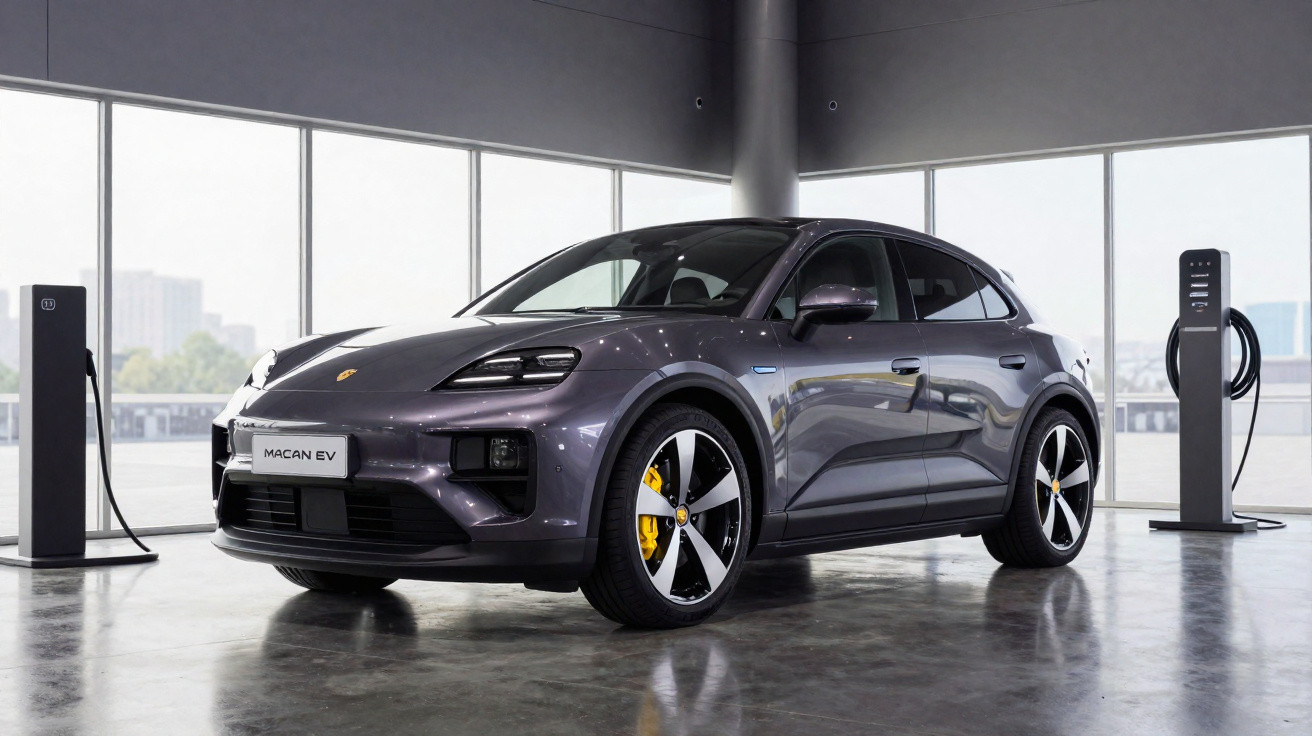
It’s electric-only, but don’t let that put you off. The new Porsche Macan is one of the strongest SUVs in its class.
Even though Porsche has seen a worldwide dip in demand for 100% electric cars this year, the arrival of the new Porsche Macan still marks another historic moment for the German brand. As promised, the latest generation of the SUV-one of Porsche’s best-sellers-comes exclusively as a fully electric model.
The new Macan is already on sale in several markets, with Portugal featuring prominently. Portuguese interest in the new Porsche Macan accounts for around 45% of the entire Iberian market. Despite delays to its launch, the SUV has continued to build up pre-orders.
By the numbers, 213 units have already been delivered in Portugal, and projections suggest that figure could climb to close to 450 units by the end of the year.
Now, at last, it was time for our first dynamic drive on Portuguese roads.
It’s a Porsche, without question
At first glance, it’s immediately clear this could only be a Porsche. A number of elements introduced with the Taycan also appear here, including the headlamps with four-point lighting signatures and the rear horizontal LED light bar.
Porsche’s smallest SUV is anything but small. Overall length is almost 4.8 m and width is 1.94 m, with height sitting just above 1.6 m. It’s slightly longer and wider than the previous generation.
The key for the test car we were handed woke up the lighting system on a dark-coloured Porsche Macan Turbo fitted with 22-inch wheels. As with its predecessor, the decorative sideblades are still present along the flanks, while the roofline now looks even more “Porsche”.
As with the Taycan, the Turbo badge loses the association it previously had on the combustion-engined Macan and becomes the top-tier designation in the range. Turbo also identifies the flagship combustion models, and Porsche didn’t want that to be lost with its electric line-up.
A modern cabin that still feels familiar
In the driver’s seat, I don’t even need to look: I know that to start the “engine”-in this case, an electric system with two motors-I need to use my left hand. The difference is that, instead of inserting a key, there’s now a button in that position.
The driving position is spot-on, with electric adjustment for both the seats and the steering column. That puts the three-spoke sports steering wheel right in front of me and set in a more upright orientation. As on the Taycan, the transmission selector has also moved to the right-hand side of the instrument panel.
Inside, there isn’t much more to add beyond what Diogo Teixeira showed us in the video during the first presentation earlier this year.
It’s worth reiterating that there’s plenty of space on board, and close to 670 litres of combined luggage capacity: 580 l at the rear and 84 l under the bonnet in the frunk-very much in the spirit of a Porsche Boxster.
Finally, out on the road
The most immediate driving impression-clear within the first few metres-is how solid the whole car feels. That isn’t simply down to the 2.5-tonne kerb weight; it’s more about the high structural rigidity and build quality, which shuts out unwanted noises. True to its electric nature, cabin sound insulation is excellent.
Even over speed humps and broken surfaces, that solidity remains-not only in the cabin itself, but also in what comes through the steering column and in how the suspension “plants” the car, despite the huge 22-inch wheels and the low-profile tyres on our test vehicle. Even so, comfort remains impressively high.
Most of the 130 km route was on the motorway, with a lot of it driven in heavy rain. The combined peak output of 430 kW (584 hp)-or 470 kW (639 hp) in Overboost with Launch Control-demands real care with how you modulate the right-hand pedal. It’s easy to be “catapulted” forward into very high speeds. The instantaneous 1130 Nm of torque makes the Macan’s 2500 kg feel featherweight.
The PPE (Premium Platform Electric) architecture underpinning the Macan-an EV-specific platform co-developed by Porsche and Audi (first used by Audi in the Q6 e-tron)-uses an 800 V system. For now, there’s only one battery available, with a capacity of 100 kWh, of which 95 kWh is usable.
The Macan Turbo claims a 590 km range (WLTP combined), but on this first drive it wasn’t possible to draw firm conclusions on consumption. That will have to wait for a full test.
On the other hand, the four-wheel steering system once again proved its worth: it remains a perfect aid during manoeuvres, while also delivering strong stability through corners. Working alongside a direct, accurate steering set-up, it translates into a genuinely engaging drive.
More versions on the way
The first two variants added to Porsche’s configurator were the Macan 4 and the Macan Turbo, priced from €86 793 and €118 846 respectively. And those are exactly the two we’ve already driven-and the ones we’re now starting to see out on the road.
Right now, two more options can be ordered: the Macan (base version) and the Macan 4S, although the first deliveries are only expected next February. For the Macan 4S, the starting price is €94 038, but it’s the base version that is likely to draw the most attention on price.
The Porsche Macan tasked with being the entry point to the range starts at €83 671 and will be the first Macan offered with rear-wheel drive only. Its single motor delivers 360 hp, and the 0–100 km/h sprint can be completed in 5.7s.
The most significant figure, however, is the claimed maximum range of 643 km, since the battery is the same as in the other versions-i.e., a 100 kWh pack (95 kWh usable).
As for what comes next, it’s still too early to say what the future holds for the Porsche Macan and the PPE platform. What is already clear is that the brand’s original plan to reach 80% of total sales from electric models by 2030 is no longer going to happen. That could mean combustion engines staying in the line-up for longer, alongside more hybrids. Read everything in the article below:
Comments
No comments yet. Be the first to comment!
Leave a Comment