
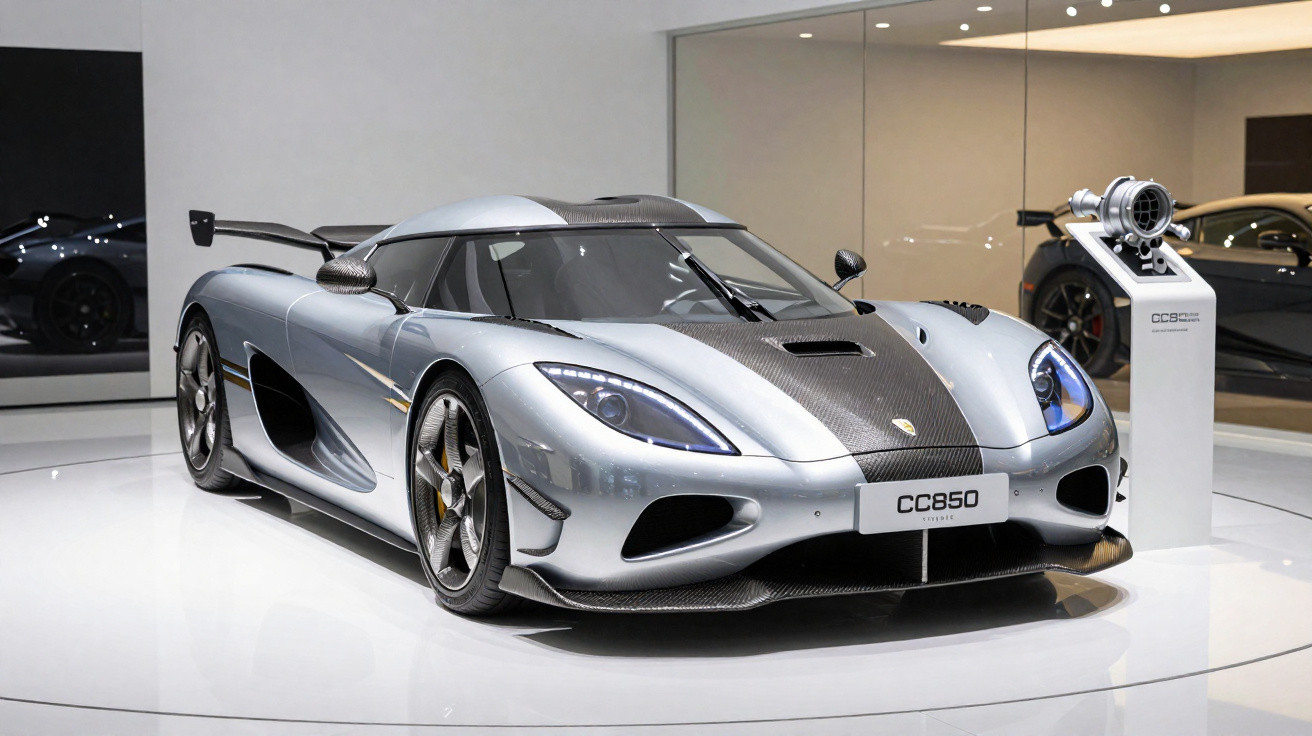
Koenigsegg may still be a relatively young brand, but last weekend at The Quail: A Motorsports Gathering in California it unveiled its first tribute car: the CC850.
The CC850 was created to celebrate Koenigsegg’s very first model, the CC8S, originally shown in 2002 - and, in truth, it really does look like its direct successor.
As Koenigsegg describes it, this new “megacar” stays very close to the original in overall form, yet its lines and surfaces have been brought up to date - above all in the details that fill them in, such as the lighting units, which have advanced dramatically over the past 20 years.
While the styling clearly nods to Koenigsegg’s beginnings, the engineering and technology are thoroughly modern.
The CC850 uses Koenigsegg’s own 5.0 V8 biturbo - the same engine as the Jesko - delivering 1385 cv and 1385 Nm when running on E85 (85% ethanol and 15% petrol). On petrol alone, output drops to 1185 cv.
The number 1385 appears again on the scales: it weighs 1385 kg, giving it a 1:1 power-to-weight ratio - 1 kg/cv.
That is exactly the same power-to-weight figure as the Koenigsegg One:1, the first model to introduce the brand’s “megacar” designation - a reference at the time to producing one megawatt (MW) of power, equivalent to 1360 cv.
Revolutionary transmission
In keeping with the CC8S, the CC850 is rear-wheel drive only, but it is the way it sends the V8 biturbo’s power to the rear wheels that draws the most attention.
Koenigsegg calls it ESS (Engage Shift System). It is based on the already remarkable Light Speed Transmission (LST) used in the Jesko, which features nine ratios and… seven (!) clutches.
The key innovation for the CC850 is that, as well as operating as an automatic, the system can also be used as a six-speed manual - complete with a third pedal for the clutch.
The intriguing part is that manual mode offers six gears, while automatic mode uses nine. A nine-speed manual would be excessive.
This difference also creates new possibilities: the split in ratios between the two modes allows the CC850 to have distinct gearing set-ups for road or track use when you drive it as a manual.
As a result, Koenigsegg can claim the CC850 is the most powerful and fastest manual production car in the world - distilled into the near-unreadable acronym TWMPAFMPC (The World’s Most Powerful And Fastest Manual Production Car).
Adding to the theatre, the gearbox mechanism is left on display, topped by a gear knob “crowned” with the Swedish flag - a nod to the origin of this very special manufacturer.
The mechanical, analogue theme continues inside. The instruments are split into three dials with no screen in sight - the central display combines the speedometer, rev counter and turbo boost pressure gauge.
When will it arrive?
Koenigsegg says the CC850 was not built to chase top-speed records - that task will fall to the Jesko Absolut - but instead to “deliver the highest level of driving satisfaction and enjoyment with the thrilling performance for which Koenigsegg is renowned.”
For now, Koenigsegg has not said when the CC850 will be launched, nor has it announced a price. Production was initially limited to just 50 examples, so a suitably eye-watering figure is to be expected.
Already sold out, but there will be more
Just five days after the CC850 was revealed, Koenigsegg announced that all 50 units had already been sold. In response to the high number of requests, the Swedish brand made an exception and decided to produce 20 more.
According to Christian von Koenigsegg, the company’s founder and CEO: “Demand for the CC850 is impressive (…) the 20 extra units we will produce are nowhere near enough to satisfy demand, but they allow us to meet the wishes of long-standing customers and attract some new customers.”
Before committing to the additional 20 CC850s - bringing total production to 70 examples - Koenigsegg consulted several of its longest-standing customers to gauge their views on the idea. Their positive response gave the green light for the increase.
Note: article updated on 25 August at 17:45 with news of the production increase after the original allocation sold out.

Comments
No comments yet. Be the first to comment!
Leave a Comment