
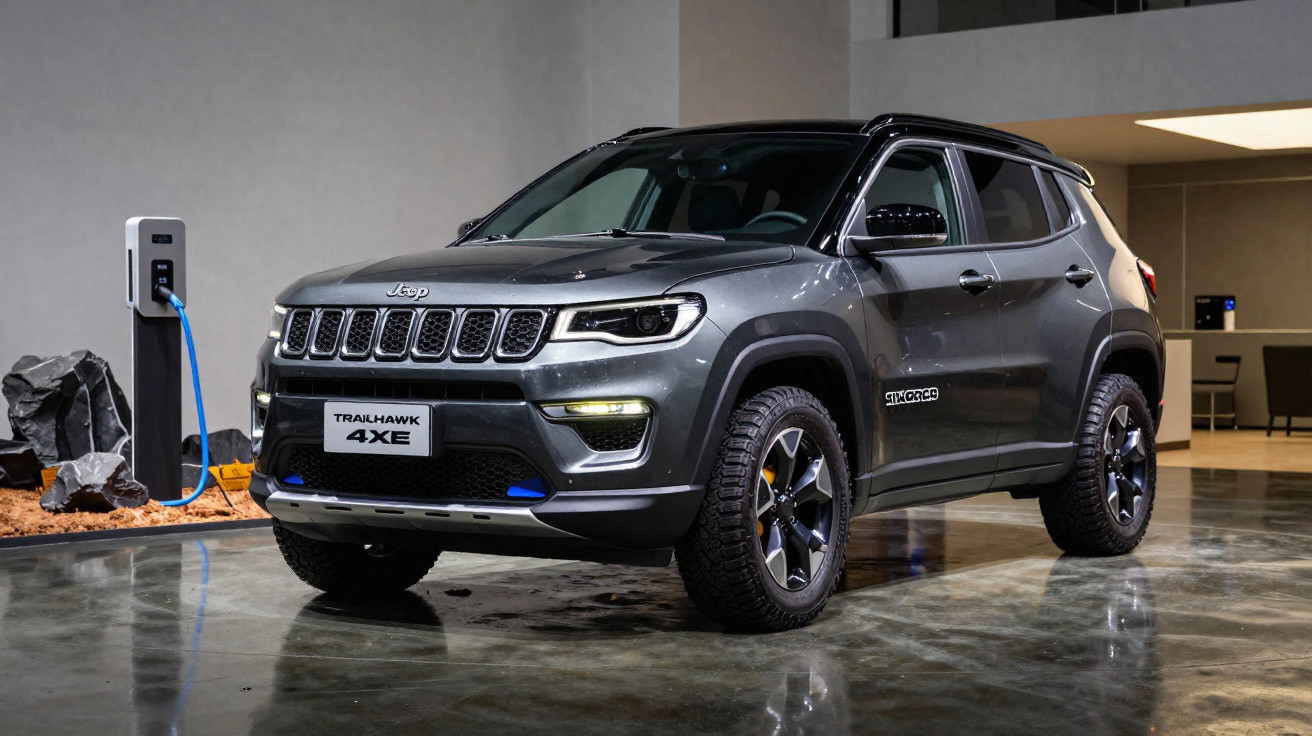
Once largely “reserved” for the versions pitched around efficiency and eco credentials, plug-in hybrid powertrains are now far more widespread, turning up across all sorts of model derivatives - including more adventurous takes such as the Jeep Compass Trailhawk 4xe.
Freshly updated, Jeep’s European best-seller (accounting for 40% on the “old continent”) has seen these versions take on particular prominence in the line-up, with 1 in 4 Compass models sold featuring plug-in hybrid mechanicals.
But does that formula still stack up in the Trailhawk variant, which is more squarely aimed at off-road ability? Do we genuinely gain something, or does it simply become a heavier car that mainly helps to hit emissions targets?
Change for the better
From the outside, most of the revisions are easy to miss - but inside, that is not the case, largely because it is… completely new.
Gone is a look that had started to feel dated, with oversized physical buttons (and the accompanying labels spelling out their purpose) scattered around. In its place is a dashboard that not only looks more contemporary, but also brings materials that feel more pleasant to the touch (and to the eye).
In the name of ergonomics, physical controls have not vanished, but the location of some of them - namely those for the driving modes and for choosing the propulsion type - still deserves a bit of criticism.
Beyond that, the new 10,25” digital instrument cluster is impressively comprehensive and features modern graphics. The infotainment system follows suit: here it pairs a 10,1” display with Uconnect 5, though it is hard not to complain about a few very small controls (such as the seat heating/ventilation buttons).
As for space, the Compass continues to score well, and even the boot holds up in this plug-in hybrid version. It sacrifices only 18 litres versus the combustion-engined, front-wheel-drive variants (420 litres rather than 438 litres).
“Climbs” almost anything
With the static walkaround out of the way, it is time to assess what matters most in any car: the driving experience.
Sitting noticeably higher than its “range siblings”, the Jeep Compass Trailhawk 4xe gives you a driving position that is higher even than what we have come to expect from SUVs. There is no doubt about it: you are in a Jeep.
On the move, it quickly becomes clear this Compass is happier tackling hills and ruts than carving through a series of bends. It gives up the sharpness of some rivals in the segment in order to deliver genuine all-terrain capability - the kind that (almost) all competitors can only dream of.
True, the steering is not the most precise and, when pushed, the higher centre of gravity makes itself known. Even so, Jeep’s offering remains predictable and safe, while also providing a pleasing level of comfort on board.
Still, it is when the tarmac ends and the “rough tracks” begin that this Jeep Compass Trailhawk 4xe really shines. For a start, you get more generous angles, “low-range gearing” (the 4WD Low function keeps 1st and 2nd gears engaged up to the redline, replicating the effect of a transmission with low-range), the option to lock the four-wheel drive, hill descent control, and five Select-Terrain drive modes: Auto, Sport, Snow, Sand/Mud and Rock.
Each mode changes the responses of the electronic aids, the engine and the automatic gearbox, ensuring you can keep moving even on the toughest routes - with an ease that does justice to the American brand’s reputation.
As for the plug-in hybrid system, it not only makes very low consumption possible in hybrid mode (my average over the test, without any particular economy-minded effort, was 6,6 l/100 km), it also delivers an electric-only range that comes very close to the official claim (52 km in town) - I managed around 42 km of “electric driving”.
It is true that the handover between the petrol engine and the electric motor is not always perfectly smooth. Even so, Jeep has achieved the main goal of plug-in hybrid powertrains: combining low consumption with the ability to drive in electric mode.
The only “downside” is that, thanks to the small fuel tank of just 36,5 litres, the total range of the Jeep Compass Trailhawk 4xe is somewhat limited. That undermines one of the biggest strengths of plug-in hybrids: helping you “forget” the range anxiety still associated with EVs.
Finally, on performance: despite a combined maximum output of 240 cv and 533 Nm of maximum combined torque, the Compass Trailhwak 4xe is not trying to be a sports model.
The six-speed automatic gearbox is smooth, but not especially quick, and 1935 kg does not help. Even so, it never feels underpowered. What happens instead is that you do not get the sensation of having virtually the same power under your right foot as a Volkswagen Golf GTI.
Is it the right car for you?
If you want a comfortable, well-equipped SUV, with plug-in hybrid power and genuine off-road ability, you will struggle to find an alternative that matches the Jeep Compass Trailhawk 4xe.
For the purists, the idea of electrifying a model geared towards off-road driving (in other words, an “aspiring hardcore 4x4”) might even sound like heresy. The reality, though, is that after a few days behind the wheel of this Compass Trailhawk 4xe, I have to admit the concept makes complete sense.
In town, you can drive in electric mode (as you can on shorter trips), and when you leave the “urban grid” behind, the petrol engine is there to “broaden horizons”.
With no official prices yet, it remains to be seen whether this updated version will stay close to the 49 500 euros asked for the pre-facelift version.
Article updated on 4 June at 9:07 with a more detailed explanation of the 4WD Low system.

Comments
No comments yet. Be the first to comment!
Leave a Comment