
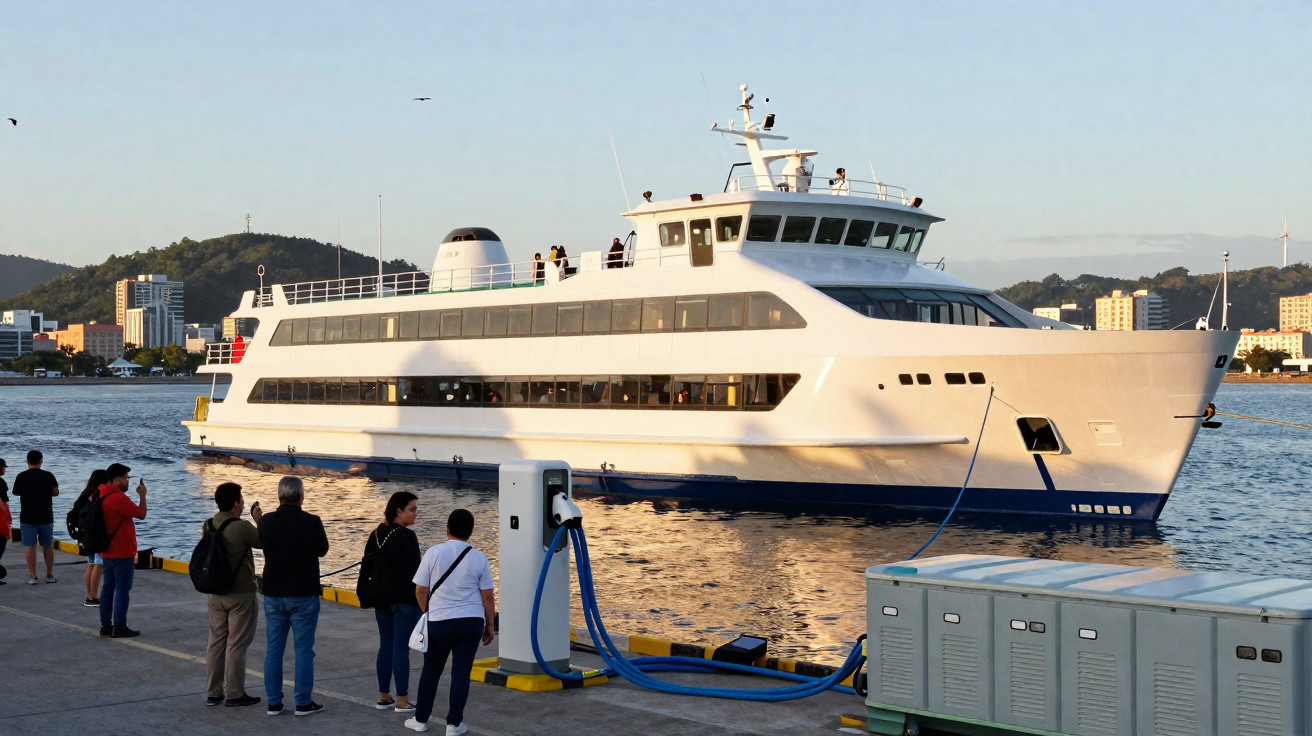
On a stretch of estuary normally known for calm, a standout aluminium giant has just changed expectations.
At first glance it could pass for another fast ferry. In reality, it is far more disruptive: a full‑scale, battery‑powered passenger ship engineered to operate all day, every day, without consuming a single drop of fuel. Constructed in Australia and destined for South America, it is already prompting shipbuilders and ferry operators to reconsider what short‑sea travel can be.
The world’s largest all‑electric ship takes to the water
On 14 December 2025, the vessel known as Hull 096 finished its first sea trials off Tasmania. Measuring 130 metres, this aluminium catamaran is now the largest 100% battery‑electric ship ever built. The builder, Incat Tasmania, delivered it for South American operator Buquebus, which intends to operate it between Buenos Aires in Argentina and Colonia del Sacramento in Uruguay, crossing the Rio de la Plata.
Its headline figures are hard to miss. Hull 096 is designed to carry roughly 2,100 passengers and over 220 vehicles-capacity more typically linked with diesel or LNG ferries. In this case, however, the propulsion system is entirely battery and electric waterjets. There is no “just in case” combustion engine running quietly out of sight.
The interior brief also goes beyond basic transport. Rather than being treated purely as a shuttle, the ship has been planned as a floating public venue. It will feature the largest retail area ever installed on a ferry, turning the 90‑minute passage into a brief shopping trip for many travellers instead of a purely functional journey.
With its 130‑metre hull, 2,100‑passenger capacity and zero local emissions, Hull 096 shifts electric ferries from niche experiment to mainstream tool.
A floating battery pack the size of a small power plant
The biggest step change sits beneath the passenger decks. Hull 096 depends on more than 250 tonnes of lithium‑ion batteries, divided into 5,016 individual modules and laid out across four purpose‑built battery rooms. Combined storage exceeds 40 MWh.
To put that into perspective, this is about four times the battery capacity of the most advanced electric ferries that came before it, and comparable to the daily electricity use of thousands of households. Up to now, energy storage at this scale has largely been associated with grid projects on land.
Every battery module is air‑cooled, each with its own fan to keep temperatures steady while charging and discharging. That detail is not trivial: for high‑power maritime battery systems, thermal control is critical. Consistent temperatures support better output, help extend cell lifespan, and reduce the likelihood of thermal runaway.
Eight electric jets, zero tailpipe emissions
Power from the battery system is delivered to eight electric waterjets, driving the catamaran across the estuary at speed. The run between Buenos Aires and Colonia del Sacramento lasts around 90 minutes, and the timetable is intended for repeated return trips throughout the day.
That operating pattern influences almost every design choice. Rather than plugging in overnight, the vessel is built around rapid port charging. At each end of the route, industrial chargers are expected to replenish the pack in about 40 minutes. Achieving that calls for more than tough marine connectors-it also requires strengthened local electricity networks capable of handling sharp peaks several times daily.
Fast turnarounds define the business case: 90 minutes at sea, roughly 40 minutes on shore, then off again, with no diesel in reserve.
From LNG concept to full battery leap
Hull 096 was not originally conceived as a zero‑emission vessel. Early plans-under the working name China Zorrilla-were based on LNG (liquefied natural gas) propulsion. LNG is often presented as a cleaner alternative to heavy fuel oil because it can reduce CO2 and certain air pollutants, which made it attractive to operators facing pressure to cut emissions.
In recent years, the balance shifted. Concerns about methane slip from LNG engines grew louder, fossil fuel pricing became more volatile, and governments tightened climate policy. With that context, Buquebus and Incat opted to abandon the LNG approach and redesign the ship around all‑battery propulsion.
Robert Clifford, the founder of Incat Tasmania, described the completed trials as a world first for a ship of this size operating on batteries alone. For Australia, the project also demonstrates that a shipyard known for fast ferries can compete in next‑generation electric shipbuilding-where tolerances are tight and safety requirements are exacting.
A direct response to shipping’s climate problem
UN trade body UNCTAD estimates that shipping produces roughly 3% of global greenhouse gas emissions. That percentage may not sound enormous, but the sector often relies on some of the most polluting fuels in use, and total traffic continues to expand.
Hull 096 presents a clear counterpoint: no direct emissions during operation. Construction still involves embedded carbon, and the electricity used for charging depends on how power is generated, but local air quality along the route should improve as soon as the vessel enters service.
Just as important, this is not a grant‑dependent demonstrator or a limited trial. Buquebus intends to deploy it as a standard commercial workhorse. That, in turn, sends a message to other operators serving short, high‑frequency routes-from Scandinavian fjords to crowded Asian straits.
Electric records at sea: a new reference point
Electric shipping is no longer a novelty; what has changed is the scale. Since 2015, multiple vessels have set benchmarks across different categories.
| Vessel | Country | Type | Year | Main record | Battery capacity |
|---|---|---|---|---|---|
| Hull 096 | Australia / South America | Passenger ferry | 2025 | Largest fully electric ship | > 40 MWh |
| Ampere | Norway | Ferry | 2015 | First commercial e‑ferry | ~1 MWh |
| Yara Birkeland | Norway | Container ship | 2021 | First electric autonomous cargo | ~7 MWh |
| E‑Ferry Ellen | Denmark | Ferry | 2019 | Longest all‑electric crossing | 4.3 MWh |
| Yangtze Electric Cargo | China | River cargo | 2023 | Largest electric river freighter | ~20 MWh |
| Color Hybrid | Norway | Hybrid ferry | 2019 | Large European hybrid | ~5 MWh |
In that context, Hull 096 is notable not because batteries at sea are unheard of, but because no passenger ship of similar length and capacity has run purely on batteries until now. Carrying more than 40 MWh, it helps move electric propulsion beyond short pilots and into fully operational international commercial service.
What this means for ports and coastal cities
A ship rarely changes in isolation: new propulsion systems tend to reshape the ports they call at. For Hull 096, the implication is straightforward-substantial grid connections are needed on both the Argentine and Uruguayan shores of the Rio de la Plata.
If 40‑minute turnarounds are to be reliable, ports and utilities must provide high‑capacity transformers, heavy‑duty cabling, and charging equipment built for saltwater conditions, spray and constant movement. Some locations may also look to on‑site solar, local battery storage, or even temporary generators to help smooth the demand spikes placed on city networks.
If delivered well, that investment will not only serve one ship. The same high‑capacity shore‑power assets could support future hybrid cargo vessels or smaller electric ferries operating from neighbouring terminals.
- Air quality improves around terminals, which are often close to densely populated neighbourhoods.
- Noise levels drop, as electric propulsion and shore power both cut engine noise while alongside.
- Ports build early experience with megawatt‑scale charging, which can also be relevant to buses and lorries.
Risks, trade‑offs and the battery question
The project also highlights difficult trade‑offs. Lithium‑ion systems introduce fire risks that differ from traditional fuel arrangements. That makes reinforced fire protection, sophisticated monitoring, and crew training focused on early warning and containment essential.
There is also the upstream impact. Extracting and processing lithium, nickel and other metals has environmental and social consequences-especially as demand grows simultaneously from cars, lorries and grid storage. Maritime deployments such as Hull 096 increase the urgency for cleaner mining, tighter supply‑chain checks and stronger progress on battery recycling.
Commercially, the case hinges on electricity costs, maintenance reductions and regulatory pressure. Avoiding fuel cuts exposure to oil and gas price swings, while electric motors generally require less maintenance than complex diesel powertrains. Against that, upfront costs climb sharply for both the vessel and the shore infrastructure, and replacing batteries after roughly a decade will be expensive.
What this could signal for the next decade at sea
For the moment, fully electric ships make most sense on short, repeatable services: ferries crossing fjords, estuaries or straits, and cargo shuttles running the same leg again and again. Hull 096 fits that profile precisely. It demonstrates that where distances are limited, schedules are predictable and port calls are frequent, batteries can replace fuel tanks rather than merely supplement them.
Longer routes are still likely to be dominated by hybrids for some time, combining batteries with engines using methanol, ammonia or biofuels. Ocean‑going container ships need weeks of energy storage, which today’s batteries cannot provide. Even so, every new benchmark on shorter routes speeds up learning-from insulation approaches to high‑power connectors-and lowers perceived risk for early adopters.
For passengers stepping aboard in Buenos Aires in the coming months, the change may seem almost ordinary: quieter decks, cleaner air in open areas, and no diesel smell as the ship pulls away from the quay. Behind that subtle shift is a 40‑MWh choice that hints at where coastal shipping could go over the next decade.
Comments
No comments yet. Be the first to comment!
Leave a Comment