
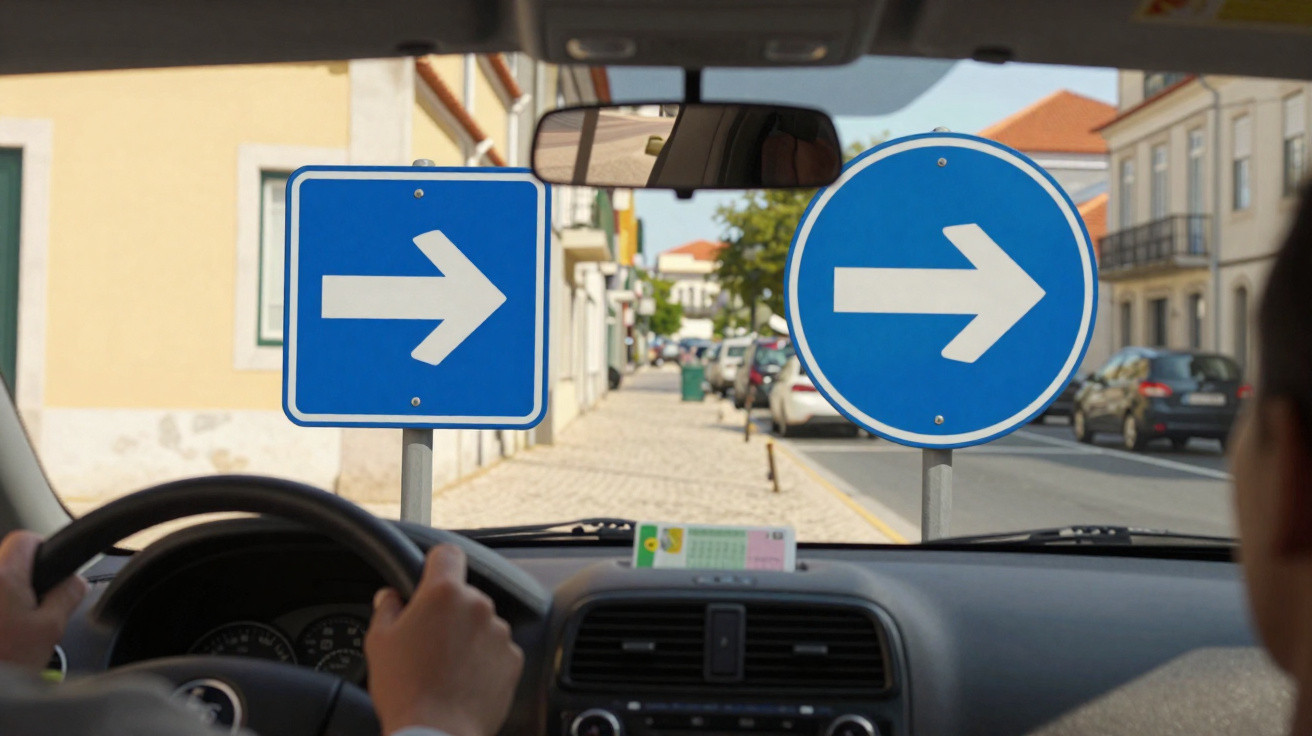
Two white arrows on a blue background can look almost identical. Yet they do not mean the same thing, and they do not demand the same actions. Mixing them up leads to wrong turns, sudden scares and, at times, avoidable penalties.
Why the confusion persists
The brain tends to register colour first and shape second. At night, in heavy rain, or in dense traffic, it takes shortcuts. Two blue signs with a white arrow can therefore seem interchangeable. In reality, one sign provides information while the other creates an obligation. That small difference changes what you are allowed to do at the exact moment you reach a junction.
Two blue signs, two opposing messages
A blue rectangular sign with a white arrow indicates a one-way street. It tells you the direction of traffic flow along that road. You may continue straight on, turn right or turn left at the next junction, provided no other signs prohibit it.
A blue circular sign with a white arrow sets a mandatory direction. It instructs you to go straight on. Turning right, turning left and making a U-turn are forbidden at the point where the sign applies.
"Blue rectangle = indication of a one-way street. Blue circle = mandatory direction. Same arrow, different consequence."
| Sign | Shape and background | Meaning | Permitted | Forbidden | Where you might see it |
|---|---|---|---|---|---|
| One-way street | Rectangular, blue background, white arrow | This road is used only in the direction of the arrow | Continue; turn at a junction if nothing forbids it | Driving against the flow (wrong way) | At the street entrance; repeated partway along |
| Mandatory direction straight on | Circular, blue background, white arrow | You must go straight ahead at the sign’s location | Go straight on | Turn right; turn left; U-turn | Junctions; roadworks; near schools |
What it changes when you are driving
On a one-way street, you are travelling in the correct direction and you decide what to do at the next intersection. The sign does not force your next move. Instead, you choose based on the signs and markings at the junction (give way, no-turn restrictions, no entry, road markings).
When you meet a mandatory straight-ahead direction, there is no longer a choice. You stay on your line and go through the junction straight ahead. Even if a turn looks available, it remains unlawful as long as the sign is in force.
"At a junction, only the circular sign dictates your immediate manoeuvre. The rectangular one describes the street’s direction, not your next move."
Common mistakes seen on the road
- Confusing one-way with no entry, then accidentally joining the next junction against the flow.
- Turning right while a mandatory straight on sign still applies before its point of effect.
- Following the sat-nav while ignoring a circular sign, then cutting across lanes at the last second.
- Noticing the arrow but not the shape, especially at night or in wet weather.
Legal consequences and risks
Failing to comply with a mandatory direction is an offence. Enforcement may result in a fixed penalty and, depending on the manoeuvre and circumstances, penalty points.
If you drive the wrong way, the offence becomes far more serious, with a risk of licence suspension and vehicle immobilisation where other road users are put in danger.
An insurer may reduce or refuse compensation for the at-fault driver if an investigation confirms that road signs were not obeyed. Where there is injury, criminal liability can be added to civil liability.
"Ignoring a circular sign costs far more than a fine: it increases the risk of head-on collisions and refused payouts."
The quick method to stop getting it wrong
Three checks you can do in two seconds
- Look at the shape first: circle = mandatory, rectangle = information.
- Identify the point of effect: the sign applies where it is placed, sometimes up to the next junction.
- Check for supplementary plates and markings: plates such as "except cycles" or "except residents", or directional arrows painted on the road.
Real-world scenarios
City centre, narrow street. You spot a blue rectangle with an arrow pointing ahead. You may carry on and then turn left at the next junction if nothing prohibits it. If a no entry sign blocks the street to the left, that left turn is not allowed, even though you are on a one-way road.
A roundabout exit is temporarily altered by roadworks. A blue circular sign with an arrow pointing ahead faces you before the next intersection. You keep straight on. Even if your navigation app suggests a turn, you delay any change of direction until the next permitted opportunity.
Cyclists, motorcyclists, heavy goods vehicles: useful nuances
Cyclists often encounter supplementary plates reading "except cycles" beneath prohibitions or mandatory directions. These can sometimes allow a right turn or a contraflow cycle arrangement. Without a clear plate, the circular mandatory sign applies to bicycles as well.
Riders of powered two-wheelers should be especially wary of fast filtering lines. A prohibited last-second turn can catch drivers out and lead to side impacts.
Heavy goods vehicle drivers frequently see mandatory directions combined with size restrictions. Route planning remains essential to avoid prohibited manoeuvres in urban areas.
When signage is missing or seems contradictory
Slow down, read the road markings and identify the most recent valid instruction. Temporary roadworks signs often take local priority. If you are unsure, choose the safest line and report the issue to the relevant local authority if the confusion continues for several days.
Practical reminders to memorise
- Information signs: rectangular or square shapes, an advisory role, no manoeuvre imposed.
- Mandatory signs: blue circular shape, an action required immediately.
- Supplementary plates: small additional signs that limit, clarify or extend how a sign applies.
"Shape before colour, message before sat-nav: that reading order prevents expensive mistakes."
To take it further at home
Run a quick self-test: print five photos of junctions, cover the road markings, then decide what manoeuvre is permitted by looking only at the sign shapes. After that, reveal the markings and compare. This exercise builds the right reflex, particularly when visibility is poor.
Make a small visual crib note: blue circle = I must comply, blue rectangle = I am being informed. Keep it in your logbook. Add reminders of common supplementary plates ("except cycles", "except buses", "residents access") so you can anticipate local exceptions.






Comments
No comments yet. Be the first to comment!
Leave a Comment