
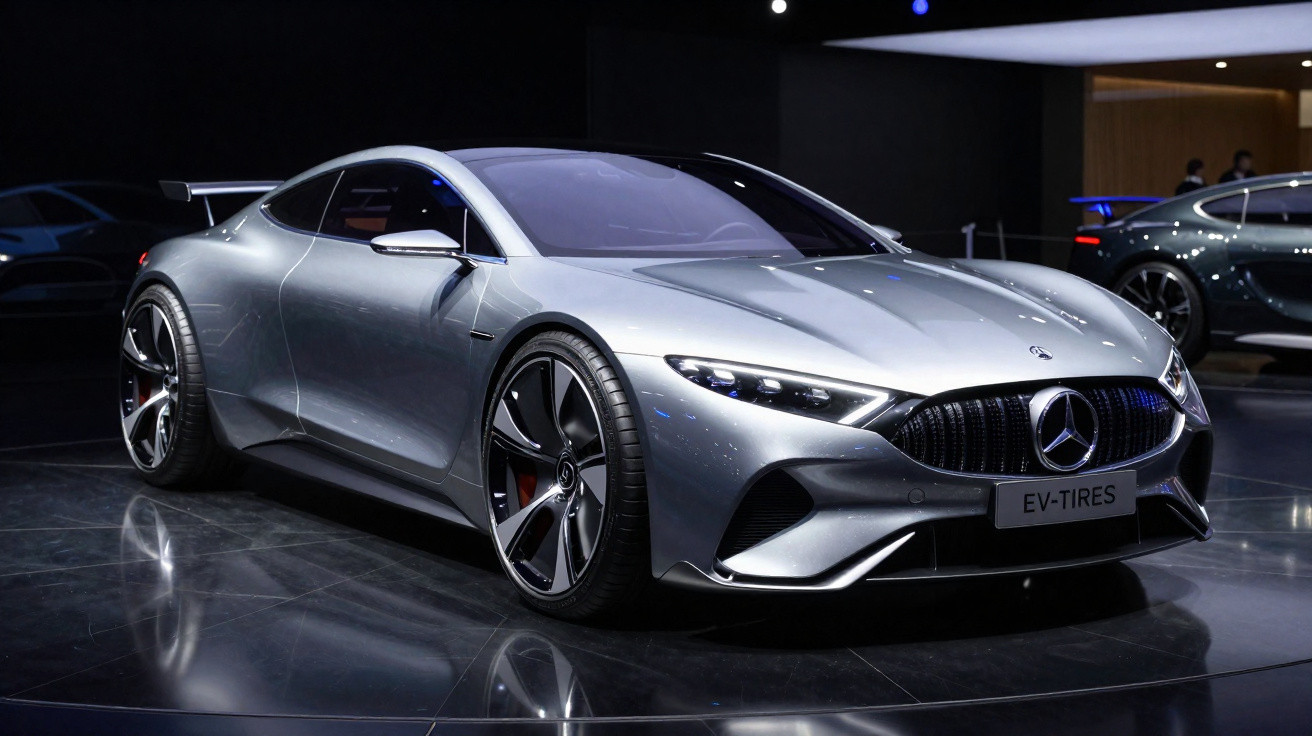
Electric cars have reshaped the way we drive, but they also bring up a question that rarely arose with combustion models: do they need different tyres?
To explore this properly, we headed to Mercedes-Benz World in the United Kingdom. There, we drove a selection of electric Mercedes models fitted with Continental tyres, to see in real conditions how acceleration, braking, cornering behaviour and energy efficiency depend not only on the vehicle itself, but also on the tyres it runs.
We had access to three models from the Mercedes-Benz electric line-up, each paired with a different type of Continental tyre:
- Mercedes-Benz EQA 250, fitted with EcoContact 6 - a tyre designed with energy efficiency in mind and engineered to reduce rolling resistance.
- Mercedes-Benz EQB 300, fitted with PremiumContact 7 - a tyre developed to prioritise driving comfort and, thanks to its Red Chili compound, intended to deliver performance straight from the start.
- Mercedes-AMG EQE 53 4MATIC+, the star of the dynamic exercises, running SportContact 7 - Continental’s most sporting tyre. It uses the Black Chili compound, created to favour grip and precision at higher speeds.
A perfect setting for testing the limits
We began with a straight-line acceleration exercise: a launch control start behind the wheel of the Mercedes-AMG EQE 53 4MATIC+. With 460 kW - the equivalent of 625 bhp - and 950 Nm of torque sent to all four driven wheels, this electric car, weighing more than 2.5 tonnes, goes from 0 to 100 km/h in 3.5 seconds. That instant shove of power highlighted one of the biggest tyre challenges on electric vehicles: coping with immediate torque.
Compounds such as Black Chili, used in the SportContact 7, are engineered to increase molecular interaction between tyre and tarmac. The aim is to deliver high traction while also keeping rolling resistance optimised. In an electric car, that balance matters even more, because energy efficiency is a central part of everyday use.
After acceleration, we moved on to braking on a wet surface. Here the extra battery mass becomes impossible to ignore. More weight means more energy must be shed, which typically results in longer stopping distances. In this test, the PremiumContact 7 underlined the value of the Red Chili compound.
Continental describes this formulation as being able to hold on to grip consistently even in lower temperatures, reducing the need for the tyre to warm up - a key advantage for unexpected braking and winter conditions.
The third exercise was a short, twisty circuit. The purpose was not to chase lap times, but to examine how a tyre manages lateral forces on a heavy vehicle. At this point, the structure of the SportContact 7 proved especially relevant. Its tread is designed to adapt to varying lateral loads, preserving stability and steering precision even when dealing with the extra forces created by battery weight.
The final part of the assessment looked at the link between rolling resistance and energy efficiency, using the EcoContact 6. When a tyre creates less mechanical resistance as it rotates, more of the energy needed to keep the vehicle moving can be used effectively.
Why do electric cars create different tyre challenges?
The first differentiator is weight. Batteries are a heavy structural component and significantly increase the load placed on the tyre. In acceleration, braking and cornering alike, that extra mass calls for reinforced construction, higher load ratings and compounds that can deliver an immediate response even under greater demand.
The second factor is instant torque. Unlike combustion engines, which generally build power more progressively, electric motors can deliver maximum force the moment the accelerator is pressed. This places greater demands on compounds and sidewall structures, which must absorb that energy input without sacrificing traction or control.
Next comes rolling resistance, which carries extra importance because of its impact on the efficiency of an electric drivetrain. Lower resistance means the tyre requires less energy to keep the car moving, supporting more effective energy performance.
Finally, there is silence. With far less mechanical noise, electric vehicles make tyre noise more noticeable. To improve acoustic comfort, technologies such as ContiSilent were created to reduce road noise by applying a foam layer inside the tyre.
What is a tyre prepared for electric vehicles?
These are tyres that build in features intended to meet the demands of electric cars as well. That does not mean they are tyres exclusively for this type of vehicle. Rather, they are designed to cope with higher masses, elevated torque, optimised rolling resistance and lower noise levels, while still retaining the versatility needed to fit combustion vehicles too.
Tyres such as EcoContact 6, PremiumContact 7 and SportContact 7 reflect this approach: each targets a different usage profile with an emphasis on efficiency, comfort and performance, but with updated engineering to address the challenges electric cars bring.
True or myth?
The answer is straightforward: electric cars do not need special tyres, but they do benefit from tyres that are prepared for their specific requirements. Weight, instant torque, dynamic behaviour and energy efficiency all directly influence how a tyre works and how it behaves on the road.
What we saw on track reinforces that point. With the right tyre on the right car, the driving experience becomes safer, more consistent and more efficient, regardless of whether the powertrain is electric or combustion.

Comments
No comments yet. Be the first to comment!
Leave a Comment