
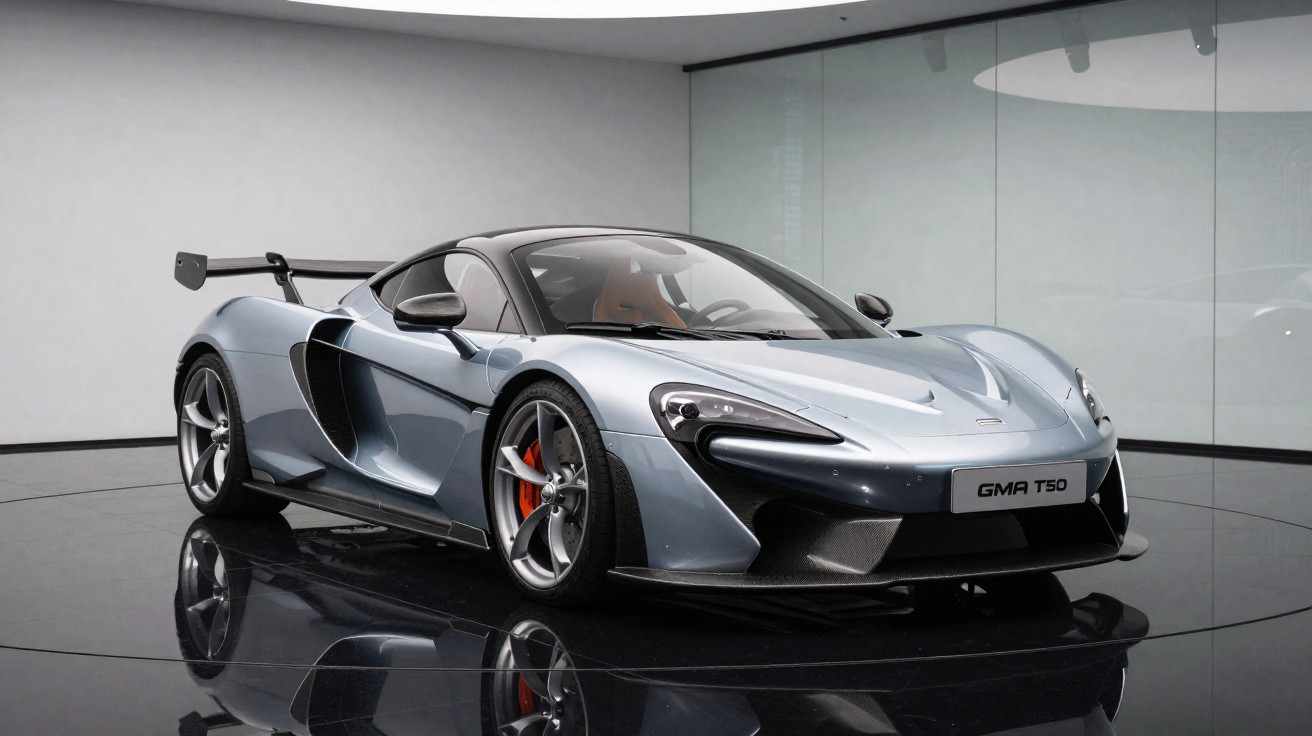
It’s here at last… the Gordon Murray Automotive T.50 - or GMA T.50 for short - has finally been unveiled. After months of anticipation for what has been billed as the true successor to the McLaren F1, and as the “purest and lightest supercar ever made”, we can now see the full “portrait”.
Before we get into the numbers that define this machine, the naming question is now settled: it really will be the rather anti-climactic T.50 - even if it doesn’t have the instant myth-making ring of F40 or F1.
The designation comes from the project count: it is Gordon Murray’s 50th design programme. The number 50 also lines up with 50 years of his career, which he is now celebrating - and what a way to mark it.
Without further delay, here is this resolutely analogue machine explained through the stark clarity of its figures:
986 - GMA T.50 weight (kg)
Some call it obsession, but in the car world weight is the right kind of obsession. It’s also one of the main reasons Gordon Murray is so widely admired. The GMA T.50 weighs just 986 kg, with all fluids and ready to drive. When was the last time you saw a supercar come in under a tonne?
Even the stripped-back Ferrari F40 tips the scales at more than 1,200 kg in running order. For context, 986 kg is (slightly) less than the roughly 1,000 kg of a Mazda MX-5 1.5 - and the T.50 manages that with three seats and a V12 mounted behind you.
Breaking the 986 kg down into some of its major components:
- 150 kg - carbon-fibre monocoque structure and carbon-fibre body panels;
- 178 kg - the naturally aspirated 4.0-litre V12. It is the lightest production V12 ever made, using steel, aluminium and titanium;
- 80.5 kg - six-speed manual transmission, around half what a dual-clutch gearbox would weigh;
- 7.8 kg - each front wheel (19 in × 8.5 in);
- 9.1 kg - each rear wheel (20 in × 11 in);
- 13 kg - combined weight of the three seats;
- 3.9 kg - bespoke Arcam audio system with 700 W and 10 speakers.
12 100
Stratospheric. 12 100 is where the rev limiter sits for the naturally aspirated 3,994 cm³ V12 engineered by the specialists at Cosworth.
Peak output arrives only “slightly” lower down: 663 hp at 11,500 rpm. Maximum torque is 467 Nm at a lofty 9,000 rpm. Any fear that this is an overly peaky engine is eased by the fact that 71% of peak torque is available at a much more civilised 2,500 rpm.
What’s more, the GMA T.50’s V12 offers two dedicated engine maps accessible via the driving modes. In GT mode, revs are capped at 9,500 and power is limited to 600 hp, making the T.50 more manageable in town.
More V12 figures:
- 166 hp/l - the highest specific output ever achieved by a production V12;
- 14:1 - among the highest compression ratios used in an Otto-cycle engine;
- 0.3 s - the time it takes to go from idle to redline;
- 178 kg - the lightest production V12 ever made.
6
Bolted to the 4.0-litre V12 is a six-speed manual - yes, three pedals and an H-pattern - developed by Xtrac. Compact and extremely light at 80.5 kg, it uses an aluminium casing and promises a very short throw, operated via a titanium gear lever. The linkage is visible from the cabin, another detail that only adds to the T.50’s sense of occasion.
The first five ratios are shorter to maximise acceleration, while sixth is considerably taller - better suited to open roads or motorway cruising.
672
With 663 hp moving just 986 kg, the T.50 delivers a power-to-weight figure of 1.48 kg/hp, or the more British-friendly 672 hp per tonne.
That’s roughly 40% lower or higher, depending on which way you do the comparison, than a “typical” supercar. Gordon Murray Automotive cites 1,436 kg as the average mass of a modern supercar; to match the T.50’s power-to-weight ratio at that weight would require adding roughly 300 hp to the T.50’s 663 hp - in other words, more than 960 hp, bringing extra complexity and… more weight.
40 - rear fan aerodynamics on the GMA T.50
In the GMA T.50’s aerodynamic toolkit, the star feature is the rear fan: a substantial 40 cm in diameter. It’s a comparable concept to the Brabham BT46B “Fan Car”, the Formula 1 single-seater Gordon Murray designed back in 1978. Murray says the new solution is more sophisticated than what he devised more than 40 years ago, because it enables multiple modes with distinct effects.
As well as dominating the rear view with its 40 cm diameter, the fan spins at 7,000 rpm thanks to a 48 V electric motor.
The fan system offers six modes: two automatic (Auto and Braking) and four driver-selected (High Downforce, Streamline, V-Max, Test):
- Auto - the default setting. The T.50 behaves like any other supercar with passive ground-effect;
- Braking - automatically sets the rear spoilers to maximum angle (more than 45°), with the fan running at maximum speed in combination with the diffuser valves opened. In this mode, downforce is doubled and it can cut 10 m from the braking distance from 240 km/h. This mode overrides all others when required.
- High Downforce - prioritises grip by increasing downforce by 50%;
- Streamline - reduces aerodynamic drag by 12.5%, enabling a higher top speed and improved efficiency. The fan runs at maximum speed, drawing air from the top of the T.50 and creating a virtual tail to reduce turbulence.
- V-Max Boost - the T.50’s most extreme setting. It uses elements of Streamline, but thanks to the ram-air effect it allows the V12 to reach 700 hp for short periods to sharpen acceleration.
- Test - used only with the T.50 stationary. It exists to test and verify correct operation of the entire system, comprising the fan and multiple moving elements such as rear spoilers and diffuser ducts/valves.
3
It could hardly be any other way. If the GMA T.50 is the true successor to the McLaren F1 - and with Murray having created both the F1 and the T.50 - the driver had to sit in the middle, with two seats flanking them: three seats in total.
When it comes time to explore this supercar’s dynamic ability on the road, the benefits of the central driving position should be obvious: improved weight distribution, better alignment of steering wheel and pedals, and clearer visibility.
That advantage is reinforced by the T.50’s compact footprint, taking up about as much space on the road as a Porsche Cayman - far less than many other supercars:
- 4.352 m long
- 1.85 m wide
- 1.16 m high
- 2.70 m wheelbase
The low mass of the GMA T.50 also made it possible to avoid more complex and heavier adaptive damping or air-suspension systems. Instead, the T.50 uses forged-aluminium double wishbones (front and rear), and the steering is unassisted - except during parking manoeuvres.
Its four contact patches come from Michelin Pilot Sport 4 S tyres - 235/35 R 19 at the front and 295/30 R 20 at the rear - fitted to forged aluminium-alloy wheels that are notably light for their size (as shown above).
For stopping power, the GMA T.50 uses Brembo carbon-ceramic discs - 370 mm × 34 mm at the front and 340 mm × 34 mm at the rear - clamped by air-cooled Brembo aluminium-alloy callipers: six-piston front and four-piston rear.
228
Gordon Murray rarely ignores day-to-day usability in his creations, even when the end product is a supercar like the T.50. It’s no surprise, then, that among the released details we also learn the GMA T.50’s luggage capacity. Total storage is 228 litres, rising to 288 litres with two occupants (and with a purpose-made bag designed for that use) - a respectable figure, somewhere between a city car and a small hatchback.
Those practical considerations are even clearer when you look at ground clearance: 12 cm at the front and 14 cm at the rear. That’s in the realm of a normal road car, meaning there’s no need to add complex, heavy suspension-lift systems just to avoid scraping expensive carbon-fibre spoilers and diffusers on even mild access ramps.
120
Access to the cabin is via dihedral-opening doors, and the interior could hardly be more focused. There’s no indulgence - only what matters.
From the central driving position, you face a three-spoke carbon-fibre steering wheel. The instrument panel combines two (non-touch) screens with a central analogue rev counter measuring 120 mm in diameter, with an almost watchmaking-like feel - even the needle is machined from a solid block of aluminium.
The brake and clutch pedals are “sculpted” from a single solid block of aluminium, featuring a web-like pattern to save weight and provide a non-slip surface. The accelerator pedal, meanwhile, is carved from a solid block of… titanium.
100
Only 100 examples of the GMA T.50 will be built, although production is not due to begin until later in 2021 - there is still plenty left to develop - with the first cars scheduled to be delivered in 2022.
Even with a starting pre-tax price of more than €2.61 million, most of the allocation has already been reserved - and it’s easy to believe that, following this unveiling, any remaining cars won’t struggle to find owners.

Comments
No comments yet. Be the first to comment!
Leave a Comment