
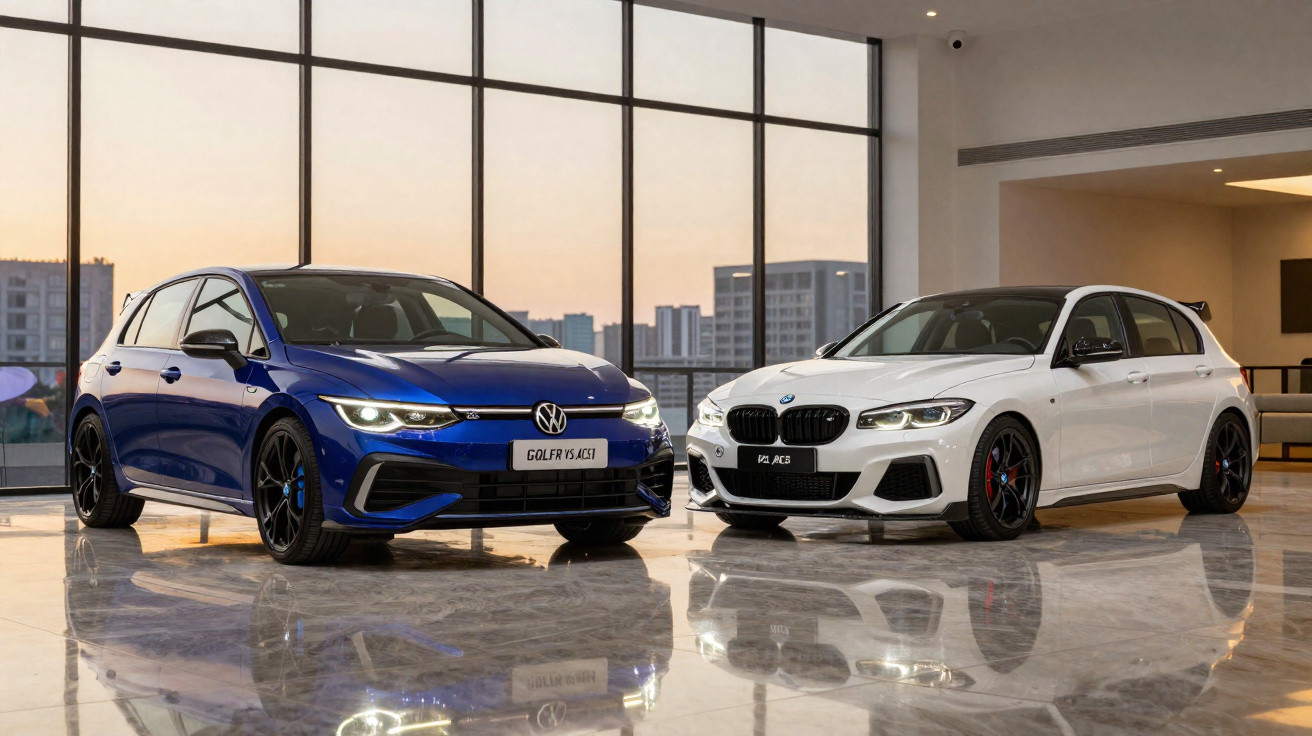
Elongated paddle shifters: a small part of the refresh for both cars pictured here, yet arguably the key to understanding what they’re really about. Between them, you’re staring at close to £100,000 worth of hot hatch. And although that spend gets you eight driven wheels in total, 15 gears and 618 horsepower, both cars can just as easily coax you into pottering along, wrapped up in comfort and all-weather security.
Paddle shifters as a cue to get involved
Which is why it helps that each steering wheel has a pair of very obvious, very physical prompts sitting behind it - like bookmarks daring you to jump back into the action.
The most conspicuous (read: loud) are on the AC Schnitzer ACS1, effectively a BMW M135i that’s been lightly reworked in Aachen. The exaggerated outline and the red lettering lean a bit “third-party PlayStation wheel”, although BMW’s own proper carbon items in an M3 can give off a similar vibe. Either way, that red practically shouts “get involved!” from an otherwise rather grey cabin.
Photography: Mark Riccioni
Equally angular but much more understated in colour are the paddles in the Volkswagen Golf R. This one comes straight from the factory - no aftermarket pit-stop - so it isn’t a perfectly like-for-like opponent for the ACS1. Even so, the R has used at least one similar trick to separate itself from the more ordinary Golf GTI crowd.
Putting these two together underlines a few truths. First, it’s alarmingly simple to spend fifty grand on a hot hatch with under 400bhp. Second, the standard BMW M135i looks so restrained next to VW’s all-wheel-drive hot-hatch reference point that it takes a proper going-over from a respected tuner to bring the two onto similar terms - at least for kerb appeal and a sense of occasion.
[Themed carousel]
Volkswagen Golf R: polish, pace and a very specific route to fun
How much sparkle you see in the Golf R will depend on the reverence you still have for the old Mk7. There’s no debate that when it arrived in 2014 it was a massive step on from every previous R-badged, four-wheel-drive Golf. It offered more interaction than the GTI of the time, and with the help of hard-to-ignore lease deals it rapidly became a runaway hit.
Once the initial hype cleared, though, it’s hard to argue it left behind an undisputed great. Yes, it was far more entertaining than earlier versions, but you still had to commit - properly - to loosen it up and coax out the playful side. The Mk8, with extra power and a smarter differential, really just pushes the same idea further. It refines the existing recipe rather than rewriting it.
Ignore the Drift Mode headlines - those systems are beyond foolish on public roads, and messy sliding will see you thrown off any trackday worth attending - and what you’re left with is another all-season hot hatch so meticulously finished it could almost dazzle you.
That’s not the same as saying it’s dull. It simply demands that you know where the fun is hidden. An “R” button on the steering wheel jumps you into a frankly excessive list of performance settings, including Drift and Nürburgring. But the mode you actually want is Individual, where you’ll probably drop the suspension to one of the softer of its 15 (yes, 15) electronically adaptive steps, then relax the ESC - after far too many stabs at the touchscreen.
Do that and you start to feel how it sends drive rearwards to tighten your line on the way in, then fires you out with the force of a bigger lad nudging you aside at the bar. It won’t have you howling at its cheekiness, and it never attacks bends like a sausage dog skittering across lino - the way the very best 200bhp front-driven hot hatches can - but there’s unmistakable athletic ability. The Golf’s relentlessly professional character is simply very good at persuading you not to bother searching for it.
Speed, though, is never in doubt. It feels every bit worthy of its 316bhp peak. And while it’s irritating that the seven-speed DSG won’t ever hand you total authority over upshifts, the upside is a near-EV smoothness as it surges up to the British speed limit.
[Themed inline galleries - item 0]
AC Schnitzer ACS1: coilovers and intent for the BMW M135i
The BMW - and therefore the AC Schnitzer - is also all-wheel drive, but with a more front-led setup that can allow a wriggle of torque steer when the surface turns grim. That’s not a problem in my book. What’s less appealing is that, in standard form, the M135i feels even more buttoned-up than its unmodified German rival.
Even so, the ACS1 is clearly an improvement over the slightly underwhelming base car. You’re looking at roughly £11,000 worth of modifications: drop your 1 Series with Schnitzer for a while, collect it later, and you get something that looks and drives differently. But the real reason it feels keener than BMW’s own version comes down to one major change - a £2,500 coilover suspension kit.
Adjustment is manual, with plenty of clicks to play with, but it arrives set up according to the tuner’s preferred configuration at each corner. You can probably guess which race circuit those settings were honed on. Whether that’s any less gimmicky than tapping the Nordschleife map inside the Golf’s drive-mode screen is for you to decide, but what matters is the result: an impressively judged blend of control and compliance. It also means the 20in alloy wheels feel less like rubber-band bravado on scarred British B-roads than they have any right to.
Although the BMW’s 302bhp peak trails the VW’s output, I suspect you’ll carry more speed here because it deals with bumps so confidently. And because there’s no in-cabin suspension fiddling anyway, you quickly stop obsessing over drive modes (even if the real buttons in here are genuinely satisfying) and just get on with driving quickly, rather than constantly asking the mode screen “what if?”.
What neither the M135i nor the ACS1 ever becomes is “flamboyant” - something their old six-cylinder, rear-wheel-drive namesake could absolutely be, particularly when the roads were wintry. There’s no wild personality waiting to be unlocked. What Schnitzer has done is sharpen the edges of a car that’s always going to stop short of genuinely astonishing you. Still, with more tailored styling touches inside and out, it should brighten the everyday driving that so obviously suits it.
I should add: much of my time in the Mk8 Golf R has been spent expecting a single standout moment that never quite arrives. Its strengths are delivered more evenly and more smoothly than that. The VW is the more premium and more capable machine here, no question - yet it’s also the one I ended up driving in the most sensible way, even though its rear axle is actually more eager to play. A Schnitzer-fettled M135i brings extra intent and intrigue, with those red paddles doing their best to bait you into something beyond simply enjoying the effortless speed that this particular corner of the hot-hatch world has turned into its defining trick.
Volkswagen Golf R – 8/10
£39,445 (on the road), £48,600 (as tested)
2.0T 4cyl turbo, 316bhp, 310lb ft
0-62mph in 4.7secs, 155mph
AWD, 7spd DSG
AC Schnitzer ACS1 – 7/10
£40,897 (M135i with the coilover upgrade), £50,023 (as tested)
2.0T 4cyl turbo, 302bhp, 332lb ft
0-62mph in 4.8secs, 155mph
AWD, 8spd auto
Comments
No comments yet. Be the first to comment!
Leave a Comment