
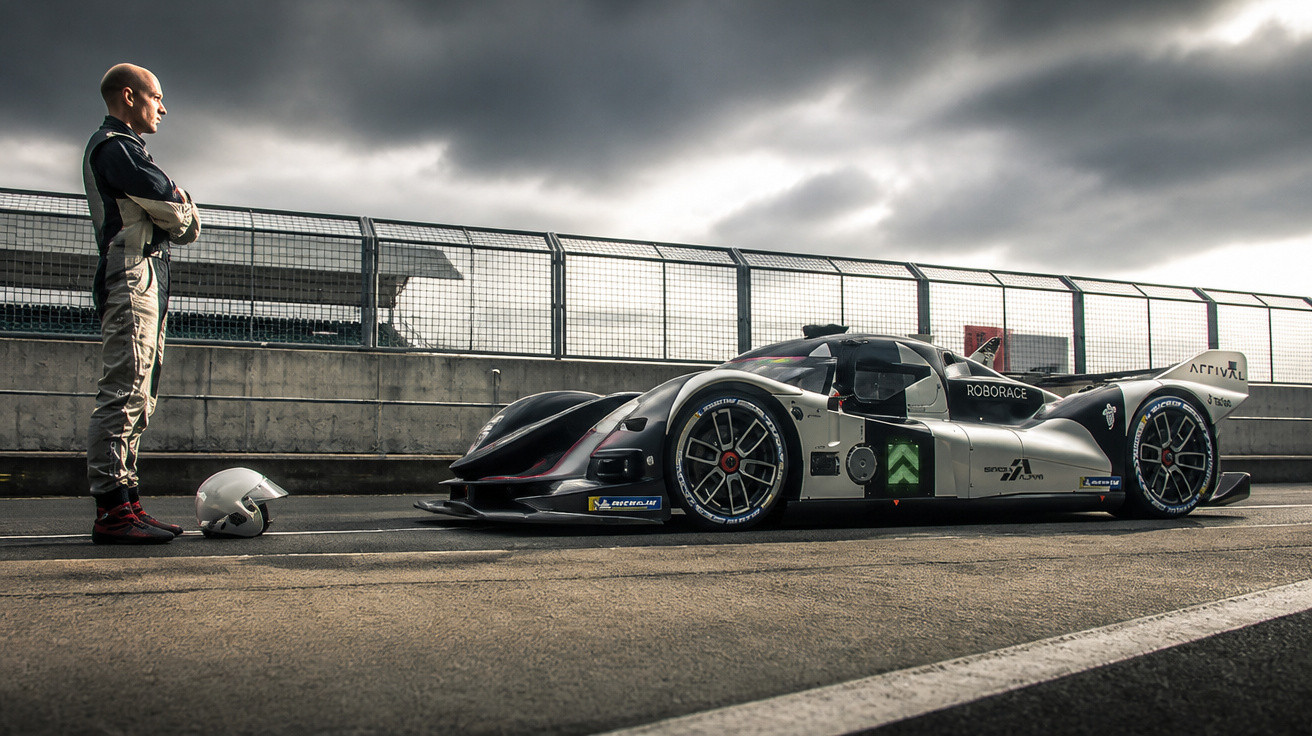
Strapping into Devbot 2.0 at Silverstone
Is this what pressure feels like? I’ll own up: I’m a bit on edge. I clasp the harness, tuck my feet into the footwell, and the light on the dash turns blue. The car responds with a synthetic flatulent chirp, the steering wheel gives a nervous twitch, and then it hums away.
The nerves disappear once we’re through Copse. Devbot 2.0 pulls hard.
To be honest, I wasn’t particularly concerned about letting it take me round. Silverstone has acres of run-off, and nobody is going to strap you into an autonomous racing car these days unless they’re extremely confident in the tech. And, presumably, the lawyers. In some ways it feels more reckless taking your hands off the wheel in a Tesla.
Carousel image placeholder
Words: Ollie Marriage // Photography: Rowan Horncastle
The uncomfortable question is different: what if the car is quicker than you? That’s much harder to swallow. But why shouldn’t it be faster? Supercomputers have been taking chess grandmasters apart for decades, and motor racing is, at heart, a binary exercise: strict track limits, and a fastest route that can be calculated. It simply comes down to how aggressively you’re willing to push the margins.
One lap: driver versus machine
I pushed those margins as far as they would allow. Honour was on the line; there was no chance I was letting a computer beat me. The format was simple: a single timed lap, human first, then machine.
So, for my one attempt, I drove in the most human fashion imaginable: like a battle-crazed berserker. Full commitment. If in doubt, flat out. Sort it at the apex. Route one. The idiot’s manual for over-driving. Feed that into your algorithms and chew on it, machine.
The fact it worked says something about both of us.
What Devbot 2.0 is (and what it’s for)
Here’s the background on Devbot 2.0. It’s the development arm of Roborace, the autonomous racing outfit whose Robocar has been appearing around the world over the past couple of years. Appearing is the key word: high-speed demonstrations, burnouts, doughnuts - but not genuine wheel-to-wheel racing. Not yet. There are plans, though, and they’re not exactly conventional.
Devbot 2.0 - this is the second-generation car - is the serious, experimental side. As head of partnerships Paul Andrews puts it: “Don’t think of it as a car so much as a hardware platform,” and, “Devbot contains all the sensors, processors, Lidar, cameras and GPS which allows others to test their software packages”.
Look at it this way: anyone working on autonomous driving - which is to say, almost everyone now - can use Devbot as a test bed. Volkswagen recently used it to validate a braking sensor algorithm. Once the VW engineer had loaded the software package onto Devbot, the Roborace team asked whether he trusted his own code enough to sit in the car while it ran. He did. It didn’t crash.
Image placeholder: Big Read (left)
For manufacturers, Devbot can compress development time; for others, it’s a blank sheet for new ideas. I meet Danilo Caporale, a postdoctoral researcher at the University of Pisa, who explains: “Our lab is a robotics and bio engineering lab. So we do a lot of things from robotic prosthetics to humanoid robots to industrial robots. They’re very, very different point of views. So we ask what can we do here that will improve the cars of the future? And by doing this, what can we learn to improve the robots of the future? Let me give you an example: we have a humanoid robot designed for disaster recovery in challenging environments, for instance a collapsed house. With Devbot we can test its sensors, how fast they respond, how they react in what we say is a very clean environment. So it’s not just about cars.”
Devbot also runs competitions for research groups - “not just track laps,” Andrews tells me, “but making the vehicle work out where it is if the GPS is disengaged or finding its own way through a maze of cones. The possibilities are huge”.
Today’s task is comparatively straightforward, and so is the software it’s using. It can’t learn and refine its approach lap by lap; it can only repeat what it has. The race engineers say it’s rare to see laps differ by more than 0.1 seconds.
The car underneath (and the limits of the test)
Strip it right back to the core and the chassis is a Ginetta LMP3. It’s then rebuilt with an electric motor at each end, delivering 550bhp (around 410 kW) and 0–97 km/h (0–60mph) in about three seconds.
There’s something else I haven’t admitted until now: both of us - Devbot and me - were capped at a thoroughly unheroic 100 km/h (62mph). That’s hardly no-holds-barred racing. But who does that actually suit?
If I’ve learnt anything from racing, it’s that the quicker I go, the more errors I make. With the speed restricted, my mind shifts to tactics. Do you even need the classic racing line? Wouldn’t the shortest possible route round the circuit be quicker? My brain starts overheating - these are variables I’ve never really considered on a track before.
Reduced to its essence, my lap becomes: flat out, forget the brake pedal, turn in and deal with it. Same old story, except there’s no need to let it run all the way out to the kerbs on exit.
The steering is heavy, the brakes are heavy, and it bobs and fidgets like the slightly unfinished racing car it is. It’s loud as well. Electric race cars are - and not in a flattering way.
Image placeholder: Big Read (right)
Watching the robot drive
Now it’s the car’s go.
Off the line it’s noticeably less violent, plainly trying to meter the power rather than stamp on it. I can tell I’m already a nose up.
Through Copse it leaves roughly 30 cm (a foot) to the inside kerb, whereas I’d helped myself to about 0.9 m (three feet) of paint. It looks strong into Becketts, though: it brakes later than I did, and the pressure goes in smoothly. The problem is it stays on the brakes for far too long - and it doesn’t slam the power back in properly afterwards.
And yet it’s fascinating to watch. Along Club Straight it makes the same twitchy corrections it showed on the run to Maggotts: a digital jink-and-release, like the little stabs you make in Forza. In the turns, however, it’s excellent - steadily adding lock, and matching that with brake force. It’s calm and balanced.
Still, I know I’ve beaten it before anyone pulls up the telemetry. The engineers talk me through the data and the four-second gap.
What’s intriguing is the shape of the traces on the screen. My apex speed was far higher, but the way Devbot bleeds speed, the steadiness of its steering, and the crispness of its inputs all hint that the chassis had plenty more in it.
Later on, they have another go. An engineer heads out with Devbot running a different software package: a higher top speed and a more relaxed relationship with risk.
At Becketts it drifts a touch wide, touches the wet white line on the outside and oversteers. Devbot arrests the initial slide, but when it snaps back the other way it can’t hold it.
Yes - the robot car spins.
That makes me oddly pleased. It’s proof of fallibility: machines have to learn as well, and that learning curve isn’t quick or simple. But it will, unlike me, only become faster.
I’m not convinced I’ll want to repeat this challenge in ten years’ time, but I’m absolutely enjoying this moment while it’s here. Smug superiority is a very human trait.
Comments
No comments yet. Be the first to comment!
Leave a Comment