
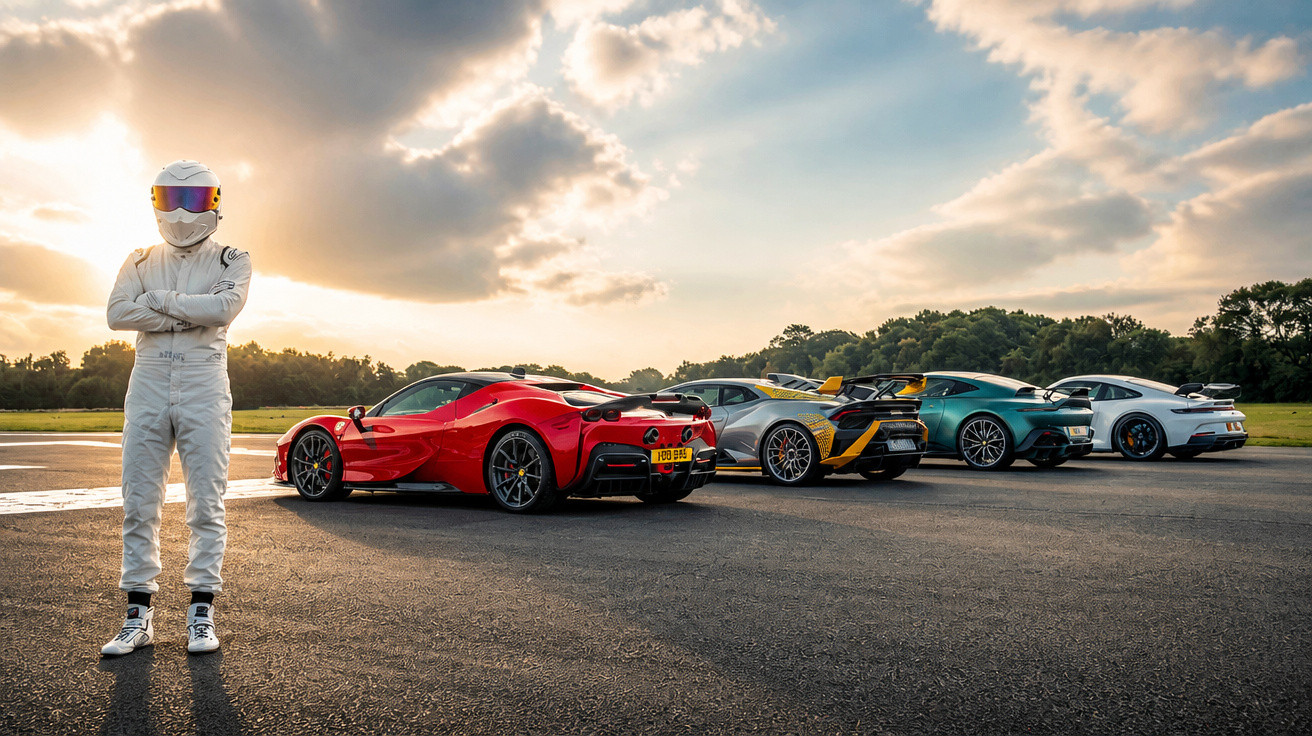
For the past few years Lamborghini has been on a roll, largely thanks to people with questionable taste queueing up for absurdly rapid SUVs. Its proper sports cars, though, have felt undernourished for ages. The long-in-the-tooth Aventador seems to book in annually for another bit of cosmetic work, while the Huracán can sometimes feel like it exists chiefly to remind you how accomplished the Audi R8 is. Yes, there are occasional specials to satisfy the very wealthy and very loud, but not much that recalls what the brand can really do.
From the pictures, the new Huracán STO - and yes, to some eyes that badge still reads STD - looked like another bout of peacock theatre: noisy styling, big intentions.
Lamborghini Huracán STO: a proper driver’s Lamborghini again
It takes about three minutes behind the wheel to grasp that the STO is the best Lamborghini since the Murciélago LP640. It nails what the badge ought to stand for: rapid, demanding, largely ridiculous - yet genuinely absorbing to drive. That last ingredient has been absent from too many modern Lambos, and finding it again is reason enough to grin.
As you’d expect, the STO turns the standard recipe up a few notches. It’s lighter, more single-minded and sharper-edged than the regular car. These days everyone knows the playbook: take something already outrageously fast and make it faster still. Most manufacturers can execute that idea competently now. What’s rare is a very fast car that goes for the full training montage and comes back transformed for the better.
A naturally aspirated V10 does a lot of the heavy lifting. However smart turbocharging gets, it never quite provides the same bedrock for a great driving experience. Cars like this should make you fizz and beam. Brush the throttle and the rev counter snaps upwards; the whole thing trembles and fidgets with intent.
The steering deserves its own praise: quick, talkative and razor-edged. Yes, it’s loud and it’s uncompromising, and the suspension is so firm it can bustle you about even on a circuit - but you could say that about the last handful of Lamborghini “specials”. The point where many of them unravel is the first corner, when the nose starts washing wide.
Not here. Turn in and the STO simply sticks to its line, with none of that reluctant shove. Then it serves up the bit that makes you laugh out loud. Leave the traction control on, select Corsa, and the rear begins to arc neatly before the electronics - an unmistakable drift brain - hold it there and flatter you into thinking you’re a hero.
Photography: Mark Riccioni
So what makes that such a big deal? Because when Lamborghini previously ditched the front-driven element, the cars often felt strange and overly spiky at the limit - as if the job hadn’t quite been finished. The STO, by contrast, feels like it was designed from the outset to be two-wheel drive.
Turn everything off and it’s remarkably friendly: easier to slide than the other three cars here, and far less intimidating than you expect. The brakes are excellent, and the gearbox finally feels properly matched to the engine, so it’s hard to moan about not having a gearlever. The seat, naturally, is dreadful - but then it is still a Huracán.
Ferrari SF90: breathtaking pace, distant sensations
Coffee grounds get used in perfume shops to reset your nose between fragrances - a sort of palate cleanser for the senses. Perhaps I should have downed an espresso before getting into the SF90. It is so quick, so capable, and so separated from the driver that the worst possible move is to step straight out of the pantomime Lambo and into Ferrari’s oddly clinical performance universe.
The SF90 doesn’t so much feel like the quickest car in this company as it does a device that plays a sped-up version of reality through the windscreen and side glass. It’s so advanced you genuinely start wondering whether what you’re looking at is the real world, or some VR-enhanced projection being fed back at you.
This particular SF90 comes with £40,000 of Assetto Fiorano pack and enough extras to push the price beyond half a million pounds. It is also one of the fastest cars I have ever driven. The sustained surge from the twin-turbo V8 and electric motors is, frankly, unsettling. It’s wild to consider that anyone pinning one of these flat-out for more than three seconds in the UK will be breaking the law. Three seconds - that really is a blink.
Which is the SF90’s fundamental issue: its headline party trick is speed, and speed alone. In a world where you can barely use it, that becomes irritation rather than joy. The steering is hyper-quick yet offers very little real connection, and after the Lamborghini the soundtrack feels fairly forgettable.
The chassis, too, is almost too clever. For traction and ride comfort it’s comfortably the best of this group, but the car’s decisions about how to distribute power between the front and rear axles can leave you guessing. Sometimes it presents as a pure rear-wheel-drive machine. Sometimes it dishes up a pleasing four-wheel drift, Nissan GT-R style. And sometimes the front axle arrives with so much torque that the car simply understeers. You never fully know what you’ll get next.
In the world of Haribo, surprise is part of the appeal; in a near-1,000-horsepower Ferrari it’s closer to dealing with a mild-mannered friend who gets punchy after a few beers. You’re never sure when it’s going to kick off.
Technically, the SF90 is a monumental piece of engineering - extraordinary in its capability, and in that narrow sense it’s the “best” car here. But I’m not convinced I care about best any more. This chapter of motoring feels like it’s winding down, and I’d rather be entertained. I also like being able to pack an overnight bag, which is another thing the SF90 struggles to accommodate.
Aston Martin Vantage F1 Edition: safety car swagger, mixed results
You’ll have seen plenty of this green Aston Martin over the past year because it’s the one Formula One drivers dislike most: the safety car. After two decades of AMGs irritating young race stars by not being quick enough, Mr Stroll has managed to get F1 to run one of his own cars. As marketing plays go, it’s undeniably smart. The product itself? I’m not entirely sold on all of it.
What does land is the chassis and the steering. Aston is genuinely strong in this area, and making a car that works so well on track while staying usable and comfortable on the road is no small achievement. The powertrain is decent too - but in this company it feels a bit ordinary. It’s the only car here with a torque-converter automatic, and that puts it at a real disadvantage on circuit because each shift feels slightly smeared.
The bigger issue is that the F1 edition doesn’t feel far enough removed from the standard car. It’s a touch quicker and a touch sharper and so on, but compared with the step-change you get with the STO and the GT3, the Aston’s transformation is pretty mild. Buyers of this sort of thing want to feel they’ve moved into something distinctly beyond the base model.
Then there’s the rear wing. It’s part of a package that supposedly adds another 200 kg of downforce, and you can sense that in high-speed corners - but just look at it. It’s so apologetic, and to my eyes it completely spoils the lines of what is otherwise a very handsome car. Wings are like beers: if you’re going to bother, do it properly and fill yer boots.
And as someone who used to sneer at the Vantage’s fish-lips front end, I now feel a bit guilty - because the “normal” Aston grille doesn’t quite work for me, and I catch myself looking back at the earlier design and thinking it looks great. Overall it ends up with a slightly tuner-car vibe, rather than a clean factory look.
Still, it is quick, engaging and hugely capable. You can argue for it - right up until you remember Aston wants more for it than Porsche asks for a GT3. At which point you go, “nah – that’s just silly”.
Porsche 992 GT3: the one you’d spend your own money on
The GT3 is probably the slowest car here, which sounds ridiculous when you remember the Ferrari has roughly twice the power of a car that will run to almost 320 km/h. Some people claim the 992 GT3 is too firm on the road; I’m not among them. It’s a GT3 - the previous one wasn’t a limousine either - so crack on.
This is Porsche’s home territory, so it’s no shock that the car is exceptionally good. In character it sits closer to the STO than anything else here. It’s less neutral than the Lamborghini, more inclined to either push wide or rotate into oversteer in bigger chunks, and it’s less of a sensory assault. But the steering is magnificent, and the engine screams all the way to 9,000 rpm. The naturally aspirated flat-six is so special it very nearly justifies the price on its own.
And once you’ve accepted how talented the GT3 is - how much more involving it is than a “normal” 911, and how little extra discomfort it demands in exchange for being this entertaining - it becomes hard to fathom why it costs roughly the same as a highly specced Carrera GTS. It’s effectively a seven-eighths race car you can use on the road.
Can I pick a winner? Not really, because they’re wildly different propositions. The Aston is the one that misses its intended brief by the widest margin, yet by any sensible measure it’s still a brilliant thing to drive. The SF90 continues to baffle me: it’s a stunning execution of what I suspect is the wrong kind of sports car. The Lamborghini is utter chaos - and the best thing to come out of that part of Italy in years. And the GT3 is the one you’d actually hand over your own money for.
Comments
No comments yet. Be the first to comment!
Leave a Comment