
Rain where it shouldn’t be
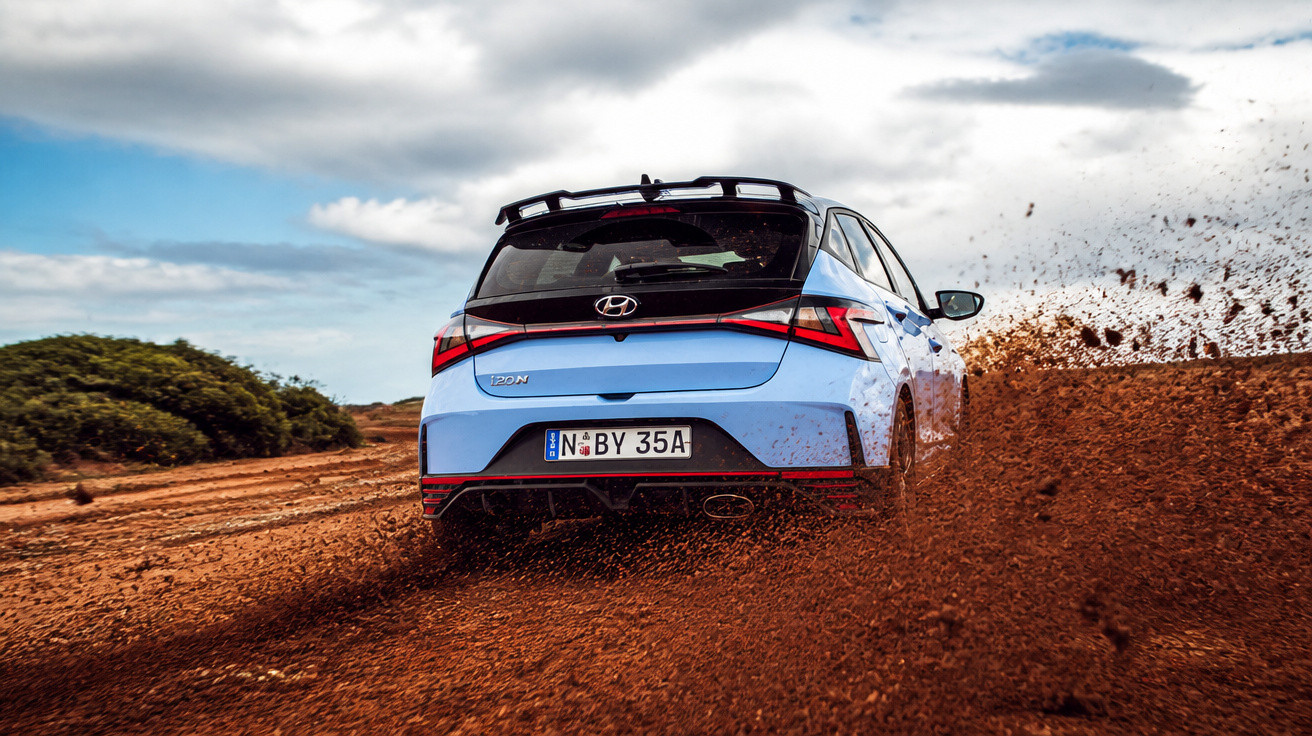
Rain in the desert is the sort of thing that feels like it breaks the rules. Yet here it is in full force: an apparently bottomless sheet of water battering a little blue car in the middle of a vast red land. It gets worse. The storm has shut the only road between where we are and where we’re trying to go.
After a burst of swearing that matches the downpour for volume and persistence, we admit defeat and decide to aim somewhere else. That becomes Plan B, which is instantly overtaken by Plans C, D and E when we learn every route is closed except one: the road we used to get here, which only leads back to where we started this morning.
That’s far enough away in both time and kilometres for Plan F to become Plan Eff This for a Joke. So, short on fuel but overflowing with misery, we aquaplane our way back along the one remaining option, each splash hosing red sludge out of the wheelarches.
Plan A: testing the Hyundai i20N beyond British B-roads
The original idea - Plan A - was almost laughably neat. We already know the Hyundai i20N is sensational on track, wonderful on British B-roads, and entertaining on both in a way that embarrasses cars costing many times more. But the world is a good deal bigger than the Top Gear test track and the B4391, so it follows that the i20N ought to cope with more than that.
Plan A, then, was simply to take it somewhere it really had no business being, point it down roads it had no business using, then return to civilisation with an excess of pretty photos and purple prose.
What we got instead was every plan collapsing in sequence until we stopped making them at all, plus a roughly 4,000 km grind over mountain passes, endlessly soaked highways, and dirt tracks with a taste for destroying cars. Along the way we’d end up drifting across an unplanned rally-style special stage, avoiding more kangaroos than seems mathematically reasonable, and discovering - improbably, in a pub after a few beers - a genuinely smart idea.
The rot had started before we even left Sydney. A rain system stretching from the top of Australia to the bottom was marching east, due to arrive at our intended destination at exactly the moment we planned to get there. We’re reckless enough to continue anyway; the authorities aren’t. Roads get closed and, if you insist on using them, fines of £550 per wheel get handed out.
So we bin the notion of a mostly pleasant cruise west towards the desert and try to leg it there as fast as we can. Which works brilliantly - right up to the moment it doesn’t.
Photography: Alastair Brook
Themed image carousel
From the minute we’re rolling, it’s as if everyone in Australia has collectively forgotten the basics of driving. A few hours in, a lorry lies on its side across a mountain pass, forcing us to retreat all the way back down the mountain and hunt for another route. It’s an early warning of what’s to come: accidents everywhere, delays that drain the soul.
Roughly 10 hours after departing, we nearly end the whole trip in spectacular fashion when a line of lights suddenly appears beyond an escarpment. We stamp the brake pedal hard enough to feel like we might rip it out of the bulkhead, then creep towards the glow. It’s a lorry jackknifed across the carriageway, its trailer pushed just far enough into the opposite lane to have peeled an oncoming car open like a tin.
So, for the first time - though certainly not the last - we abandon any hope of meaningful progress and start messing about instead. We trundle slowly around Mount Panorama, head over to Carcoar Dam for a chat with the locals, and even place the i20N on disused railway tracks so we can make “it corners like it’s on rails” jokes. Best to blame that one on fatigue.
Eventually we remember the point of the exercise and push on, sheer bloody-mindedness keeping tiredness at bay through 20 hours behind the wheel. At last we reach the turn-off to Lake Mungo: the roads are still open, but we’re late enough to watch clouds gathering on the far horizon.
That’s motivation enough. We leave the last strip of tarmac and commit to dirt, fully aware that if we don’t get back out before the storm arrives, the roads will shut and we could be stranded for days - possibly longer. We can’t yet judge the true heft of those clouds, but we can absolutely feel the pressure.
Lake Mungo: dirt roads, washboards and rally pace
The approach to Mungo is a chaotic sampler of surfaces: firm stone, soft talcum dust, egg-sized rocks gouged into trenches by huge 4x4s, and hard-packed ruts stuffed with loose desert sand. To drive it briskly demands concentration; to drive it at the speed we choose consumes almost all of it, leaving only a sliver spare to wonder when an ordinary bad idea graduates to industrial strength.
And we have to keep it moving. In part because we want to reach Mungo and return before the storm hits, and in part because we’re leaning on a theory that sounded terrific - as all interesting theories do - and rather less convincing once tested. The idea with washboard is to travel quickly enough to skim across the ridges, avoiding the troughs that shake a car to pieces.
In reality, you surrender a sizeable chunk of traction and adopt a pace that triggers a quiet internal voice asking where, exactly, you picked up such “wisdom” in the first place.
When Hyundai began describing the i20N as rally-derived, it initially felt like marketing overreach. Out here, with frankly ridiculous front-end bite and a rear end willing to wag as much as you ask, it starts to make sense. Even at triple digit speeds (measured in metric, of course) over constantly changing surfaces, the i20N never once gives the impression it’s out of its depth.
For a dirt-driving novice in a tiny hot hatch to feel so untouchable at those speeds, on those roads, is extraordinary. The i20N communicates what it wants to stay neat - countersteer here, ease the throttle there, let the rear rotate for this section - and my task is reduced to following its instructions.
It’s almost disappointing when our improvised rally special stage ends, but it’s hard to mourn when the finish line looks like Lake Mungo.
It’s still referred to as a lake, despite the small detail that it hasn’t contained water for around 10,000 years. People are optimistic out here. More importantly, this is where Mungo man was discovered: buried by the shoreline some 40,000 years ago, and found in a way that upended accepted thinking about when humans first set foot on Australian soil.
Looking across Mungo’s seemingly boundless expanse, it’s clearly a place of immense history, surreal landscapes, and exactly twice as many flies as any location needs.
It turns out the i20N’s just the thing for proper lift-off oversteer silliness in a muddy field
We watch the cloud line continue to organise itself along the horizon, masking what would otherwise be an all-time great sunset. Then it dawns on us: we’re a very long way from civilisation, and we now have to drive that distance in pitch-black new-moon darkness.
That brings an obvious issue. Headlights, by design, point forwards. Kangaroos, by virtue of their incomparable stupidity, have a habit of launching out of the scrub at odd angles, stepping from safety straight into your path.
Soon enough, probability does what probability does and places a red kangaroo - about 1.5 metres tall - precisely where physics is about to deliver the i20N. The loose surface confuses the ABS, the rear swings around, and now we’re sliding towards roughly 75 kg of kangaroo rather than simply driving.
The marsupial studies the onrushing beams, appears to consider its options the way you might assess a long lunch menu, then nonchalantly hops aside as we slide through the space it had occupied less than a second earlier. Rabbits prove smarter, but less lucky: we clip one and line another up perfectly under the i20N’s left-front wheel, perhaps demonstrating once and for all that luck beats cleverness.
We grind precious enamel off our teeth, but we make it through the wildlife gauntlet: running on fumes, coated in dust, and somehow without a kangaroo as a bonnet ornament. A life-saving jerrycan top-up at the roadside gives us just enough range to reach the next service station, where we buy fuel and half-cooked pot noodles instead of a proper dinner.
The storm still hasn’t arrived, and my last thought before sleep is whether we’ve rushed the whole trip for nothing.
Mud, closures and the pub that rescued the route
Morning answers that immediately. The world is water: sky, ground and air all feel saturated. The i20N is scrubbed clean by the deluge, and yesterday’s dirt-road lunacy already feels distant.
There is, however, one bright side to this kind of rain: it creates enormous quantities of fresh red mud. You might make hay while the sun shines, but you play in the rain.
As it happens, the i20N is perfectly suited to proper lift-off oversteer silliness in a muddy field. No manual handbrake required - you just roll towards the corner (today it’s a solitary saltbush), come off the power and turn in, letting the rear swing.
Even with the ham fists of the terminally exhausted, it doesn’t take long to start linking slides and having real fun. The i20N uses an ultra-rigid two-piece torsion bar at the rear and a proper limited-slip diff at the front. In plain terms, that means the front axle finds grip and bites even in churned-up mud, only pushing wide when you’re being a complete pillock.
Do it properly, though, and you can somehow steer from the rear in a front-wheel-drive car. Rear-wheel-drive drifts would be almost too straightforward to feel rewarding on a surface like this; getting the i20N’s weight transfer just right to connect two, then three, then four mud-roosting arcs is uniquely satisfying.
Which is fortunate, because it turns out to be the only sliver of happiness in an otherwise hateful day.
Back on the road - mud-caked and hundreds of kilometres from anywhere - it feels as though we’re broadly on schedule, right up until we find the route shut. We pore over maps, begging them to offer an alternative. None appears.
We cycle through fresh plans, backup destinations and increasingly desperate workarounds. Nothing sticks. Worn out, thoroughly beaten, and with the day almost spent, we creep back to the same motel we checked out of this morning.
With us effectively stranded, we decide the only sane response is to abandon the car at the motel, slog to the pub, and pour beer into ourselves until the situation looks less grim. As stress management it’s debatable - but it’s also the first decent call we’ve made all trip.
With spirits and clothing equally damp, we sit at the bar, drinking strong beer and moaning feebly. After feeding us, refilling our glasses and listening patiently, publicans Ben and Marie casually save the entire journey.
The trick, they say, is simply to keep heading west until you reach the fringes of civilisation, then turn north. Do that and you’ll run into a road called the Silver City Highway. After the run of losses that landed us in this pub, it sounds like a highway paved with gold.
Next day, we drive further west than we even realised we could. It’s the right move: the storm keeps travelling east, and our luck finally stops trending south.
As the oppressive blanket of cloud pulls back, there’s a tangible sense of release, and the outback starts behaving as it should: relentless yellow sun, blue sky, and red dirt.
Broken Hill, the Silver City Highway, and what the i20N proved
We track the highway and end up in the rough country behind the Silver City itself: Broken Hill. Out there, on the last unbroken hill before the desert becomes completely flat, the horizon wraps around us in an uninterrupted 180˚ sweep.
We sit at a dusty crossroads between humanity and wilderness, staring into twilight and thinking through the deranged route that delivered us here. Later, when it’s dark enough to see satellites streaking in front of the stars and the desert dust blurs into the Milky Way’s haze, we finally land on the truth.
If everything happens as intended, it isn’t an adventure. Nothing on this trip happened as intended - and yet every time we escaped unscathed, the car would simply carry on, humming as if we hadn’t just treated washboard roads like a rally special stage.
Or aquaplaned for hundreds of kilometres while trying to prise control of the front wheels back from physics that seemed impossible to beat. Or played in the dirt until the i20N was half mud and half machine, then driven hundreds more kilometres with only a desert storm capable of washing away the proof.
It took roughly 4,000 km, 56 muesli bars, two road-killed rabbits and a once-in-a-decade deluge to know for certain, but we got there: the i20N is brilliant at everything you’ll realistically use it for, absurdly capable at plenty of things you won’t, and engineered to a standard nobody sensible will ever exceed.
We took it to the edge of humanity and back with no modifications, no farkles and nothing broken - not even a bent rim or a burst tyre.
As we rolled east out of Broken Hill for home, a realisation arrived: the hill might be broken, we might be broken, but the car somehow isn’t. That simple line stayed with us across the 14-hour drive back to Sydney, back into the same storm that had washed away every plan until all that remained was an idea and the adventure it produced: do what nobody would ever think to do in a car like this, just to find out whether it can be done, and see what happens.
And what happened was as surprising, as spectacular and as landscape-changing as… rain in the desert. A low-slung hot hatch that delighted in crossing hundreds of kilometres of roads that exist only in name and shared delusion. A tiny car that stayed comfortable and entirely unflustered over oppressively long distances.
A little Hyundai hatchback that didn’t just win Top Gear’s Speed Week and the Performance Car of the Year award, but performed so strongly, so far outside its supposed comfort zone, that it was impossible to do anything other than name it our overall Car of the Year.

Comments
No comments yet. Be the first to comment!
Leave a Comment