
A Spanish road and a surprise overtake
There he is: a weathered old fellow, hands on the wheel of a half-fossilised Suzuki SJ410, trundling at exactly 60 km/h along a quiet strip of tarmac just outside Seville. His face looks like sun-cured leather, and the puzzled crease aimed at the road ahead hints at tired eyesight-while his meandering path suggests a steering box that’s seen better days. He has no idea what’s about to happen.
As we sweep through a bend and the view suddenly opens into a straight that runs the length of the valley-with not a lorry coming the other way-I brace myself, tug the left paddle in this Lexus IS-F… and plant my foot. Reality gets a little strange as 417bhp tries to prise the back tyres away from their settled patch of road. The Suzuki appears to rocket towards us as if it’s stamped on its brakes, while the Lexus’s Yamaha-fettled engine hits a tipping point at 3,600rpm: some large, loud valve seems to crack open, and the polite low-rev hum turns into a dense, threatening bellow.
I can’t make out his expression properly, but the old chap in the SJ twitches at the wheel as the IS-F lunges, snatches the next ratio, gives a small shimmy as it brushes a dusty centre strip, then storms up the valley like an irate chunk of concentrated evil. A Lexus that makes people wince because it’s so loud? That’s something I can get behind-very much so. And then it gets better.
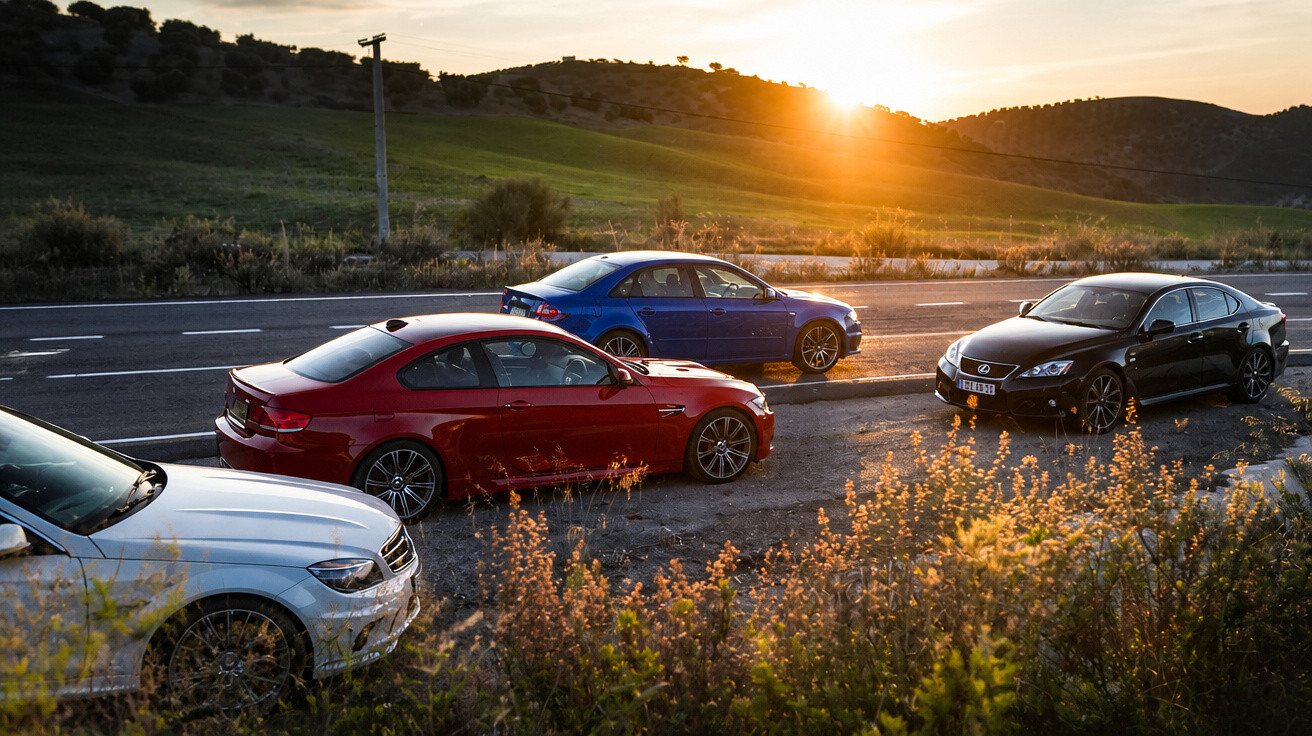
A couple of miles later we pull into a grimy, rocky little lay-by, and there it is, spelled out in glorious metallic 3D: IS-F vs M3 vs C63 vs RS4. It’s difficult not to grin like you’re back in school.
There’s been plenty of muttering, of course. Some have been forecasting the end of big-power excess, insisting that fast-for-fast’s-sake is, well, so 2005. I’m happy to report, from a Spanish hillside, that this is nonsense. Horsepower isn’t dead; it’s simply matured a touch and relocated to the suburbs. The spiky-haired, wing-fitted, bottle-waving fast-car hooliganism may have fallen out of fashion in the shadow of media-friendly global doom (and its Prius-driving foot soldiers), but that doesn’t mean the car makers have stopped building quick stuff. They’ve just told it to comb its hair and shine its shoes.
- Images: Lee Brimble
This feature was first published in Issue 177 of Top Gear magazine (2008)
[carousel: themed]
Subtle looks, serious pace: Lexus IS-F vs M3 vs C63 vs RS4
With that in mind, it dawns on you that none of these cars looks like a Rampton day-release special, despite each being quick enough to clap your ears round the back of your skull. So you get discreet(ish) bonnet bulges, flared arches, larger-diameter wheels, bigger exhausts and deeper scoops-but no cartoon spoilers or lurid splitters screaming for attention. They’ve all added lean muscle without tumbling into caricature, avoiding that bodybuilder’s waddle.
Of the quartet, the Lexus is the most overtly hostile: black wheels, swollen arches, cooling vents cut into the front wings, and those quad piggyback exhaust tips.
The C63 is a strong shape-instantly recognisable-but it isn’t a fluorescent billboard. The bonnet’s half-submerged, torpedo-like blisters hint at what the C-Class can do, yet visually it keeps its temper in check, even if the four tailpipes make the point a bit more plainly. The BMW plays the same restraint card, and although we’ve got the coupé here, there’s something almost über-normal about it: easy to miss at first glance, but linger and you’ll find a stash of gorgeous performance details.
As ever, the RS4 sits slightly in the shadows-self-assured, understated and brawny-its arch flares and distinctive wheels working neatly with twin-oval exhausts that announce the V8’s intent. None of these cars carries much visual fat, and every one of them benefits-more Bruce Lee than Incredible Hulk.
That’s especially impressive given the performance they’re hauling around: 0–62mph in under five seconds and more than 155mph from all of them, even though each has four seats and enough boot space for real life, and all for early £50k. Figures like that keep these cars within daydream reach-and they make me very happy.
Four different characters behind the wheel
The headline act, naturally, is the IS-F-and it’s an early adopter’s fantasy. Its 5.0-litre V8 uses the same basic block as the LS600h, only without the ‘h’ bit and with Yamaha involved to make it more intrusive. Yamaha is known for two things-motorbikes and pianos-so tuning is clearly in its wheelhouse. Plenty else is happening to extract 417bhp and 373lb ft of torque from the block, but the upshot is that this is about as close to a Buick 302 as an F1 car is to a bicycle. It’s paired with a version of the LS eight-speed automatic, though here it gets an ultra-rapid paddle shift.
In Direct drive, the shift takes 100 milliseconds; slip it back into ‘comfort’, and it regains that smooth, slightly slushy luxury-auto charm. Pottering around gently in ‘D’, you’d barely suspect what the IS-F is capable of. Yes, it has a tidy set of blue-lit, racy dials, sportier seats and a well-finished dashboard, but it doesn’t exactly advertise that it’s ready to staple your head to the rear screen when you press the ‘Sport’ button on the right-hand spoke and push the throttle past a quarter travel.
The ride is almost eerily good, and it delivers the insulated, relaxed-speed brilliance of the IS250, right down to steering that’s so numb on-centre I briefly wondered whether my fingers had stopped working.
By contrast, the Mercedes Benz C63 AMG feels straightforward on paper-if not always in the detail. You’re looking at a huge 457bhp 6.3-litre V8 with 442lb ft of torque, installed in a relatively compact car, driving the rear wheels through a seven-speed automatic with paddle override and a properly aggressive shift programme if you prod and twist the necessary knobs. The steering is razor sharp and liable to kick back over broken Spanish surfaces; the seats are deep buckets that clamp hips and haunches; and the engine’s delivery is both far too much for the rear tyres in most scenarios and one of the most life-affirming machines I’ve ever met.
Driven quickly, it isn’t exactly relaxing. You don’t settle into it, and you never calm down enough for your pulse to drop below imminent-heart-attack territory. On these fast, flowing Spanish roads-roads that love to throw in unsettling craters mid-corner, or a hard-edged lump in the worst possible place-the C63 can be downright brutal. It’s so stiff that, braking hard from a quick straight into a 35mph left-hander, the car hit a bump and I hit the roof. Hustling a C63 along a bumpy, treacherously cambered road like this isn’t for the timid-or for anyone particularly attached to an intact skull.
Its overridden seven-speed auto also comes across as horribly clunky next to the Lexus, and it’s nowhere near as satisfying as either manual here. Oddly, for an automatic AMG, it’s the one that feels most like a racing car. Nailing it takes more care because you can’t simply stamp on the throttle: leave traction control on and the flashing orange light chops away at your progress; turn it off and a careless bootful risks force-feeding a Merc into a tree. It’s the exact opposite of the RS4’s grip-happy four-wheel-drive security. Still, perhaps that’s the price of converting so much horsepower and torque into forward motion-but even so, it’ll make you smile every time you open up that exhaust opera.
And that leads neatly to the BMW M3: arguably the original sports saloon iconoclast, and about as dependable a bet as straight bullion. This one is the six-speed manual, making 414bhp and, in this company, a modest 295lb ft of torque (147lb ft less than the C63) from its 4.0-litre V8. The trade-off buys an 8,400rpm red line, but it’s still a trade-off-and you feel it immediately. The Beemer is simply slower and less urgent down low, even with the ‘power’ button pressed and the EDC dialled right up.
It properly wakes up only once you’re past 5,500rpm. Then the whole car stops playing the friendly plodder and suddenly comes alive. You end up grabbing ratios just to catch another hit of hydrocarbons burning at 8,400rpm, to feel the engine run its fingertips along your spine. Among this group it changes direction with the greatest fluidity and feedback, shrinking around you like warmed clingfilm.
It’s so sweet to place and balance that you can take liberties without paying for it in ego-slicing humiliation. Which is why the downsides sting: an interior that’s too drab, a clutch and gearbox that feel a touch delicate, and a steering wheel so thick it borders on silly. There’s so much to admire that the weak spots really grate.
Then there’s the Audi. The RS4 is here as the control sample-the Petri-dish benchmark for this new wave of shiny speed hardware. It can’t fully compete because, thanks to a shortage of newly forged ‘old’ A4 bodyshells to RS-ify, it’s technically out of production. But in a world full of one-trick ponies, the four-wheel-drive RS4 has repeatedly proved itself to be a genuinely brilliant all-rounder.
It doesn’t rely on gimmicks, either. The formula-414bhp, 311lb ft from a V8, plus Quattro four-wheel drive-is basically all you need. Most of the time it runs a 40/60 torque split front to rear, but it can send up to 85 per cent to the back axle if things get slippery. And yes, there’s that gorgeous, rev-hungry V8 under the bonnet, but the RS4 really just deals a straight deck: a phenomenally quick Quattro, and the first of an Audi generation that delivers a proper driving experience as well as impressive stats.
It’s also one of the rare cars that lives up to fond memory, every nuance still there in sensitive Technicolour even through the cotton-wool of a hefty drivetrain. I loved it when it launched.
That hasn’t changed. The trick is steady throttle and feeding power in on the apex. Get greedy and it’ll understeer, but overstep slightly and it gathers itself without drama. It feels torquier than the BMW, though not as punchy as the Merc or the IS-F. In the wet it’ll even offer a touch of lift-off oversteer, or some tidy, undramatic four-wheel drifts.
It doesn’t have the same joyful power-oversteer as the other three rear-wheel-drive cars, which is mildly disappointing, but I reckon 95 per cent of the time you’ll be delighted with Quattro. As an everyday performance car, the RS4 is a living legend.
Flaws, favourites and the non-verdict
After a few hours of mixed driving, one thing is obvious: there isn’t a dud among them. What there are, instead, are four cars chasing the same brief in wildly different ways. Each delivers an experience so distinct it feels as though every saloon was built for a different bespoke customer.
The way they behave makes you want to Frankenstein the ultimate super-saloon from assorted components, because although all are superb, none is flawless. The Lexus has one of the most startling drivetrains of its era-shockingly fast and strangely capable. It floats along like a limousine, handles daily life more comfortably than anything else here, and (to my eyes) looks terrific. But it comes with irritations: it bonging, dinging and twittering at every tiny event.
Then there’s the odd detail that the exhaust tips don’t actually connect to the exhausts-something you can plainly see if you follow the car at night. Lexus claims it’s to disperse heat around the rear bumper, but whatever the justification, it’s visual fakery that makes the car feel cheaper than it ought to. And the steering is so ill-suited to Europe it makes me want to shout. It can do hooligan, but relentless perfection has sanded off the edges. I like fast cars to have a bit of roughness; it makes them feel more human.
Everybody steps out of the C63 with a light sheen of sweat and an expression that says relief. This is a phenomenal effort from Mercedes-its game has improved to the point that you no longer need to apologise for a big AMG. The car has personality in everything it does. If it rode more kindly, and if it had the Lexus gearbox and the BMW steering, I’d be in love. But it doesn’t-so I’m not. Not completely, anyway.
The RS4 is probably the sensible choice, but it’s also the simplest to get on with. Never has a car been this entertaining while also being this safe, or this quick. Where the Merc wants to tear your face off and the Lexus can seem slightly aloof, the RS4 walks a magical tightrope. You can’t play quite as freely as you can in the rear-drive cars, though, and over these otherwise perfect few hours that has felt like a small but important thread missing from the RS experience.
Which leaves the BMW. It isn’t the most hardcore here, and it isn’t the quickest. The cabin is dull and the torque feels almost anaemic. Yet it’s inspiring: content to cruise, eager to hustle, easy to explore, and unexpectedly satisfying when you turn up the aggression. Its balance, poise and steering are what draw you in-and the longer you spend with it, the more you realise just how broad its ability really is. So, who wins?
After plenty of deliberation, endless circular debate and several pints of strong cider, the conclusion is: nobody. There is no “best” in this bunch. I’ve tried to pick a winner, and it simply won’t happen. Each has strengths and weaknesses-some you’d tolerate more readily than others-but none feels like an absolute deal-breaker.
For me it goes like this: I’d have a C63 as a toy because it makes me feel 17 again, but it would exhaust me as an everyday car. I’d take an RS4 for daily duties, yet I suspect I’d occasionally miss something more throttle-adjustable. The M3 is the strongest all-rounder, but I’m not especially keen on the M3 image or its ubiquity.
So that brings me back to the Lexus. A brilliant, thrilling, slightly unhinged Lexus. It’s imperfect. It isn’t aimed at the hardcore among us. But for reasons I can’t quite shake, it pulls me in: the technology, the fact there’ll only be 150 in the UK per year, and its sheer oddness.
So, just this once, I’ll leave the decision to you. Last one back to the UK isn’t trying hard enough.

Comments
No comments yet. Be the first to comment!
Leave a Comment