
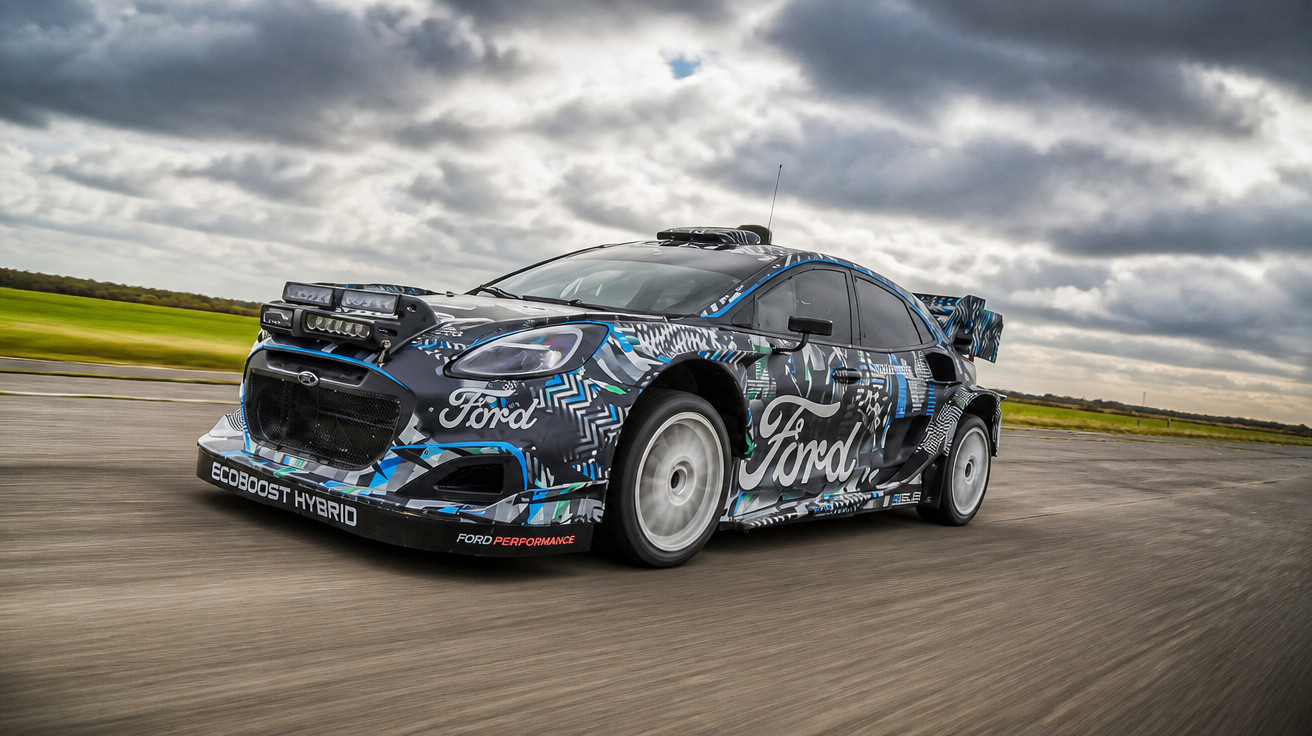
“This is an entirely different thing. It’ll take a switched-on crew to get something out of that.”
Coming from David Lindsay, it lands with weight. Over the past 20 years he’s been embedded in M-Sport’s world, shaking down the team’s (and therefore Ford’s) World Rally Championship machinery. From the Focus WRC forever linked with McRae, through to the outgoing Fiesta WRC that delivered title glory with Ogier, he’s had seat time in the lot. If you want a neat, no-nonsense verdict on what the new, hybrid-powered Ford Puma WRC feels like, Lindsay is exactly the person to ask.
Ford Puma WRC and the 2022 rules reset
For 2022, top-level rallying arrives with major regulation changes, and the shift from Fiesta to Puma puts them in plain sight. The new cars are designed to be safer and larger, featuring an FIA-mandated wheelbase that’s 107 mm longer, plus an extra 70 kg of… not timber, but batteries. This marks the first real step into electrification for the sport’s top class, and it’s bound to get people talking.
Photography: John Wycherley
[node:field_carousel-themed]
Hybrid boost: how Rally1 power is delivered
Under the skin, the Puma’s fundamentals remain close to the Fiesta it replaces. Ford sticks with a 1.6-litre four-cylinder engine, driving all four wheels through a five-speed sequential gearbox, with peak output at around 400 bhp. The headline change is the hybrid system, capable of adding a further 134 bhp as a boost, dramatically improving the power-to-weight ratio… sometimes.
That caveat applies to everyone. Each battery pack comes sealed from Compact Dynamics and is installed in an FIA-specified position, chosen to prioritise safety and to encourage broadly comparable weight distribution across Ford, Hyundai and Toyota’s Rally1 runners.
Even so, don’t expect the Puma - or its i20 and Yaris rivals - to behave like 500-odd horsepower cars all the time. On the start line, drivers can deploy full power for the first burst of acceleration, lasting around three seconds. That’s effectively the car’s 0–62 mph time. After that, it drops back to petrol-only running until the driver earns what’s referred to as a ‘valid regen’. In simple terms, they must brake hard enough, and for long enough, to meet defined criteria - which then unlocks a 30 per cent boost that may already be available but unused.
“It’s not like the endurance side of things; hybrid isn’t something that’s been slowly coming in for the past couple of years,” says Craig Breen, who has switched from Hyundai to spearhead M-Sport’s championship push. “It’s the first exposure we’ve got to it so we’ve got a lot of things to learn. It’s definitely taken me a little bit of time to get myself up to speed.”
Driving style: learning where to brake for regen
So, will drivers start braking for corners they’d normally take flat, just to harvest energy? “There’s definitely a bit of adaptation that needs to be done,” says Breen. “It’s a trade-off; we want to unlock as many boosts as we can but obviously every time you’re braking. you’re slowing the car down.
“So you need to be realistic about where you’re genuinely better off braking a bit more, and getting the boost, and where you’re better off not worrying about it and just carrying the speed. It’s going to take over rallies in the coming years and it might be a couple of seasons before people really get to grips with it.”
It’s easy to picture some of rallying’s old-school committed heroes - a particular Scotsman whose photos line the corridors of M-Sport’s Lake District base springs to mind - being less than thrilled about deliberately stamping on the brakes when it isn’t strictly necessary, simply to earn a sharp electric shove onto the next straight. Then again, braking brutally into a corner and launching out with a big slug of extra power could also produce some wonderfully chaotic moments.
Spaceframe safety and how Rally1 is built
That brings the conversation neatly to safety. The last Fiesta WRC really was a Fiesta at heart: a production bodyshell transformed for competition. Rally1 changes the recipe. The foundation of all the new cars is a steel spaceframe chassis built to tight regulations, with bespoke panels - several in carbon - bonded on. Side-impact protection has been the key priority, and early high-speed testing accidents involving the Puma’s competitors have already stress-tested the new structure. Although certain roll-cage angles are FIA-defined, M-Sport maintains that, even stripped to the essentials, you’d still be able to tell the three Rally1 gladiators apart.
Above that skeleton, the Puma you see is far more aggressive than anything on the road. It’s a three-door with a slimmer, racier stance - a bit like running into a mate a few weeks after they’ve tried a fad diet. Or after a particularly relentless stomach bug. Compared with the showroom car it sits noticeably lower, and it looks as if someone’s taken a chunk of weight out of it, though that may simply be the effect of its bespoke proportions. I float the idea that it’s the perfect starting point for a road-going Puma RS - keeping the 534 bhp, naturally - and I’m met with smirks and a chorus of ‘if only’.
Kirkbride Airfield: riding shotgun in the Puma
In fairness, that sort of performance would be a lot to unleash on public roads. My own time in the co-driver’s seat lasts only a couple of minutes at Kirkbride Airfield, yet it’s rare that such a short run leaves such a strong, lasting sense of what a car can do. If you’re after a budget approximation of loose-surface motorsport, a blustery Cumbrian airstrip does a convincing job.
Even so, Lindsay makes the Puma look almost surgical. He threads it through with effortless accuracy, punctuating the run with balletic handbrake turns - the finishing touch after repeated, brutally committed braking zones following several zero-to-130 mph (ish) blasts. The Puma feels simultaneously astonishing and composed, dramatic but oddly undramatic. Modern rally cars are motorsport’s swans: pricey differentials and sophisticated damping leave the cockpit feeling eerily serene.
Yet it is properly rapid. Those three seconds of full boost feel like a rocket up the bum, and with five short, snappy gears we’re at an estimated top speed in what seems like no time at all. All the while it floats over filthy, cratered surfaces that nearly shook the door cards loose in my Hyundai road car on the way to meet the team.
I can’t personally vouch for 2022’s safety improvements, because Lindsay is a gentleman and didn’t crash. And is the hybrid system - used as an occasional punch - anything more than a gimmick for commentators to trip over? That’s arguable. In the longer term, we may see these cars whispering around service parks in silence, or covering road sections on electric power alone to generate favourable local PR. But in pure performance terms, the extra shove has left a short, savage impression on my proudly bobble-hatted head. The real test of WRC’s electrification will be watching how many drivers chase boost at every possible moment - and how many avoid the brake pedal, sticking instead to last year’s rhythm and pace notes.
“Some drivers might still try to drive their own way,” says M-Sport development boss Tim Jackson. “But ultimately they won’t win. The ones that can adapt to the challenge with an open mind, not stuck in their ways, will be the ones with the rewards at the end of the season.”
Comments
No comments yet. Be the first to comment!
Leave a Comment