
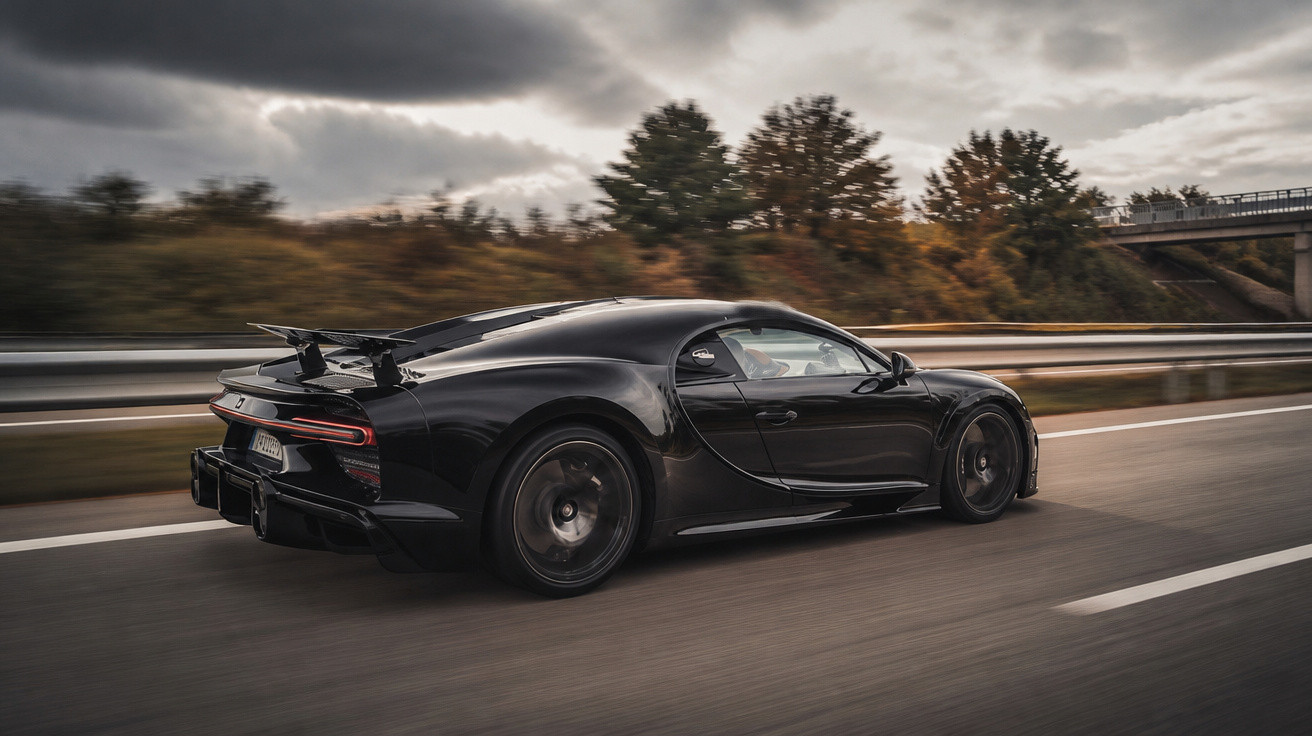
A ten-minute accident at the Nürburgring
That whole idea that time stretches when you’re about to die, or about to have an enormous shunt? Turns out it’s real - because this lap has morphed into one of Chris Harris’ trademark, outrageously slow-motion drift sequences… except this one is absolutely not for the highlight reel. I’m effectively living through a 10-minute crash, and there’s precious little I can do beyond hanging on and waiting for the impact. Every extra degree of lock and every millimetre of throttle is being fed in with the delicacy of a safecracker, yet we’re still skating about. Forget understeer or oversteer - what about no steer at all?
I’m not blameless. Anyone with a passing acquaintance with physics could have predicted that a £2.7m, two-tonne, 1,578bhp monster on cold Michelin Cup 2s, trying to claw at nothing but water, would be lively - but I just had to say those three tiny words, didn’t I: “It’ll be fine.” Top Gear has made plenty of daft decisions over the years, but this really takes the biscuit.
At least we’re not about to create a very expensive Bugatti/barrier interface somewhere heavily populated. Thank goodness we’re not in the world’s fastest car on the world’s most notorious circuit, with photographers stacked along every bend just begging for a mistake. Actually - ignore that - we are.
The one thing keeping my brain from melting is that I’ve got an expert alongside me, a sort of psychological comfort blanket for all 154 corners when the stress peaks. That expert is Andy Wallace: Le Mans winner, Bugatti test driver, the man who guided a McLaren F1 to 240mph (386km/h) and a Chiron to 304mph (489km/h). My dependable co-driver: “I’ve only ever raced around the Nürburgring once actually, three laps in a Jaguar MkII. I don’t know it that well if I’m honest. Yeah, watch out for that standing water by the way, we’ll just aquaplane and rotate and there’s zero run-off here. We don’t even need to be going fast.” Cheers Andy, that’s reassuring.
And then we do exactly that: the rear steps out, the horseshoe grille swings towards the barrier on the right, I try to catch it with opposite lock, but we’ve moved beyond measured inputs - this is full, arm-flailing panic mode… and… and I’ll stop there. More shortly.
Collecting the Bugatti Chiron Super Sport in Molsheim
Like most genuinely questionable plans, it began with a single prompt: “If you had one full day with the new Bugatti Chiron Super Sport, what would you do with it?” We let that simmer for roughly five minutes, then returned to Bugatti with a proposal.
The idea was simple (and therefore dangerous): collect the car from the factory in Molsheim, aim it north, hop across the border into Germany, hammer along a derestricted autobahn, then finish with a few laps of the Nürburgring… during a tourist session. Against all odds, Bugatti replied “OK”.
So here we are, up at an indecent hour, trundling our grubby Audi Q3 hire car past security and into the fantasyland that sits behind the Bugatti gates. Chirons are hand-assembled in the immaculate Atelier building (opened in 2005), but our Super Sport is waiting out front by the Chateau - Ettore Bugatti’s former home, now restored with obsessive care - because if you’re going to do this, you may as well have the full chocolate-box setting.
What the Bugatti Chiron Super Sport actually is
The Super Sport is the stretched, pumped-up Chiron variant that Wallace drove to 304.773mph (490.5km/h) in 2019 - the first series production car to breach 300mph (483km/h). Well… it’s a very close relative, at least.
After that high-speed run at Ehra-Lessien, Bugatti announced 30 Chiron Super Sport 300+ special editions. They’re visually and mechanically tied to the record car (though capped at 273mph/439km/h to keep tyres - and humans - alive), and they use the same 8.0-litre quad-turbo W16, uprated by 100bhp to 1,578bhp. All 30 wear identical black paint with orange stripes, and each one costs £3m.
Alongside those sits the ‘standard’ Super Sport - the mechanically identical model we’re driving here - starting at £2.7m and offered in any colour you like… provided you don’t mimic the 300+ edition.
As a photography rule, black is usually a nightmare. Yet here, whether it’s the aggression carved into the Super Sport’s face or the sheer ridiculousness of the longtail silhouette, it looks properly menacing: low, stretched, and simmering. Then I spot the saddle-brown leather inside and let out a hefty exhale. If it were my millions on the line, this would be the spec.
Photography: Dennis Noten
[node:field_carousel-themed]
Super Sport vs Pur Sport, and why it matters
If you already own a Chiron and you’re feeling twitchy, relax: Bugatti will still build only 500 Chirons in total, but that 500 will be split across Chiron, Chiron Sport, Chiron Pur Sport and Super Sport. The eye-watering, coach-built specials - Divo, Centodieci, Voiture Noire - sit outside that 500.
In fact, the ‘regular’ Chiron and Chiron Sport have now reached the end of their homologation run. So if you’ve got the entry fee ready, your choice is effectively Pur Sport or Super Sport.
The split is clear. The Pur Sport pushes harder towards cornering, lap times and handling precision. The Super Sport is the streamliner: it exists to cut drag and pile on straight-line speed.
So what changes compared with the ‘cooking’ Chiron? Up front, the corner air curtains not only tidy the airflow down the flanks, they also help evacuate warm air and turbulence from the front wheelarches. At very high speed, pressure builds aggressively in the arches; with nowhere to escape, it would migrate under the car and generate lift. Hence the venting behind the arches and the holes punched into the top surfaces - a wink to the EB110 Super Sport.
At the rear, the body is extended by 250mm, keeping laminar flow attached for longer and cutting aerodynamic stall by 40 per cent. In Top Gear terms: it’s engineered to be as slippery as a baby-oiled octopus in a bath full of baby oil.
The old, horizontal bank of four exhausts is gone; in its place are two wide-set double stacks, freeing up room for a much larger central diffuser. The payoff is that the car can remain planted even with the wing fully retracted in Top Speed mode - which you access with a second key stored down by your left thigh. Pull it out, insert it, then twist it while stationary, and the car effectively interrogates you: it drops the ride height, retracts underbody fins to bleed front downforce, and runs through a series of safety checks. Tyres older than two years? Access denied.
Crucially, any downforce generated beneath the car comes without the drag penalty you’d get from sticking aero hardware into the airflow on top - which aligns perfectly with the Super Sport’s obsession with high-speed efficiency.
Autobahn: letting the W16 off the leash
The autobahn is calling - but first Wallace walks me around the car and casually drops a few absurd nuggets that are pure notebook gold. For instance: if you could find a stretch of Earth long enough to keep it flat-out continuously, the fuel tank would empty itself in 6mins 50secs. And at 304mph (489km/h), the bespoke, internally reinforced Cup 2 tyres are subjected to a seven-tonne tearing force. Think of it as trying to rip the rubber from the rim, looping a chain around it, and hanging three and a half Chirons off the end.
With my jaw suitably unhinged, we set off.
Before any fireworks, the Super Sport has to deal with everyday nonsense: roundabouts, queues, and those baffling European one-way systems that come with surprise trams. The ridiculous part is how effortless it all feels - and this is where Bugatti really separates itself. The engineering detail required to make something stable at unimaginable speeds also makes it capable of creeping along in traffic without drama.
Wallace mentions one owner who has already covered 50,000 miles (about 80,000km) in their Chiron. I cannot tell you how pleased that makes me, because this is a car so ludicrously usable it practically demands to be driven often.
Of course, it also demands to be driven hard.
We’re on the A1 autobahn now, just beyond the magical sign, but traffic is thick enough that we’re stuck at a 120mph (193km/h) cruise. It’s outrageous how relaxed the car feels even then: we’re barely leaning on it, yet we’re already steaming along, eyes fixed far ahead, searching for a gap large enough to unleash the power station behind me.
It’s a strange sort of tension. Partly because I don’t know what will happen when I bury my right foot. Partly because the stack of dials down the centre records maximum power used, top speed reached and maximum rpm - meaning there’s no hiding. And partly because, despite being here as a safety net, Andy Wallace is actively encouraging the behaviour. “Go on, 220mph has a nice ring to it, don’t you think?” It does, Andy - but so does not being puréed by an unpredictably driven HGV.
Then the traffic finally clears, the road straightens, and I try to force the throttle through the bulkhead. There’s a bassline like distant thunder, the hiss of boost piling in, and several additional sounds I can’t repeat because this is a family website. We’re ripping down the outside lane in a way my brain struggles to file neatly.
I don’t dare glance down for the speed, so I set myself a rule: keep it pinned until the next gentle bend begins to look like a hairpin, then lift. As adrenalin deliveries go, it beats bungee jumps and rollercoasters because it feels raw, tangible, and wildly illegal… except, somehow, it isn’t. Eventually I remember to breathe.
We’ve deployed 1,615PS (1,593bhp, so actually created power) and reached 211mph (340km/h) at 6,900rpm… that’s plenty. We’ve also - not entirely by choice - carried a corner at 190mph (306km/h), which was far less dramatic than the number suggests.
The truth is, you could do it too. Given enough space, your grandparents could. This car turns superhuman feats into low-hanging fruit. The new wave of electric hypercars - including the Chiron’s new stablemate, the Rimac Nevera - might dominate off the line, but the Super Sport’s roll-on surge, the way it hammers from 100mph to 200mph (161–322km/h), is simply brutal.
It’s also more exciting, because you can sense the mechanical processes: you can feel them, hear them, even smell them. The W16 is the car’s heart and soul, and it’s the most extraordinary engine I’ve ever had the privilege of operating. Here’s hoping Mate Rimac finds a place for it - or something derived from it - in future Bugattis.
Bugatti Chiron Super Sport at the Nürburgring in a downpour
Autobahn: tick. Next, some lap time - except as the Nürburgring comes into view, the rain arrives with real commitment. Apparently that’s normal. Apparently turning up to a Touristenfahrten in a Bugatti during a torrential downpour is not.
The supercar spotters are out in numbers, including one who looks uncannily like Shrek and essentially attaches himself to us for the next three hours. Andy looks uneasy - presumably because I’m still slightly oblivious to the jeopardy we’re about to invite - but we roll up to the barrier anyway and run through a few pre-flight reminders: “We want at least 30˚C tyre temp or they simply won’t work... and don’t do anything stupid.”
Still not fully appreciating what the conditions imply, I select track mode (which loosens the ESP) and head out with exactly two laps of Nürburgring experience to my name - from five years ago, in a Megane RS, in the dry - plus a heart full of blind optimism. Two corners later, Andy doesn’t bother asking me to put the ESP back; he simply reaches over and rotates the mode dial back to ‘Autobahn’. I take that as a fairly clear signal that this may be worse than anticipated.
I’d love to give you a proper breakdown of the Super Sport’s behaviour on the limit - how it sacrifices a bit of ultimate cornering speed compared with the Pur Sport yet still does a solid job - but the honest version is that I’m creeping around, tiptoeing rather than driving.
This turns into a survival exercise: partly so we don’t get overtaken by everything (because I’m now carrying Bugatti’s reputation on my shoulders), but mostly so we keep facing the right way and stay off the phone to the insurers. To illustrate the grip level, I end up in a long, 15-corner ding-dong with a BMW 320td Compact.
That dramatic moment back in the second section? I do catch it, just - but not before liquifying my bowels and calling for my mum, and if I’m being truthful it’s all a bit hazy. What I do remember clearly is mentally drafting tomorrow’s headline: BBC TOP GEAR BINS THE WORLD’S FASTEST CAR AT WORLD’S SCARIEST (AND WETTEST) RACETRACK! WHAT WERE THEY THINKING?
Somehow, I make it back to the pits without damage and offer Andy the driver’s seat so he can demonstrate how it’s meant to be done. He refuses outright.
We sit in the car park and wait for the rain to shift from ‘biblical’ to merely ‘bannisters’, and eventually he agrees to one exploratory lap. It’s quicker than mine, but still careful, and it still includes a couple of wobbles. So no - it wasn’t purely a talent issue.
What a day. What a car. And at the risk of sounding like an old fart, it’s persuasive proof that pure electric still has a long way to go before it can deliver the full-spectrum drama of a socking great engine… because that Chiron lump remains the daddy of them all. RIP petrol, your light might be dwindling but you’re still at the top of your game.
Comments
No comments yet. Be the first to comment!
Leave a Comment